

Social media for health: How online communities help patients
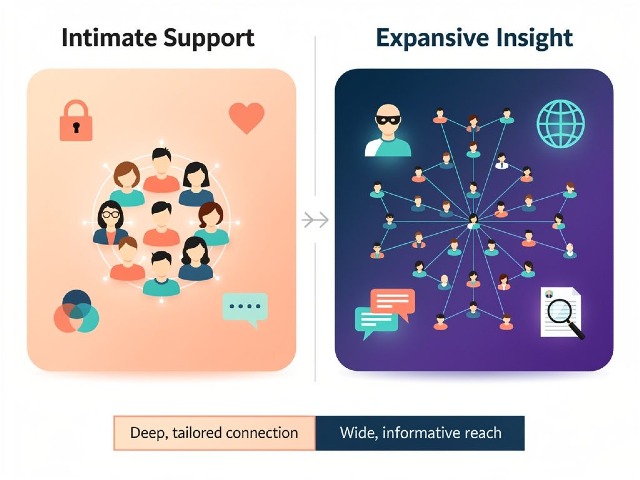
Every year, millions of people in the EU are affected by (chronic) illnesses. Managing these illnesses is often not an easy task that requires robust support. For these patients, self-management is a constant balancing act. And increasingly, they’re turning to social media for the support and advice they need. Our recent project reveals something interesting: when it comes to online patient support, bigger isn’t always better. In fact, smaller communities can offer unique advantages.
Traumatic brain injury (TBI) doesn’t just affect patients physically—it brings cognitive, emotional, and social challenges that require daily self-management. While traditional healthcare provides essential medical care, patients are supplementing this with online communities that offer emotional support, practical advice, and a sense of belonging. But not all communities are the same. Our research shows that the size and openness of these communities fundamentally shape the type of support patients receive. We analyzed two types of online communities for TBI patients: a small, closed Facebook group with around 900 members, and a large, open Reddit community with around 19,000 members. The differences were striking.
In the small, closed group, we observed what we call intimate support. Privacy and controlled membership created a safe, trusting environment where patients felt comfortable sharing deeply personal stories—about panic attacks, relationship struggles, or treatment setbacks—without fear of judgment. Members offered personalized advice, emotional validation, and even developed offline connections, meeting for coffee or group activities. The support was deep and meaningful, though perspectives were limited to the group’s shared experiences.
In the large, open community, we found expansive insight. Anonymity and a vast user base provided access to diverse perspectives and a wide range of information. Patients discussed alternative treatments, navigated healthcare systems, and explored sensitive topics, all while maintaining privacy. The breadth of information was immense, but the support was less personal, and the volume of advice could sometimes feel overwhelming.
Our findings have important implications for patients, healthcare providers, and community designers. For patients, the choice of community depends on your needs. Need emotional connection and tailored advice? A smaller, closed group may be ideal. Want diverse perspectives and anonymity? A larger, open platform might suit you better.
For healthcare providers, it’s worth recommending communities thoughtfully. Guide patients toward the type that best fits their current needs—whether it’s emotional support or access to broad information.
For community designers, consider hybrid models that combine the emotional safety of closed groups with the information richness of open platforms. Sub-communities within larger platforms could offer the best of both worlds.
Digital health communities are powerful tools for patient self-management. But their effectiveness depends on their design and characteristics. Small, closed communities foster deep emotional connections and personalized support, while large, open communities provide diverse information and anonymity. The key is matching the community to the patient’s needs—and perhaps designing future platforms that offer the best of both.
Author: Nicolai Fabian - n.e.fabian@rug.nl
References:
Smailhodzic, E., Boonstra, A., Langley, D. J., & Fabian, N. (2026). Intimate support or expansive insight? How social media community openness and size shape patient self-management. European Journal of Information Systems. DOI: https://doi.org/10.1080/0960085X.2026.2616039