

EU Automotive Emission Targets: Protecting Yesterday’s Technology, Not Tomorrow’s Jobs
While Tesla just ceded the global electric vehicle (EV) sales lead to BYD[i], European policymakers have agreed to backtrack on the 2035 deadline for ending sales of new combustion cars. The European Commission has proposed shifting the 2035 requirement from a full phase-out of tailpipe CO₂ to a 90% reduction, with the remaining 10% covered through tightly limited credits or compensatory measures (such as “made in Europe” low-carbon steel and specified fuel sourcing). The proposal still requires approval by the European Parliament and Council, but the emerging direction already looks like an uneasy compromise: it dilutes the original zero emission endpoint to relieve industry pressure, while imposing offset conditions, leaving many automakers disillusioned[ii]. The EU would have been better served by holding the line on the original target. The move is sold as job protection, but likely to prolong uncertainty and slow innovation. Delaying the 2035 phase-out does little to secure workers’ futures in the long term. In fact, it mainly protects stranded assets in obsolete technologies.
To understand why, it is important to look inside the firm. A clear, non-negotiable 2035 horizon for new combustion cars fundamentally changes how management teams allocate capital and attention. It reduces the appeal of squeezing one more product cycle out of internal combustion engine platforms and components. It makes late-stage optimizations of gearboxes, exhaust systems, and fuel-injection technologies much harder to justify. And it pushes senior executives to reassign engineers, budgets, and leadership focus to electric drivetrains, battery systems, and software architectures.
In short, a firm deadline does not simply “punish” combustion engines. It reallocates organizational energy from yesterday’s technologies to tomorrow’s.
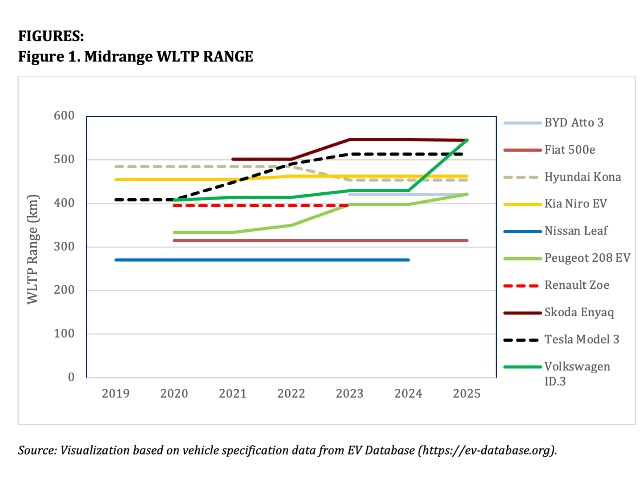
This shift is already visible in the marketplace. Across the segments that matter most for profits—mid-range and premium cars—the performance gap between electric vehicles between non-European car manufacturers and European firms is narrowing, as exemplified in the two figures below. For example, European car manufacturers are catching up with, or even exceeding, some of Tesla’s models in WLTP range. Moreover, data since 2019 show that the range gap between conventional cars and EVs in these segments has fallen substantially. At the same time, lower running costs, especially where electricity prices are moderate and fuel taxes are high, make EVs attractive for most drivers. However, Chinese EV manufacturers like BYD and XPENG are extremely competitive in terms of price-quality. Absent import tariffs, their market penetration in Europe would likely be materially higher. The strategic irony is that the market European car manufacturers counted on for long-run profits, China, is increasingly the market where they are losing ground fastest to these domestic competitors. This is a clear signal that European automakers face substantial long-term competitive pressure.
Against this backdrop, extending the 2035 deadline sends exactly the wrong signal. It tells firms that Europe is not fully committed to the transition and that there is still a case for betting on late-cycle combustion investments. That might delay some plant closures in the short term, but at the cost of keeping workers tied to product lines and components whose global demand is destined to shrink.
Research on investment under uncertainty sheds light on this dynamic. When the timing and stringency of regulation become less predictable, companies treat new projects like options: they wait to invest until uncertainty resolves. That logic is particularly strong when projects involve high sunk costs, such as building battery plants, designing new electric platforms, or retooling supplier networks. Exactly those investments that will be central in allowing European firms to compete with strong Chinese competitors like BYD or XPENG.
At the same time, a clear and credible environmental policy tends to redirect innovation toward cleaner technologies. Stable standards, like a non-negotiable 2035 end-date for combustion engine sales, make it rational for firms to train their engineers, reconfigure their product planning, and build new capabilities around electric vehicles. Weakening or delaying such standards dilutes that signal, encouraging “hedging” strategies that preserve too many legacy activities for too long.
If the goal is to protect workers rather than technologies, this is a problem. Workers are better off in factories that are part of growing value chains than in plants making components whose best days are behind them. A delay in the 2035 phase-out prolongs the life of some high-emission assets but postpones the investments needed to anchor new EV, battery, and software activities in Europe.
This does not mean that policymakers should ignore the shock that global competition—especially from China—poses for European manufacturers. Rapid growth in imports of battery electric vehicles can create acute pressure on domestic plants and suppliers in the transition period. Here, targeted instruments can help.
One option is a temporary, clearly time-limited import tax on passenger cars (in fact, a baseline of 10% and company-specific additional rates are already in place), calibrated to give European manufacturers and suppliers time to adapt to the new technology and cost advantages in offshore locations. Crucially, such a measure should be explicitly transitional, transparent in its objectives, and paired with active support for retooling, retraining, and regional development. This is important for increasing productivity through innovation to compete with lower personnel costs abroad. Used in this way, trade policy can cushion the social impact of rapid technological change without locking in obsolete technologies.
The key is to distinguish between cushions and commitments. Cushions, such as time-limited import tariffs or targeted subsidies for battery plants and charging infrastructure, can and should be flexible. They are instruments for smoothing adjustment, and they can be adjusted as circumstances change. Commitments, such as the 2035 phase-out date, should be firm. They are the anchor that tells firms and workers alike which technologies have a future in Europe and which do not.
Europe’s automotive sector is at a crossroads. One path leads to prolonged dependence on combustion technologies, permanently trailing global competitors in electric vehicles and digital architectures, and exposing workers to the risk of abrupt, unmanaged decline. The other path keeps the 2035 deadline intact, accelerates the shift in investment toward EVs, and uses targeted cushions to protect workers and communities during the transition.
Protecting jobs over the long term means aligning policy with the industries of the future, not delaying an inevitable transition and ceding ground to Chinese manufacturers that are both technologically advanced and cost-competitive. Europe should protect workers, not old technology. Let’s not repeat old mistakes we have made in certain regions, such as many former coal regions, as an illustrative example. That requires political courage: the courage to hold the line on 2035, and to direct public resources toward building the capabilities and ecosystems that will keep high-quality automotive jobs in Europe for decades to come.
A related letter on this subject has been published in the Financial Times recently: https://www.ft.com/content/fab11e13-7ff5-4dd4-8043-5111b170037d
Authors: Philip Steinberg - p.j.steinberg@rug.nl, Fenna Bisi
References:
[i] https://www.ft.com/content/c1c5f811-7b3f-4011-8e1e-cccb5aa80313
[ii] https://www.ft.com/content/52655de0-4a3e-480e-8399-86ac86de9cea
