
Do You Know Your Rivals (and Potential Allies)?

It is not always clear to managers which firms they really need to keep an eye on. Typically, firms pursuing similar strategies are interdependent because they compete for resources and/or customers. In contrast, firms following different strategies are less likely to get in each other’s way and are therefore relatively indifferent towards each other.
One way to map the patterns of rivalry is to look for groups of firms that are pursuing similar strategies. These strategic groups can be thought of as islands of interdependence separated by a sea of indifference. Firms that find themselves on the same island usually view each other as direct rivals, but they might also find ways to cooperate to make life a bit more livable on that island. For example, Citroen, Toyota and Peugeot have a series of joint ventures and alliances including a jointly owned factory producing engines that they all use in their respective models (C1, Aygo and 108). But, how do you map these islands?
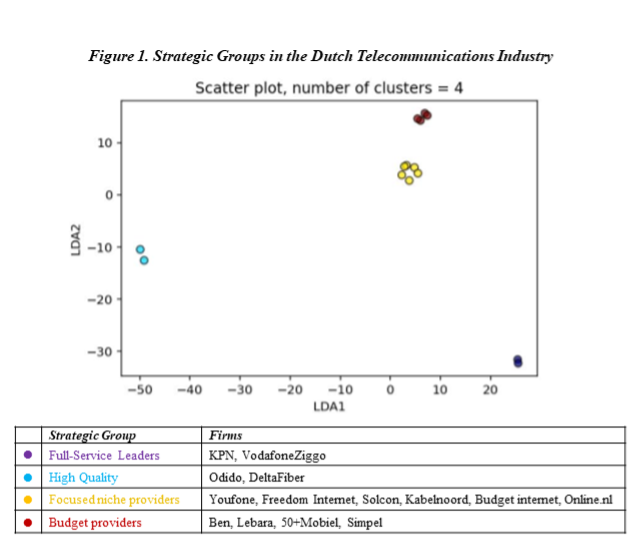
Jorrit de Boer provided a clear illustration of strategic groups in his thesis on the Dutch telecommunications industry (see Figure 1 below). Note that the clusters are both densely packed and clearly separated. The space between two groups acts like a quarantine that prevents competitive reactions from spreading between groups. While firms in large groups struggle under intense competition, firms in small groups could be more cooperative and act like an oligopoly. These differences in group dynamics can create group effects that cannot be explained by firm-level or industry-level analyses. So, a group-level analysis provides novel insights into competition (and cooperation).
Unfortunately, the clusters are not always so clear. A cluster analysis just finds the most compact groupings in the data—even in random data. Without a significance test, it is not clear if the industry actually contains meaningful groups—those islands of interdependence separated by a sea of indifference. This has been a problem in strategic groups research for decades. That is why I am developing significance tests.
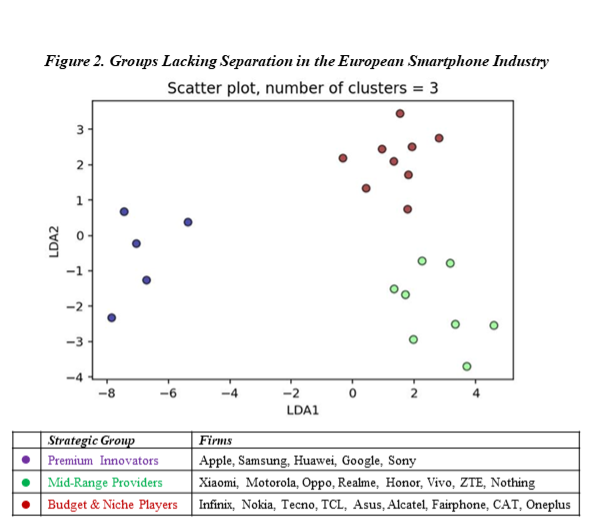
Philippa Visser’s applied the significance tests in her thesis on the European Smartphone Industry (see Figure 2). Compared to random data, the groups in that industry are relatively dense but not separated. When groups are so close together, their competitive reactions are likely to spill over, and they tend to behave like one large group.
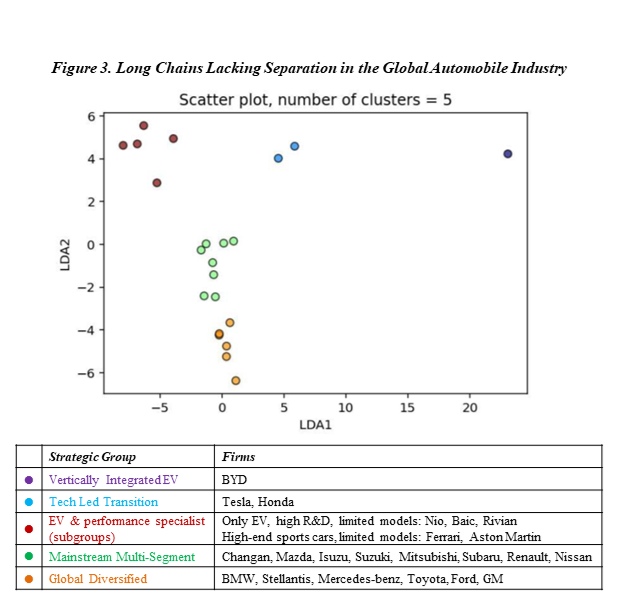
One of the trickiest problems involves long, stringy clusters like the ones that Sybren Hoen found in the global automobile industry (see Figure 3). The firms are lined up as if they found an optimal tradeoff line, and they move a little one way or the other along that line to differentiate themselves from their closest rivals. The differences between neighboring firms are small, but they do add up. Consequently, the strategies on opposite ends of the chain are so different that those firms would not regard each other as direct rivals. Hence, the chain as a whole would not qualify as a strategic group. The cluster analysis sliced the chain into relatively homogeneous groups. However, those groups are not separated, so competitive reactions would spread across them as if they were one large group. So, those pieces of the chain also do not qualify as strategic groups.
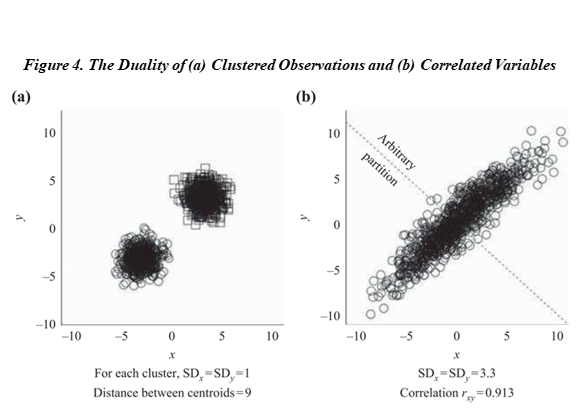
This problem involves the duality of (a) clustered observations and (b) correlated variables (see Figure 4). The obvious difference is the empty space that separates the real clusters but not the arbitrary clusters created by slicing correlated data into pieces. While we can easily see it, neither cluster analyses nor correlation/regression analyses can see it, because they focus solely on measures of similarity. So, I have been exploring possible measures of separation.
More generally, the complexity of hierarchical cluster analysis is hard to handle within statistical theory. A clever way around the challenges is to run a cluster analysis several thousand times on random data to establish benchmarks. Then you can directly see if the clusters in the real data are both more compact and more separated than the groups found in the random data. The trick in this approach is to find the best way to generate that random data to get a valid comparison.
Permutation tests try to make a valid comparison by repeatedly analyzing the real data and simply shuffling the values of each variable like separately shuffling several decks of cards. This destroys any links between the variables, and the randomized data gets widely scattered.
In contrast, Monte Carlo tests synthesize random data that resembles the real data as closely as possible except there is no clustering. By matching any correlations, the random data would be as broadly or as narrowly scattered as the real data. For example, the correlation from the clustered data in Figure 4 (a) was used to generate the random data in (b).
It turns out that these two methods complement each other beautifully. Combining a permutation test with a measure of similarity is excellent at detecting densely packed firms within groups (internal cohesion). Unfortunately, when it is combined with a measure of separation, it still struggles to detect the spacing between the groups (external isolation).
In contrast, when using a measure of similarity, a Monte Carlo test is terrible at detecting internal cohesion, but when combined with a measure of separation, it is excellent at detecting the spacing between groups.
Used together, the permutation test and similarity measure find any densely packed groups and the Monte Carlo test and separation measure weeds out the groups that are not sufficiently separated. This pragmatic combination finally disentangles the dreaded duality. More to the point, it finally makes it possible to statistically confirm whether strategic groups exist in a given industry. This makes it possible for managers to get a clearer overview on which firms to keep an eye on for both competitive reactions and potential cooperative alliances.
Author: Charlie Carroll – c.carroll@rug.nl
Links to Related Blogs
· The Impact of the Financial Crisis on Rivalry Among Chicago Banks