

A Nij Begun?

The economic agenda of the Nij Begun initiative includes the ambitious plan to create 1,000 start-ups over a period of 10 years. Such a high number of start-ups cannot come out of thin air. An entrepreneurship culture is crucial to realize such ambitions. It is a regional resource that is deeply rooted and can only grow over years. Furthermore, start-up activity has a strong effect on regional growth when it is linked to the presence of an entrepreneurship culture. This raises the question what an entrepreneurship culture is about and how to shape it.
The crucial role of entrepreneurship culture
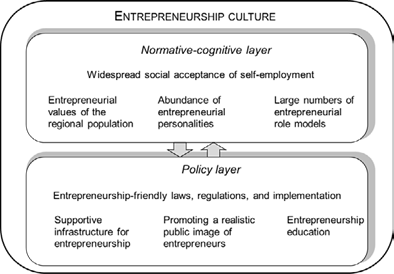
An entrepreneurship culture means that there are many people with a positive attitude toward starting a business and people who share values such as a desire for autonomy and openness. Furthermore, there is broad social acceptance of entrepreneurship. An entrepreneurship culture also includes policy measures and regulations that promote entrepreneurship, the development of appropriate infrastructure (such as incubators), and the collaboration of all stakeholders. Finally, entrepreneurship education and the promotion of a positive image of entrepreneurs are also key elements of an entrepreneurship culture (see Figure 1 for an illustration). But how does such a culture come into being?
History matters for entrepreneurship
The answer is almost sobering: it takes time, historical factors often have long-term effects that hinder the development of an entrepreneurship culture. This is illustrated by the example of regions heavily depending on resource extraction in the past (e.g., coal mining areas). These regions have below-average start-up rates even several decades after these dominating industries started facing economic crises and a need for structural change.
On the contrary, some regions like California developed an entrepreneurship culture relatively quickly in the aftermath of the Goldrush in the mid-19th century. This was mostly driven by entrepreneurial people coming from all over the world to take advantage of opportunities that benefitted the region. The clear implication is that a policy that is open for global talent is pivotal to promote an entrepreneurship culture.
Media and role models
Beyond the hunt for global talent, what else can be done to foster a culture of entrepreneurship? Perhaps we should start by seeing entrepreneurship in a more positive light in general. Entrepreneurs are often portrayed as villains in film and television. A few years ago, a German marketing agency analyzed the plots of a famous German police drama series (Tatort) and created a ranking based on the murderer’s profession across episodes. Entrepreneurs came in at number one, followed by professional gangsters in second place. Teachers came in third. A positive portrayal of entrepreneurs in the media leads to a positive perception of entrepreneurship among the viewers.
The effect of media on people’s willingness to start a business is linked to role model and peer effects. These effects are even more important at the local and family level, and refer to the transmission of entrepreneurial values and skills. Role model effects also facilitate the social acceptance of entrepreneurs. When family and friends are entrepreneurs or at least view them positively, this influences one’s own attitude. The phrase “If they can do it, I can too” sums up the issue well. Role model effects set in motion a self-perpetuation process of entrepreneurship where their presence leads to more start-up activity which feeds back into more social acceptance of entrepreneurship. Role models can serve as the starting point for the emergence of a self-reinforcing culture of entrepreneurship. Entrepreneurs who have been inspired by role models become role models themselves for future generations, thereby strengthening the social acceptance of entrepreneurship (see Figure 2 for an illustration).

Policymakers could play a role here by connecting local stakeholders with founders. Universities can do this by having students work on business challenges posed by entrepreneurs, thereby bringing them into direct contact with such role models. Unfortunately, budget cuts in the Netherlands impede funding such activities currently.
Education and universities
A solid entrepreneurship education is a key building block for fostering a regional entrepreneurship culture. There is a distinction between teaching empirical facts about entrepreneurship and connecting students with regional institutions and established entrepreneurs that can help them apply their acquired knowledge through practical guidance.
The key role of universities is also demonstrated by the empirical finding that universities are key players in fostering knowledge-based startups. There is no functioning entrepreneurial ecosystem or region with an entrepreneurship culture in which universities do not play a significant role. A regional startup policy must emphasize the importance of universities, because founders in the knowledge-based sector often come from local universities. Apart from that people do not move to specific regions to start a business, people still predominantly start businesses where they have already lived for several years, where they and their families are integrated into stable social networks. Thus, university members (students or employees) represent a central pool of future entrepreneurs.
In my own research, I have also shown that an increasing geographical distance between university locations is associated with a significant reduction in technology-based startups. Surprisingly, this effect is particularly evident for universities founded before 1900. This indicates that a historically developed knowledge base and deep regional roots are of particular importance for this effect. Of course, universities alone cannot foster an entrepreneurship culture, what matters is the networking of various regional stakeholders and a mutual trust to promote regional development via entrepreneurship.
Summary and outlook
Let me summarize the factors necessary for strengthening the power of entrepreneurship:
1. Stable framework conditions that promote entrepreneurship
2. Collaboration among key actors based on mutual trust
3. A realistic attitude among the population toward entrepreneurship
4. A strong regional knowledge base
These factors need attention to unleash the power of entrepreneurship for regional resilience to tackle the great challenges of the future and for a truly nij begun (new beginning).
Author: Michael Wyrwich - m.wyrwich rug.nl
This blog is based on Michael Wyrwich's inaugural lecture given at the University of Groningen on May 22, 2026. The lecture in print is available here: https://doi.org/10.21827/695ced2e1b7c0