

Industry 5.0: Turning Promise into Reality

Given the urgency of accomplishing the twin transition of digitalization and energy conservation, as well as securing a competitive position in the global economy, the Netherlands needs to prioritize its IT investments. In our study of Industry 5.0 (i5.0) we tackle the following research question:
In which technologies should the Netherlands invest in order to accomplish the i5.0’s goal of responsible productivity?
What is Industry 5.0?
The history of technological innovations is often presented as a series of waves:
-
Industry 1.0 signifies the shift from craft to factory-based modes of production (~1760-1840), when mechanical power (esp. steam engine), replaced human labor. Productivity improvements were generated through centralized control structures, including the clock.
-
Industry 2.0 (~1870–1914) highlights the emergence of standardized parts, labor specialization and mass production. Productivity improvements are made by rationalizing tasks to eliminate waste (e.g., human labor). Electricity, assembly lines and the internal combustion engine formed the core technologies of this era.
-
Industry 3.0 denotes the era of automation (~1960-2000), which relied heavily on information technology. Programmable software replaced hardwired operations leading to productivity improvements through the automation of repetitive tasks.
-
Industry 4.0 (~2010 onwards) is synonymous with digitalization. All activity, including social interactions, is increasingly “datafied” and digitalized. By means of data analytics these digital resources can be endlessly (re)combined and mined for novel insights leading to productivity improvements through the integration of large volumes of digital representation.
-
Industry 5.0 (~2020 onwards) begins with the rise of artificial intelligence (AI). Knowledge work is increasingly at risk in light of large language models (LLMs) that can detect patterns in vast amounts of unstructured data at very high speeds. Responsible productivity is its key objective: productivity improvements need to take the natural environment, human well-being and economic resilience into account.
Preliminary Findings
Based on laddering interviews with 15 IT-consultants in the Netherlands, we identified four means-ends chains that reflect narratives used to legitimate technology adoption. Figure 1 captures our findings:
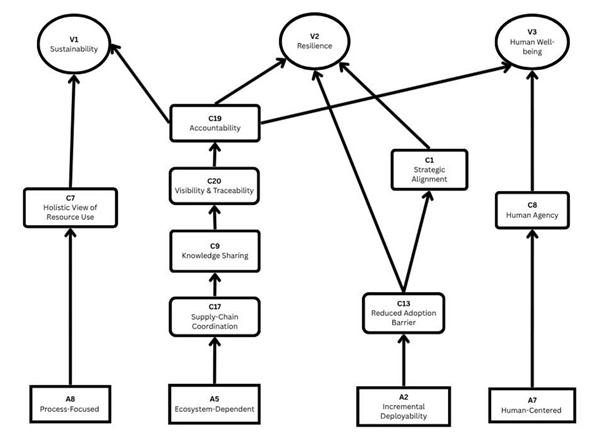
Our results show that there are four attributes that i5.0 technologies should exhibit: process-focused content, ecosystem-dependent value generation, incremental deployability and human-centered design.
Process-Focused Content
Technologies that digitally reflect the transformation of materials in the production process, afford a holistic view of resource use. By aggregating and integrating disparate data sources and maybe simulating the consequence of decisions, process-focused technologies offer a more comprehensive understanding of the manufacturing landscape. Improvements in environmental sustainability are anticipated.
Ecosystem-Dependent Value Generation
The objectives of i5.0 can only be accomplished through interorganizational technologies; however their adoption will largely rely on government mandates. Ecosystem-dependent systems enact coordination across the supply chain, which results in knowledge sharing. By sharing best practices, insights and risks, trust is built to make practices and resource use within a given supply chain actor more visible and traceable. With supply chain visibility, individual organizations and industries can be held to account for their choices (e.g., resource use, waste production). Accountability offers a potent incentive for individual actors to contribute to the three i5.0 values: environmental sustainability, ecosystem resilience, and human well-being.
Incremental Deployability
i5.0 technologies need to be relatively easy to implement. This demands sufficient maturity to reduce adoption risks. Affordability also matters, as does organizations’ ability to adapt the technology to their requirements. Incremental deployability not only allows organizations to spread the financial burden of technology adoption, but also their operational and organizational risks. By reducing the barriers to a technology’s adoption, economic resilience can be accomplished.
Incremental deployability also encourages organizations to explore i5.0’s implications for their strategy. Aligning the technology with its strategy ensures that an organization remains competitive and steadfast, i.e. resilient.
Human-Centered Design
In contrast to black-boxing AI algorithms, technologies whose data generation and analysis are accessible to and interpretable by humans are desirable. Human-in-the-loop designs enable human agency (i.e. the capacity for individuals to make choices and intentionally affect their social and physical environment). By securing humans’ place as active participants in shaping their work lives, human wellbeing can be accomplished.
Implications
The answer to this study’s research question, namely “In which technologies should the Netherlands invest in order to accomplish the i5.0’s goal of responsible productivity?” is not a list of technologies but four technological attributes that capture distinct dimensions of a given solution:
-
its content (process-focused),
-
its value model (ecosystem-dependent),
-
its risks (incrementally deployability), and
-
its relationship with human operators (human-centered).
We can apply our findings to the evaluation of smart manufacturing technologies, e.g., digital twins, cobots and digital product passports (DPP), to determine whether they should be prioritized in this latest wave of industrialization. As Figure 2 shows, the DPP meets all four desirable attributes for i5.0 technologies. To realize the promise of i5.0, namely responsible productivity, technology investments should be assessed according to these four criteria.
Figure 2: Assessment of Potential i5.0 Technologies
|
Process-Focused |
Ecosystem- |
Incremental Deployability |
Human-Centered |
|
|
Digital Twin |
✔️ | |||
|
Cobot |
✔️ |
✔️ |
||
|
DPP |
✔️(cumulative) |
✔️ |
✔️ |
✔️ |
Author: Ulrike Schultze - u.schultze@rug.nl