

From Inspiration to Partnerships: Four Ways to Create Impact for Students and Practitioners in Higher Education

What opportunities for learning and collaboration arise when higher education students interact with entrepreneurs, CEOs, managers, policymakers or other professionals? The answer can range from a single moment of inspiration to a long-term partnership. Based on a previous blog, we present a comprehensive framework that distinguishes four types of ‘student-practitioner interactions’. Our framework helps universities and regional partners understand what type of impact they want to achieve and what each interaction type asks of everyone involved.
Why do we need student-practitioner interactions?
Why is it important that students interact with entrepreneurs, CEOs, managers and policymakers during their studies? We see two main reasons. First, educational programs should equip students to navigate the complexities of today’s global and professional landscapes. Societal and technological developments have intensified calls for graduates who are not only disciplinarily knowledgeable, but also professionally skilled. Connecting with the professional field helps students in practicing relevant complex skills. Second, students do not always have a good understanding of the work field, the expectations of the labor market, and the challenges that exist there. They feel inadequately prepared for their transition to the work field and they miss important career opportunities. For instance, innovative, internationally active Small- and Medium-Sized Enterprises (SMEs) are attractive employers for Master-level graduates, but they often remain ‘hidden gems’ to students.
Universities have already made considerable efforts to develop students’ professional skills and bridge the gap between higher education and professional practice. However, these efforts often remain fragmented rather than being embedded in a coherent learning line. Existing initiatives vary widely in their nature and intensity, ranging from single moments of inspiration to longer-term partnerships in which students and practitioners share responsibility for real-world outcomes. While student-practitioner interactions can create substantial value for both students and practitioners, their effective integration into university education also presents challenges. To help universities navigate these challenges and maximize the potential of student-practitioner interactions, we have developed a comprehensive framework that distinguishes four interaction types.
Four interaction types
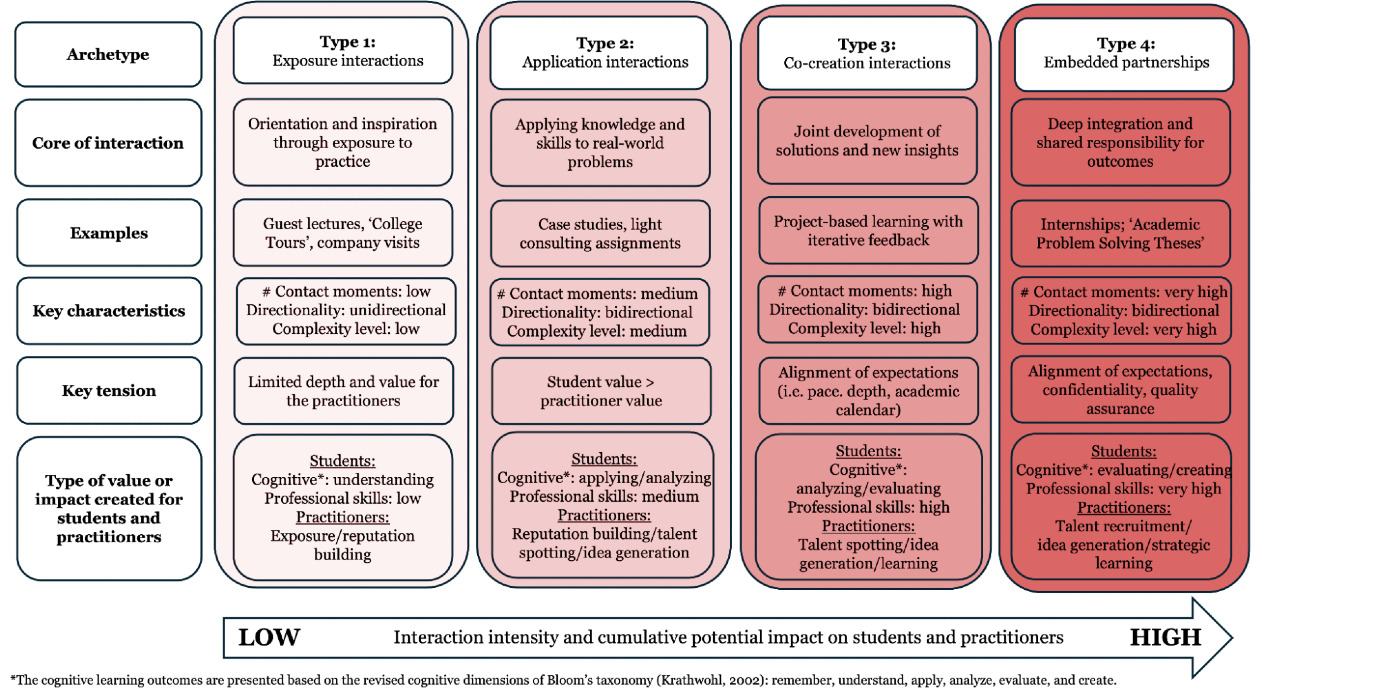
The four interaction types form a continuum, as can be seen in Figure 1. Each type has its own merits and differs in terms of activities, type of impact and challenges. Along the continuum, contact becomes more frequent, communication becomes more reciprocal, and assignments become more complex. Students develop increasingly sophisticated cognitive skills, going from applying existing knowledge to creating new knowledge, while also strengthening complex professional skills such as systems thinking, perspective taking, and problem solving. At the same time, practitioners move from unilaterally sharing their practical insights and building their reputation to more strategic benefits for them, such as talent recruitment, idea generation and strategic learning. We distinguish the following four student-practitioner interaction types:
-
Type 1: Exposure interactions. Practitioners bring the world of practice into class. Guest lectures, ‘College Tours’ and company visits show how organizations work, what professional roles look like and which employment opportunities exist in practice. Contact between individual students and the practitioners is limited and mainly flows from practitioner to student. The learning goals are orientation and inspiration: students understand how abstract ideas apply in practice. For practitioners, the immediate return is usually modest. However, they may increase their visibility and reputation as a business and/or employer to a large audience. Yet, the interaction rarely goes deeply enough to address a practitioner’s own challenge. This is the key tension: lecturers should not overpromise direct benefits to practitioners.
-
Type 2: Application interactions. Type 2 asks students to apply their knowledge and skills on a real-world problem. Examples include teaching cases and light consulting assignments. Contact is more frequent, and practitioners may provide a briefing, data or feedback. Students become more active; they apply concepts, analyze information and translate academic knowledge into practical recommendations. Practitioners may gain fresh ideas and meet potential recruits, while students develop professional skills such as teamwork and communication. Still, the balance of value often favors the student. The assignment has primarily been designed for learning, and the practitioner’s question may have to be simplified to fit the course. Being explicit about that educational purpose helps prevent unrealistic expectations for the practitioner.
-
Type 3: Co-creation interactions. In co-creation interactions, students and practitioners work together to develop solutions and new insights. Project-based learning with repeated, iterative feedback is a typical form. The practitioner is no longer only a source of information or the ‘recipient’ of a final presentation, but an active partner throughout the process. Students must analyze and evaluate a complex situation, deal with uncertainty and revise their work in response to feedback. The potential for mutual learning is considerable. Students gain a more authentic understanding of professional work; practitioners gain new perspectives, ideas and access to emerging talent. A key tension is alignment: academic calendars, assessment requirements and learning goals may not match the pace, urgency or preferred depth of the practitioner. Good co-creation therefore begins with a shared conversation about the question, roles, contact moments, feedback and what a useful outcome looks like.
-
Type 4: Embedded partnerships. Type 4 represents deep integration and shared responsibility for outcomes. Internships and ‘academic problem-solving theses’, where students write their thesis for a ‘client’, are familiar examples. Students become embedded in an organization or partnership and work on strategic questions over an extended period. They are expected not only to analyze and evaluate, but also to create, such as a new approach, tool, intervention or evidence-based course of action. For students, this can be an important bridge into professional life. For practitioners, it can support their strategic learning, idea development and recruitment. Because the stakes are higher, however, expectations must be carefully aligned. Confidentiality, ownership of results, supervision, academic independence and quality assurance all require attention. Deep partnership only creates substantial impact when both sides have the capacity to engage and when responsibilities are made explicit.
From Inspiration to Partnership: Building a Coherent Learning Pathway
A strong educational program builds on different interaction types to effectively support students’ knowledge and professional skills development and understanding of the work field. When program managers and lecturers design these interactions as a coherent pathway going from Type 1 and 2 to Type 3 and 4 interactions, rather than as isolated activities, students learn to navigate real professional complexity, while practitioners and their organizations gain ideas, visibility, learning opportunities and access to future talent. While intensive student-practitioner interactions can produce greater impact, they also demand more time, trust, coordination and quality assurance. From inspiration to partnership: each interaction has a purpose and connecting them into a coherent learning pathway can create lasting impact on both students and practitioners.
Authors: Evelien Croonen (e.p.m.croonen@rug.nl) and Salome Scholtens (s.scholtens@rug.nl)