
Data centres in space threaten astronomy and ozone layer

Entrepreneur Elon Musk already launched about ten thousand Starlink satellites into space with which he supplies his customers with fast internet. Musk now intends to launch another million satellites that together will form a huge data centre in space. All to supply the enormous computing power required for AI. Astronomers are worried about the effects of these million satellites. The satellites will interfere with astronomical observations, but they will also damage the ozone layer, says Reynier Peletier, astronomer at the University of Groningen. ‘Without the ozone layer, the radiation that reaches us is comparable to the radiation from an atomic bomb.’
FSE Science Newsroom | Text René Fransen
‘The Starlink satellites are sometimes in an orbit around the Earth that is higher than, for example, the Hubble Space Telescope,’ says Peletier. ‘This means they fly through the image, causing streaks across it. Satellite tracks already interfere with most ground-based observations.’ Now that there are ‘only’ ten thousand Starlink satellites interfering with the astronomers’ observations, the damage is still manageable: these tracks can be filtered from the measurements. This will get worse in the future though, and it will then be very difficult to remove these tracks. ‘A recent publication shows that it will no longer be manageable if there are huge numbers of satellites, hundreds of thousands or more.’
Interfering satellites
Telescopes that receive radio waves from space experience much more interference from the satellites, for example the one in Westerbork or LOFAR, the radio telescope based in Borger in Drenthe that extends across Europe. Starlink continuously sends radio waves to customers on Earth that are much stronger than the signals from space. ‘That is making accurate astronomical observations very difficult.’
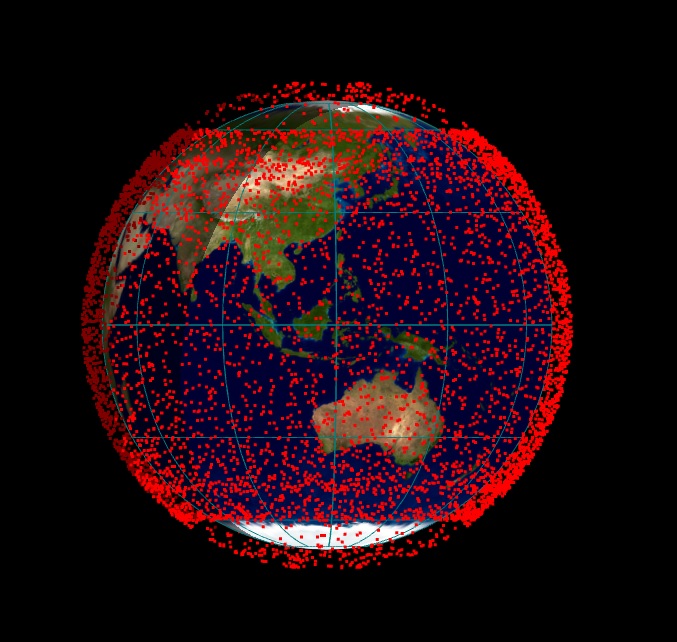
And these satellites will also have a considerable effect on observations with the naked eye. One of the programmes Peletier is involved in is ‘Donkerte van de Wadden’ (Darkness of the Wadden), which protects the darkness of the night. ‘You can already see satellites around sunset and sunrise, but if there are genuinely going to be a million more satellites, it will become very ugly,’ according to Peletier. ‘We also don’t know what the effect is on animals, for example if they use the stars to navigate. And it is not down to humans to destroy the darkness, which is a natural habitat for many animals.’
Mutations in skin cells
But the disruption of the night and the interference with astronomy are not the biggest problems, according to Peletier. An average artificial satellite of some 250 kilograms contains about 30 kilograms of aluminium. When satellites reach the end of their life, they are sent into the Earth’s atmosphere to burn. The tiny particles of aluminium that are formed cause chemical reactions that damage the ozone layer. ‘The ozone layer protects us from harmful UV radiation. Without the ozone layer, there would be no life on Earth.’
Peletier refers to a recent publication that reports that the aluminium particles can continue to orbit high in the atmosphere for decades, where they break down ozone. ‘A thinner ozone layer means that harmful UV radiation can reach Earth much more easily. If our skin is exposed to this radiation, it causes mutations in cells, which can lead to skin cancer. The effect of a thinner ozone layer is comparable to the effects of radiation caused by an atomic bomb. That is really bad news.’
The International Astronomical Union (IAU) is involved in talks with the US Congress and other parties about these problems. After all, according to the Outer Space Treaty, countries are responsible for the launches from their territory. ‘But the US senators don’t seem to think that this is a very important issue: it doesn’t involve a lot of money.’
More news
-
15 September 2026
Enzymes break down textile fibres into useful resources
-
10 September 2026
Searching for the first generation of stars
-
10 September 2026
Wouter Vansteelant appointed Scientific Director of BirdEyes