
Michelson, Albert Abraham
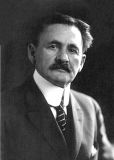
The Polish Albert Abraham Michelson (1852 - 1931), son of a jewish family, was experimental physicist.
His first experiments to determine the speed of light took place in 1879 and the result was 299,910±50 km·s-1. He refined his method and in 1883 published a measurement of 299,853±60 km·s-1.
In 1922, measurements were resumed which resulted in a value of 299,796±4 km·s-1.
He sought another measurement, but this time in an evacuated tube to avoid difficulties in interpreting the image owing to atmospheric effects. In 1929, he began to perform a measurement in California in a 1.6 km tube 3 feet in diameter. He died with only 36 of the 233 measurement series completed before the result of 299,774±11 km·s-1.
The Michelson–Morley experiment in 1887 was an attempt to measure the motion of the earth relative to the luminiferous aether: no significant difference was found between the speed of light in the direction of movement through the presumed aether, and the speed at right angles.
About the outcome he wrote:
The Experiments on the relative motion of the earth and ether have been completed and the result decidedly negative. The expected deviation of the interference fringes from the zero should have been 0.40 of a fringe - the maximum displacement was 0.02 and the average much less than 0.01 - and then not in the right place. As displacement is proportional to squares of the relative velocities it follows that if the ether does slip past the relative velocity is less than one sixth of the earth's velocity.
This result motivated Albert Einstein two develop the special theory of relativity.
He lent his name to the Michelson interferometer.