
Einstein, Albert
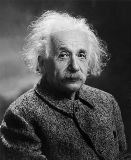
The German Albert Einstein (1879 - 1955), son to a salesman and engineer, was a theoretical physicist.
In 1905, he completed his famous papers on the photoelectric effect, Brownian motion, the special theory of relativity, and the equivalence of mass and energy:
E = m c2
where m is the mass and c is the speed of light.
In 1915, he proposed a general theory of relativity that extended the system of mechanics to incorporate gravitation.
In 1917, he introduced the concepts of spontaneous emission and stimulated emission, the latter of which is the core mechanism behind the laser and maser.
He made important contributions to statistical mechanics and quantum theory.
In the last phase of his academic life, he tried to disprove quantum theory's fundamental randomness, and he attempted to devise a unified field theory by generalizing his geometric theory of gravitation to include electromagnetism. Both attemps failed.
He lent his name to, among many others, Bose–Einstein statistics. The chemical element 99 einsteinium (Es) is named in his honour.