
Newton, Isaac
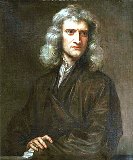
The Englishman Sir Isaac Newton (1643 - 1727), son to a sheep farmer, was a mathematician, physicist, astronomer, alchemist, theologian, and inventor.
He published a revised, corrected, and amended edition of the Geographia Generalis, a geography textbook first published in 1650.
His work has been said to distinctly advance every branch of mathematics then studied. Newton later became involved in a dispute with the German Gottfried Wilhelm Leibniz over priority in the development of calculus. He was the first to develop a system of polar coordinates.
He observed that a prism refracts different colours by different angles. He argued that light is composed of particles or corpuscles, but despite his preference of a particle theory, he in fact noted that light had both particle-like and wave-like properties.
In the Principia, published in 1687, he stated the three universal laws of motion:
- a body remains at rest, or in motion at a constant velocity in a straight line, unless it is acted upon by a force
- at any instant of time, the net force on a body is equal to the body's acceleration multiplied by its mass
- if two bodies exert forces on each other, these forces have the same magnitude but opposite directions
He gave the first determination of the speed of sound in air, inferred the oblateness of Earth, accounted for the precession of the equinoxes, initiated the study of the irregularities in the motion of the Moon, provided a theory for the determination of the orbits of comets, and much more.
He was Warden, and afterwards Master, of the Royal Mint.
He lent his name to, among others, the newton, the unit of force.