
Watching the movements of molecular life
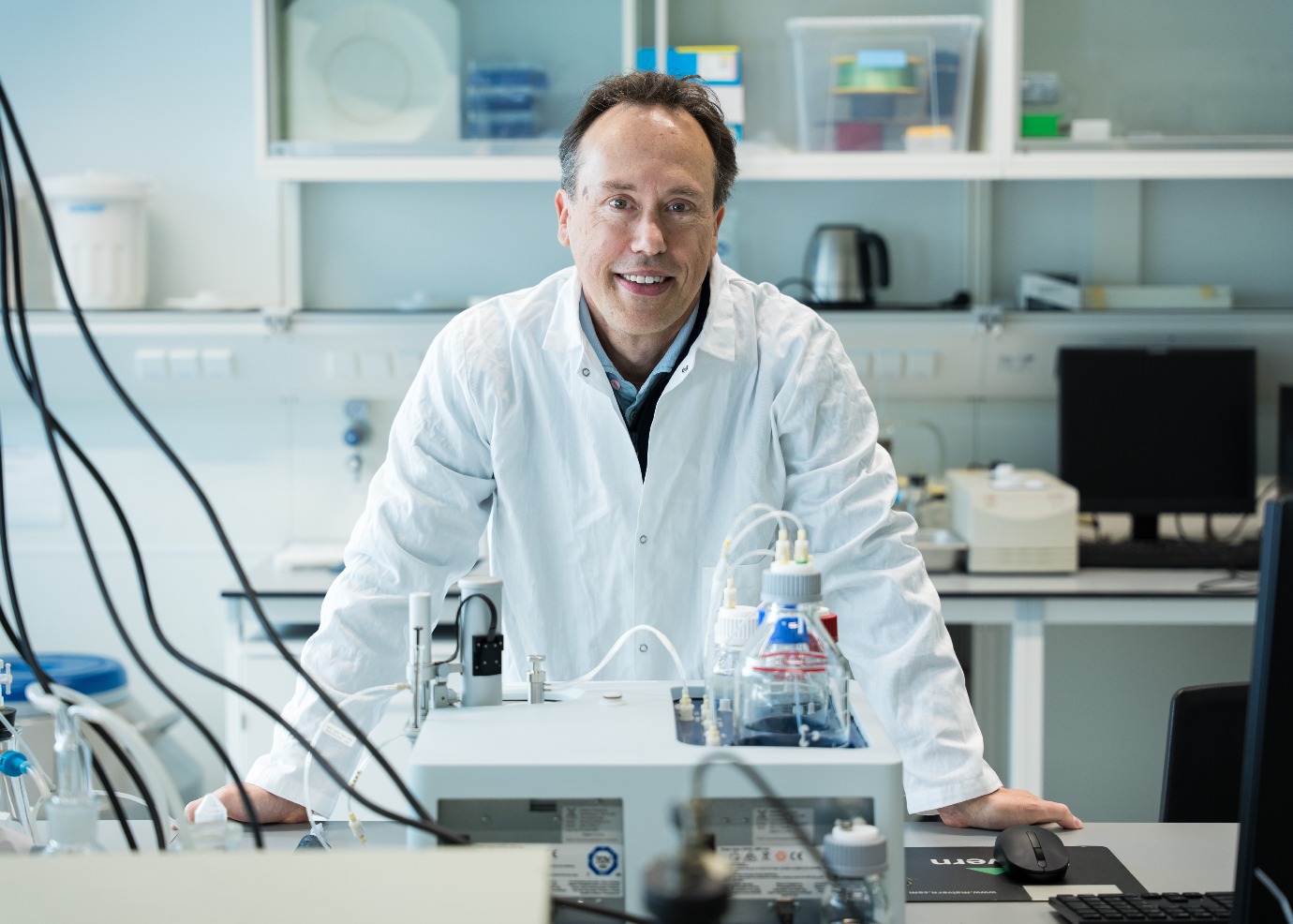
Every cell is full of assemblies of large molecules with moving parts, which are vital to life. Professor of Biochemistry Dirk Slotboom has spent his career studying this machinery. So far, he has had to study movements using snapshots of those parts. ‘But we want to really observe the movements as they are happening.’ New technology could allow just that.
FSE Science Newsroom | text René Fransen | photography UG AV-services
Slotboom has spent a good deal of his career studying transport of molecules into and out of cells. ‘Cells have to move all kinds of small molecules across their cell membrane, for example nutrients and waste products’, he explains. He has studied these processes by analysing the atomic structures of the transporter proteins which are located in the cell membrane. ‘However, all these techniques provide snapshots, from which we have to reconstruct the actual movement.’ To infer movement, computer simulations are usually employed.
Small details
The snapshot-nature of this research can lead to misinterpretations, for example when the snapshots are not arranged in the right order. ‘That is why we want to do this kind of work in a time-resolved manner’, says Slotboom. In other words: instead of snapshots, he wants to make a movie. To explain how important this is, he refers to the mechanism by which the antibiotic bedaquiline kills the bacterium that causes tuberculosis. This antibiotic blocks the movement of a protein in the bacteria that is essential for the energy balance. Slotboom: ‘It puts a clog in the bacterial wheel.’
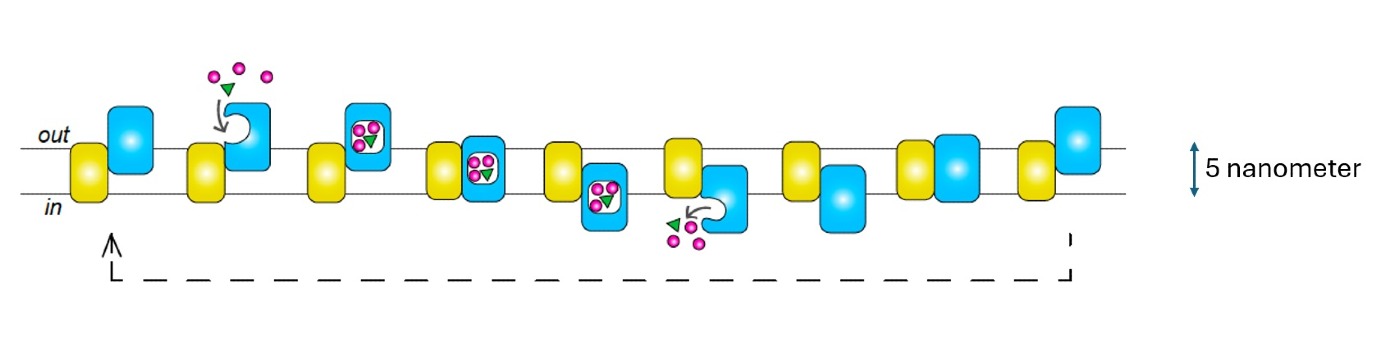
There are a number of techniques that allow the study of moving molecules. ‘We can attach a tiny light-emitting probe to a molecule to study its movement. While such studies are extremely useful to reveal how the entire molecule moves, they don’t show its dynamics at the atomic level.’ Another technique is to grow a crystal from the moving molecules. These crystals behave more or less like the individual molecules. ‘There is a surprising amount of movement possible in these crystals. And we can study them using X-rays or electrons.’ However, to trigger a synchronized movement of the individual molecules in the crystal and to observe it at a temperature relevant for life is challenging.
Once you know how a movement takes place, you can find ways to influence it.
Design of new antibiotics
In 2023, an international team of collaborators including Slotboom and Wiktor Szymanski (also at the University of Groningen) received an €11 million ERC Synergy grant to study the dynamics of proteins in the cell membrane. ‘This project was mainly aimed at developing new methods to study movement’, he explains. ‘For example, we used molecular cages, tiny molecular structures that behave like a box, which can be opened with light. When open, they release a substance that sets a large number of protein molecules in motion simultaneously.’ The combined, synchronized movement is easier to detect than that of single molecules.
Slotboom: ‘Once you know how a movement takes place, you can find ways to influence it. More insight into movement could allow us to design, for example, new antibiotics. This shows the importance of basic science, with enough researchers and funding.’ In future work, Slotboom aims to observe movement in the millisecond range. ‘That is the timescale at which many molecular biological processes take place.’
Artificial cell
Another limitation of the current molecular movement studies is that they rely on isolated molecules, taken out of their biological context. ‘It is my dream to go from proteins to bigger molecular systems and even whole bacteria.’ Slotboom is also involved in a project which aims to design and build living cells from non-living parts. ‘This adds insight into the dynamics of these parts, which is essential to gain knowledge of how they work in concert to produce a functional artificial cell.’
More news
-
22 October 2026
Seven UG and UMCG researchers awarded Vidi grant
-
22 October 2026
Doubling hydrogen production through a synergy of materials
-
22 October 2026
How someone with bad intentions could employ AI