
How do you spot a nice wool coat in a heap of discarded textiles?

Trucks filled with discarded textiles arrive daily at textile collector Sympany. The contents of these trucks are sorted manually, but the expectation is that the numbers will rise to twenty-five trucks per day, or more. That is why Sympany wants to automate the sorting process. Researcher Mauricio Muñoz-Arias and his colleagues at the University of Groningen help them to develop such a fully automated process. ‘Ultimately, we aim towards a system that can draw the conclusion: Ah, this is a vintage coat that will yield around 150 euros in second-hand sale.'
FSE Science Newsroom | Text Charlotte Vlek | Images AV-services RUG
Clothing and other textiles typically arrive at Sympany packed in plastic bags. In the automated sorting process, a machine first tests whether there is indeed clothing in these bags, after which the bags open automatically. Next, the items are spread out on a conveyor belt that passes through a sequence of scanners and sensors. Based on the data collected, an AI model must decide for each item in just one second: this one is suitable for second-hand sale, this one is more suitable for upcycling, and that other one will have to be processed into some sort of residual product.
Test, open, spread out
The Groningen tech company Demcon Industrial Systems, also involved in this project, has already developed a bag-opening machine as part of the envisioned automated process. But before that machine can be applied, testing the bag's contents is crucial. A master’s student is currently working on that. Muñoz-Arias: ‘We call it the e-nose: we make a tiny hole in the bag and analyze the smell that comes out. If it is above a certain threshold of rotting, the bag will not be opened because it most likely does not contain clothing, but household waste, for instance.'
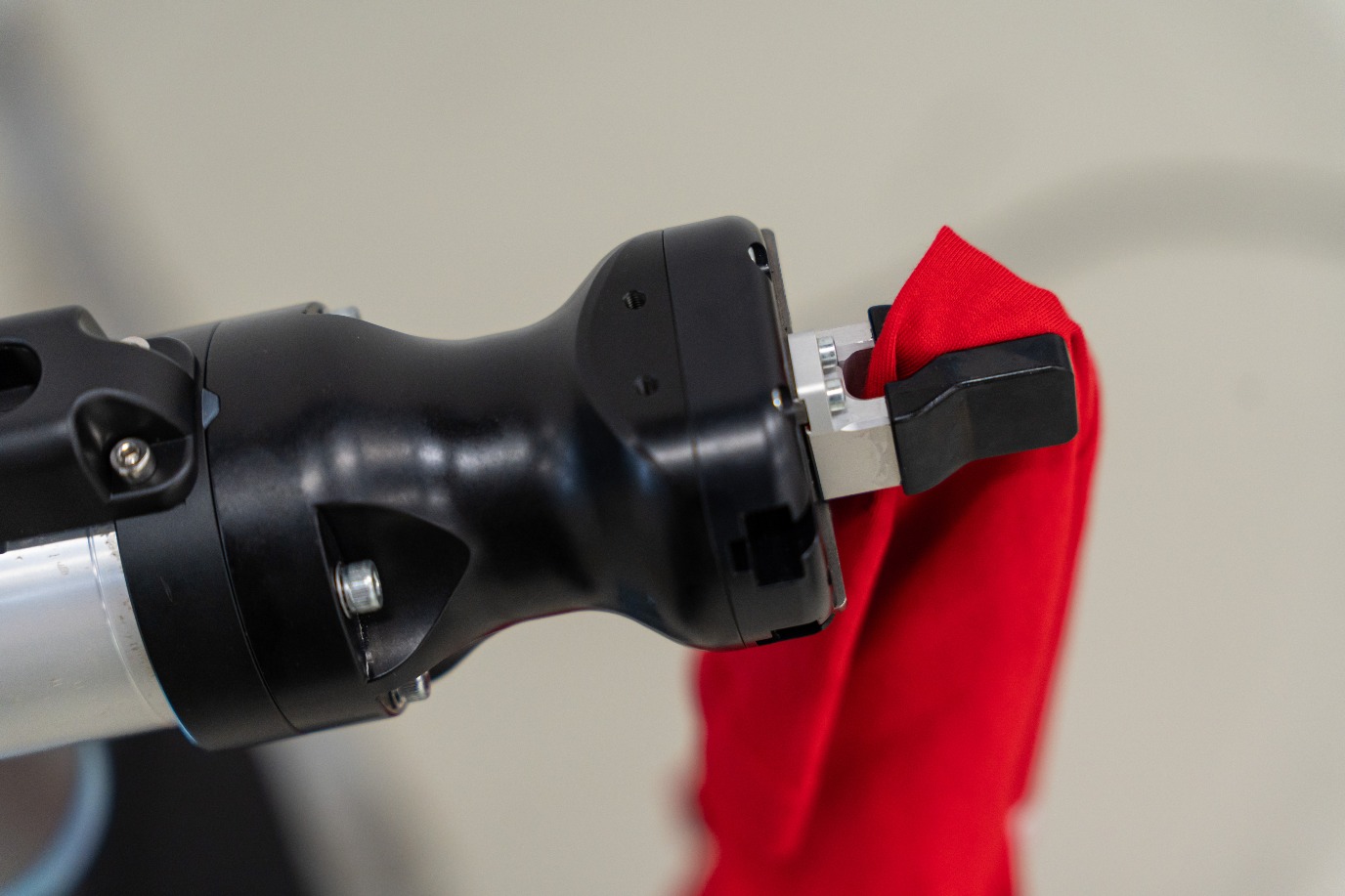
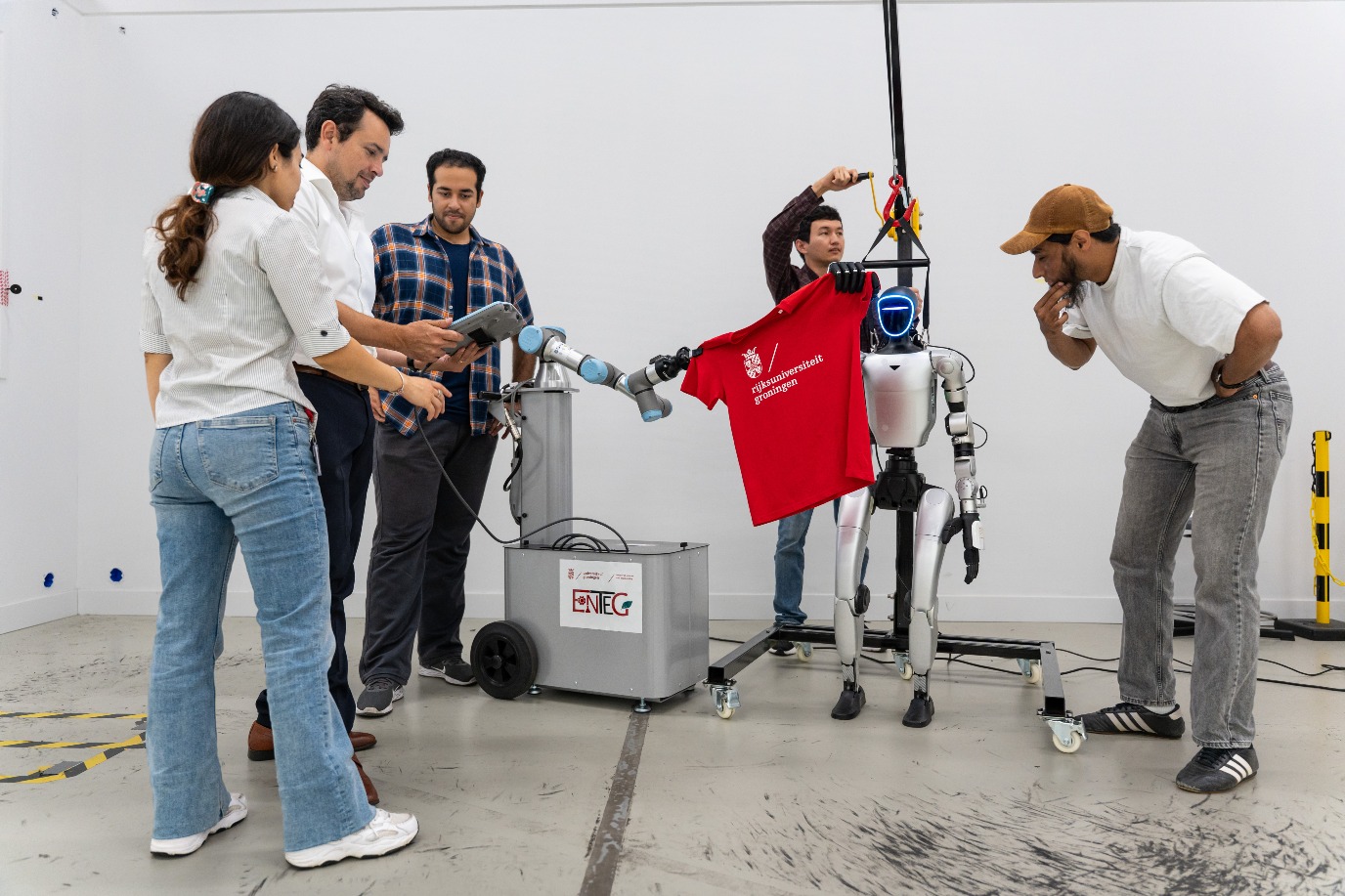
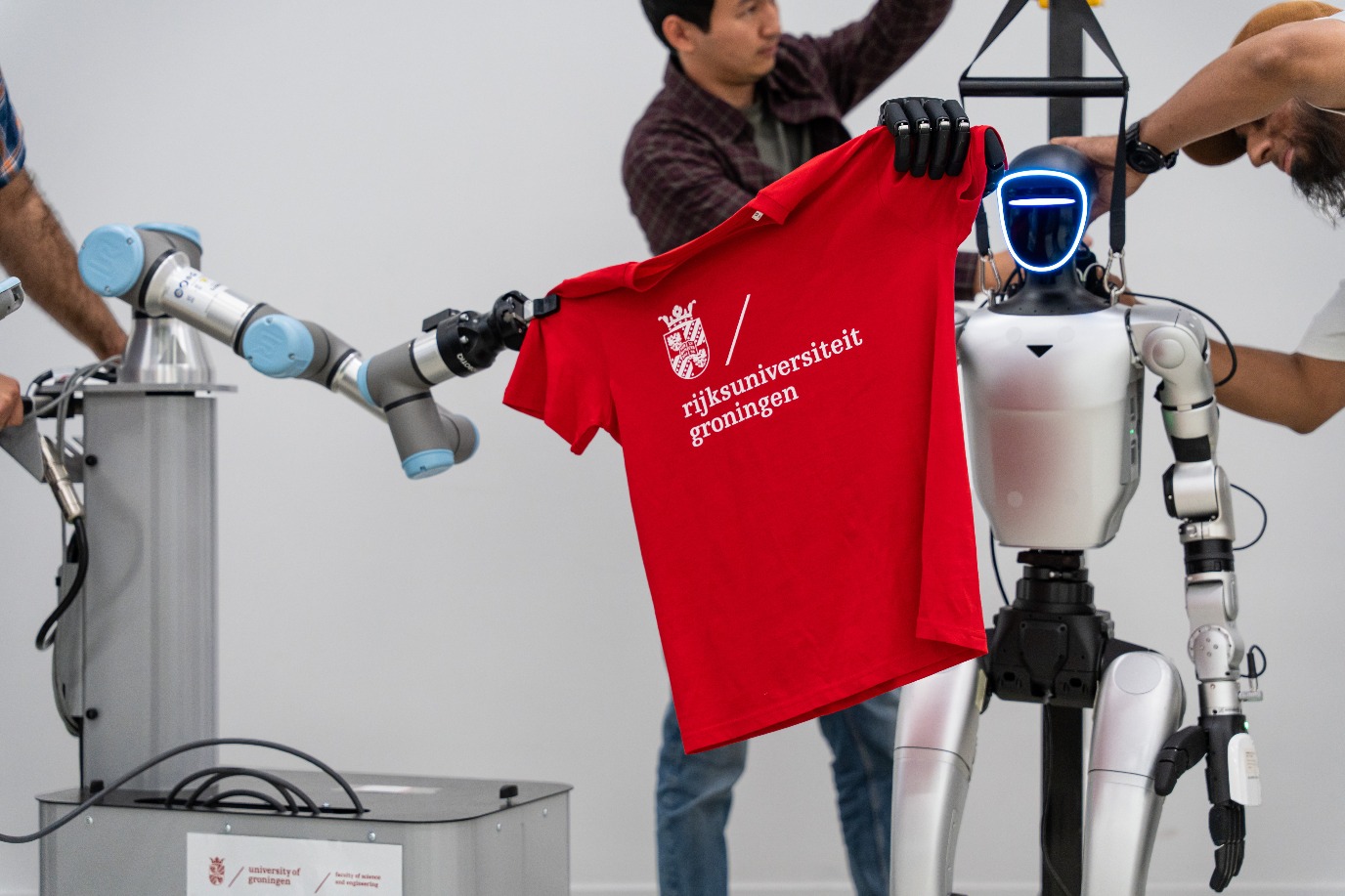
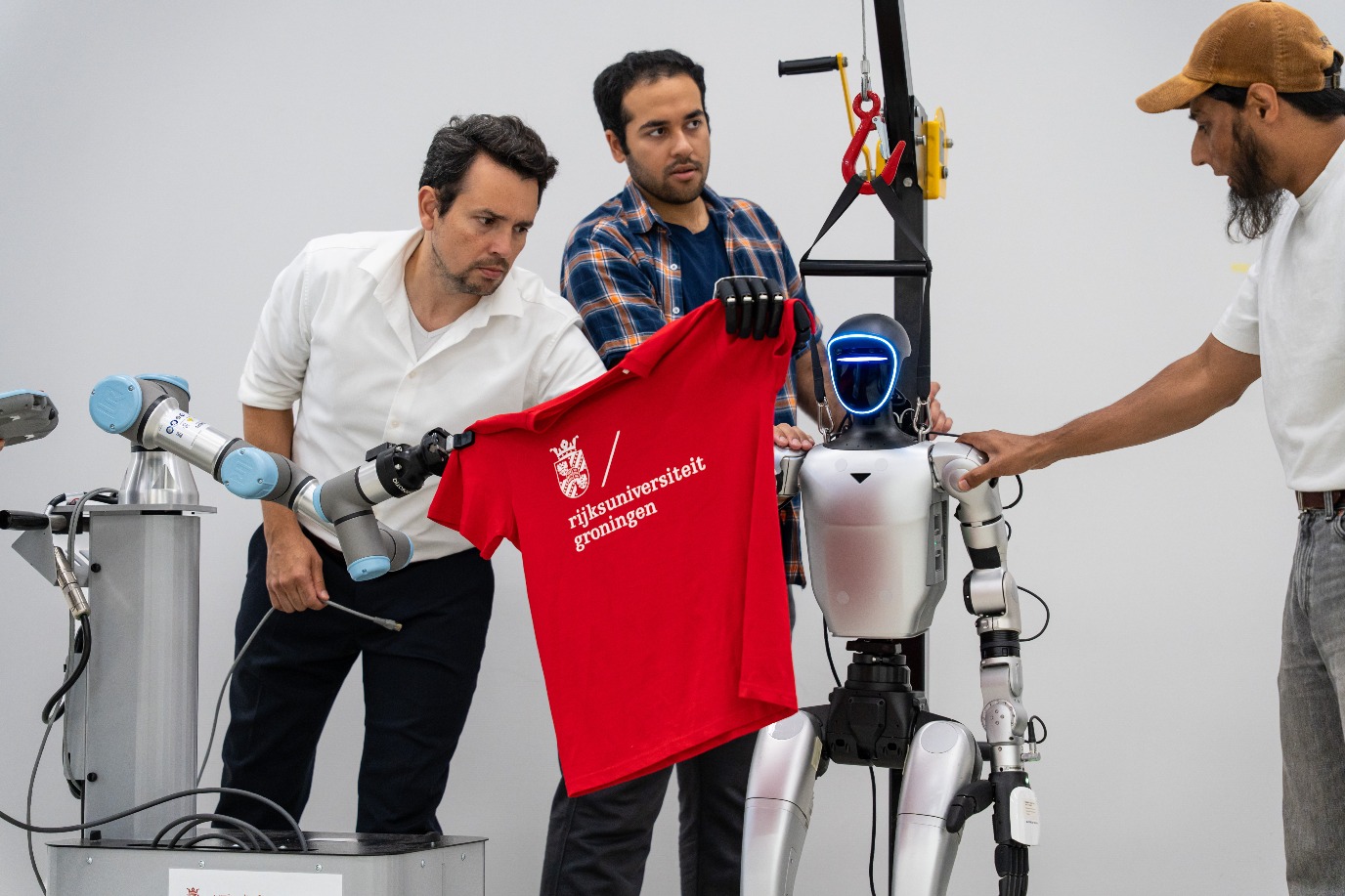
Once the bag is approved and opened, the items of clothing go onto a conveyor belt that leads them through a series of scanners and sensors. But wait, the items need to be spread out neatly on the conveyor belt! Muñoz-Arias smiles and simulates how robot arms will have to pick up an item of clothing and spread it out gracefully. In his lab, a PhD student is working with small robots that can spread out textile items – towels, for now, since these are relatively simple. The main question is: where and how does the robot have to pinch the item to spread it out neatly?
The value of an item
And then, the core of it all: what kind of textile item is it, and how much is it still worth in a secondhand shop? Muñoz-Arias: ‘Currently, we focus on determining the composition of an item: is it cotton, wool, polyester? In particular, a combination of various fibres in one piece of textile is challenging.' But it is exactly this combination of fibres that needs to be identified accurately, Muñoz-Arias explains, because even a small amount of elastane in the mix can cause problems in the next step of the recycling process.
Muñoz-Arias and his team have now developed an AI model that can determine an item's composition with high accuracy, using data collected with a specialized camera at NHL Stenden. ‘This machine uses hyperspectral imaging,' Muñoz-Arias explains. ‘It measures how the textile absorbs infrared light, and it's up to the AI model to interpret which molecules the item is composed of.'
You get to see the straight lines of polyester, the less straight lines of cotton or the messiness of wool.
But Muñoz-Arias wants to look further, preferably using a combination of different sensors to inspect the material closely. ‘You can also look at textiles microscopically', he explains. ‘That way you get to see the straight lines of polyester, the less straight lines of cotton or the messiness of wool.' By smartly combining measurements, Muñoz-Arias hopes to make the analysis even more accurate. ‘Because if the first sensor doesn't work, you will still have information from the other ones. Sensor fusion, that is called, and it's a technique that is still in development. I think it will really make the difference. It will be the key to solving this problem.'
Finally, regular camera images will have to reveal whether the item is still of interest for second-hand sale. Employees who now sort clothing will help train the AI model by labelling images of clothing items as suitable or unsuitable. In cooperation with software company Code for Good, Sympany has already started collecting images for such a training set. 'But it will not be easy to simulate human judgment,' Muñoz-Arias predicts. ‘We shouldn't underestimate what humans can do. That is something we have learned by now.'
This research is part of the project SORTED, led by textile collector Sympany. The UG team that is researching the automated sorting process consists of Mauricio Muñoz-Arias, Michele Cuccuzzella, LiangLiang Chen, Nabeel Younas, and Alexander Hübl, and PhD students Azamat Kaibaldiyev and Ali Ahmadi
Read more:
Gert-Jan Euverink and start-up company BioFashionTech want to use biotechnology to convert discarded textiles into useful resources for industry. ‘A company like DSM or Avantium could use the sugars that we obtain from cotton in this way to manufacture bioplastics, biogas, or cleaning products.’
More news
-
22 October 2026
Seven UG and UMCG researchers awarded Vidi grant
-
22 October 2026
KNAW Early Career Award for two UG researchers
-
22 October 2026
How someone with bad intentions could employ AI