
Searching for the first generation of stars

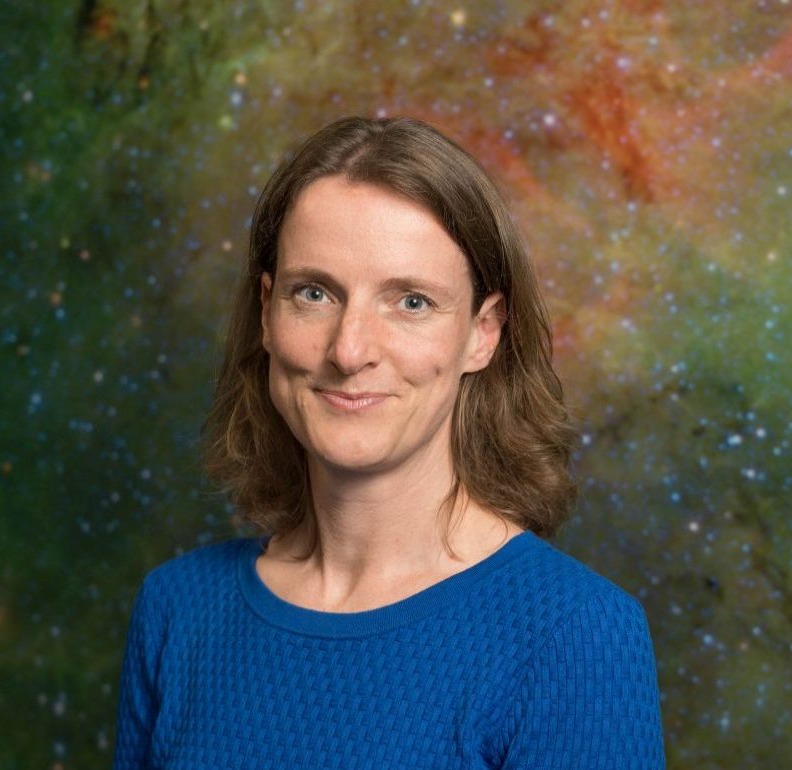
The first generation of stars, which shone in a universe that was then still dark, consisted of hydrogen and helium. They must have, because heavier elements were not present yet. ‘No one has observed such a first-generation star,’ says Else Starkenburg, astronomer at the University of Groningen. ‘And only about forty early-generation stars have been found.’ Starkenburg is involved in the international programmes WEAVE and 4MOST, which will use new instrumentation to study millions of stars in the northern and southern skies, and what they are made of. ‘With these new programmes, we hope to find many more early-generation stars. And that opens up possibilities to ask all kinds of new research questions.’
FSE Science Newsroom | Charlotte Vlek
Our Sun consists mostly of hydrogen (92,1 per cent of all particles) and helium (7,8 percent of all particles). But small amounts of iron, silicon and magnesium are also present. These can only come from other, older stars. Starkenburg: ‘Earth, and all of us on it, is also made of materials that cannot come from the Sun, but most have been formed in other stars. We are made of stardust.’
Important elements such as carbon, which is crucial for life itself, must have arisen from a cycle of life and death, Starkenburg explains. Inside the first generation of stars, hydrogen was compressed to form helium: a process called nuclear fusion, that produces a lot of energy. Once all hydrogen has been converted, nuclear fusion stops, and the star collapses under the influence of gravity. That raises the pressure on the inside of the star, leading the star to perform nuclear fusion with heavier elements. The result is even heavier elements, up to iron.
At the end of its life, a star will collapse, resulting in a shock wave that leads to a supernova, and the forming of more heavy elements. The remainders of the star are slung into the universe, and from this material, a new generation of stars form. These stars start with not only hydrogen and helium, but also some of the heavier elements that they inherit from the previous generation.
The inheritance of a star
Our Sun is very average in composition, which indicates a well-mixed set of material from many previous generations of supernovas
On the outside of a star, you can see what elements it started with,’ Starkenburg explains. ‘When there is iron there, for instance, you know there must be some remnants of a supernova in it.’ Likewise, our Sun is also a product of its ‘inheritance’. The Sun even carries luggage from many previous generations, Starkenburg explains: ‘The proportions between elements such as magnesium, carbon and iron tell us something about what came before. Our Sun is very average in composition, which indicates a well-mixed set of material from many previous generations of supernovas. When the star has an unusual composition and very few heavy elements, then it is more likely to be the result of just one supernova.’
Astronomers all over the world are busy searching for early generations of stars. The James Webb Space Telescope (JWST) can look very far into the universe, thereby observing light that was emitted long ago. Starkenburg rather searches for early-generation stars nearby, because that way she can detect more details at a smaller scale: she searches in our own Milky Way and in dwarf galaxies nearby. Ten years ago, Starkenburg developed the Pristine Survey, a search for the earliest stars, for which she designed a special filter that allows for easy identification of early generations, selecting them for further research (see text box).
The colour filter of the Pristine Survey
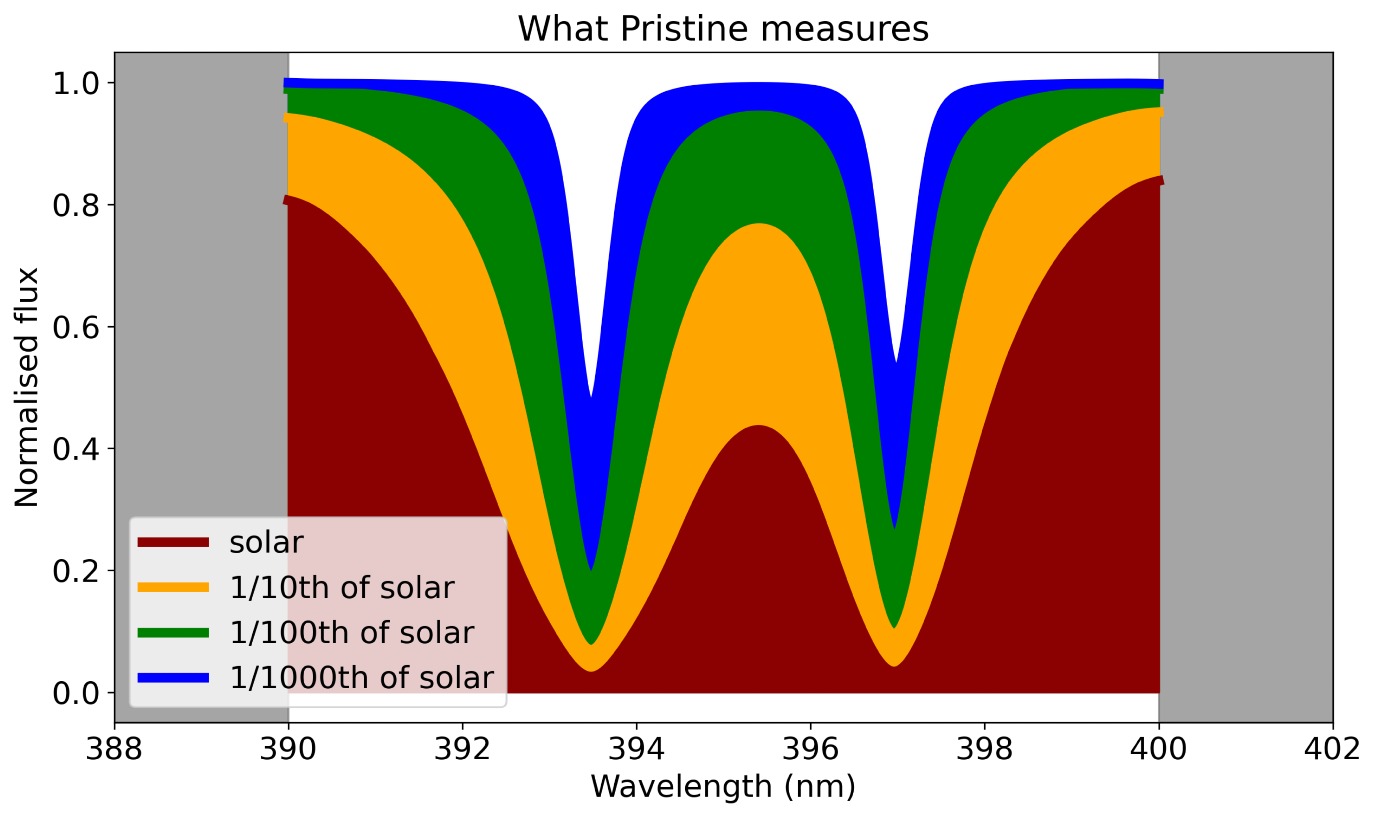
By looking at the colours of light that a star emits, astronomers can detect exactly what elements are present in a star. An element, such as iron or carbon, for instance, takes a little ‘bite’ out of the light spectrum, because it absorbs that specific colour of light.
Doing an analysis like this on a star can be complicated, and there are billions of stars to investigate in the Milky Way. ‘The new instrumentation of 4MOST and WEAVE can detect thousands of spectra simultaneously. Before the arrival of these new instruments, we were already happy when we had analysed around twelve stars per night in this way,’ Starkenburg recalls. That’s why, some ten years ago, she and her team developed a colour filter that does a quick screening, identifying potential early-generation stars, thus making the work much more efficient.
‘This colour filter takes away all the light, except that in a specific range: you only see colours of the light in wavelengths between 390 and 400 nanometers. That range contains the strong spectral lines of calcium. When a star contains relatively large amounts of calcium, the star will emit less of these colours, because the light is absorbed by the calcium. That makes the star less visible with this filter.
This way, the colour filter makes the stars with relatively high amounts of calcium, such as our Sun, less visible. The early stars that contain only a little of this heavier element remain clearly visible. And why calcium? Calcium is very suitable for the job, because it makes two clear spectral lines in the light spectrum. The research team uses this selection technique to make sure that the light of promising stars is analysed with WEAVE of 4MOST.
In 2022, Starkenburg and international colleagues discovered the most metal-poor collection of stars ever found, thanks to this filter. ‘That was a stellar stream that was probably all formed from a gas cloud in a short period of time. We didn’t know back then that such a globular cluster could appear so early in the evolution of the universe. But with our finding, this was immediately clear.’
An interesting time
‘It’s a very interesting time,’ Starkenburg says. ‘Precisely because we look at the same things nearby, as the James Webb investigates afar. And it turns out that our findings correspond in interesting ways!’ Nearby as well as far away, they observed stars and star systems (in the case of JWST) that contained a lot of nitrogen. In some stars, the amounts would be a hundred to a thousand times the expected amount. And at the same time, heavier elements that were supposed to be present too were missing. How is that possible? ‘We now think that there may have been a very special sort of supernova in the first generation of stars, causing a large part of the star to be devoured. That would explain these skewed proportions.’
‘What you really want to know is this: is what we see in these measurements normal, or was it structurally different back then? Was a typical supernova for these early stars something quite different, perhaps? Is this dependent on where in the universe such a star was formed? But currently, we have found so few of these early stars that you can’t really do any statistics yet.’
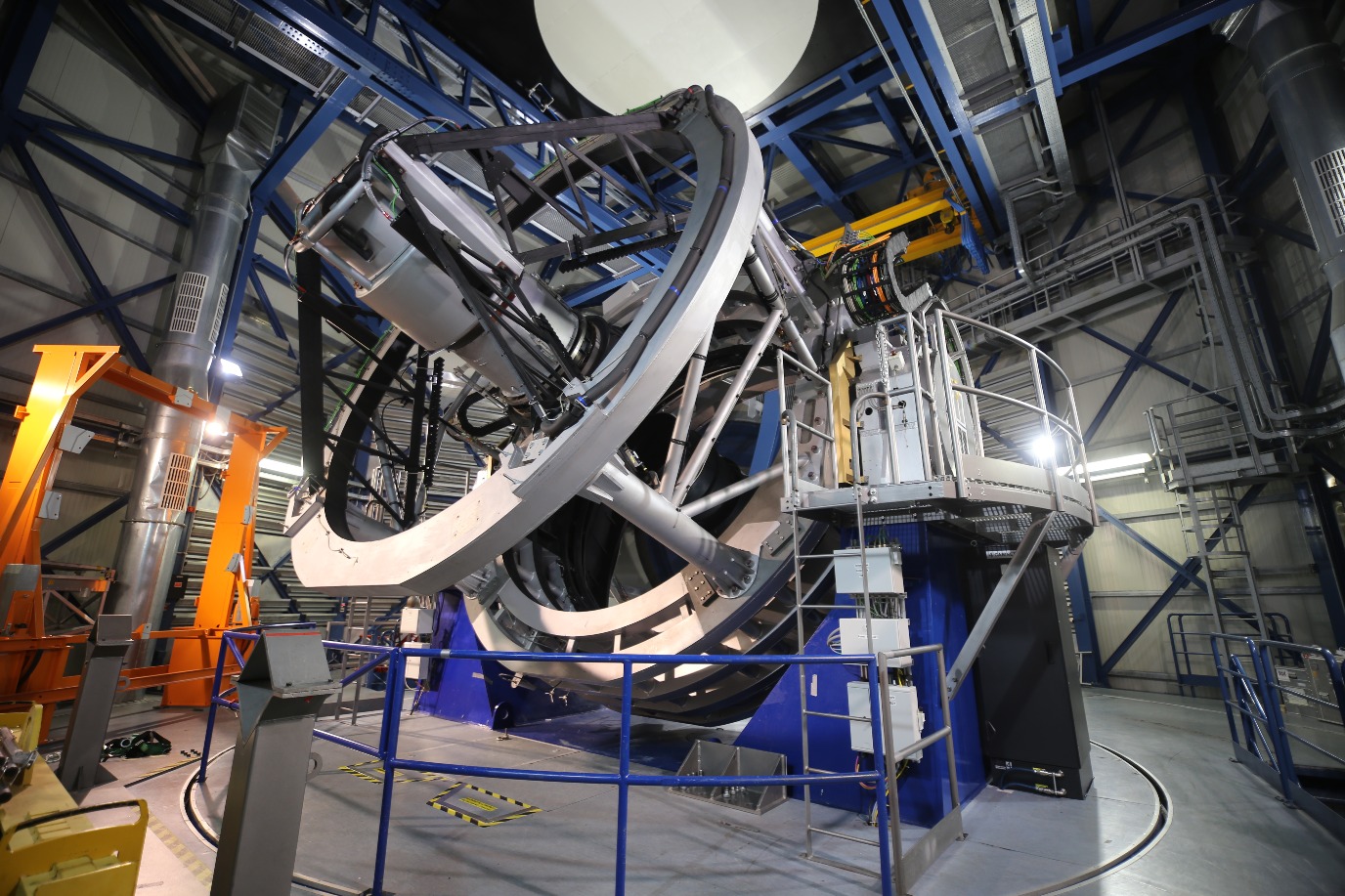
Starkenburg is currently working hard on the final preparations for 4MOST: an addition of extra hardware and software to the existing telescope at the European Southern Observatory in Chile, to study thousands of light spectra simultaneously. ‘The last scientific tests have just been completed successfully. This fall, it’s all going to start! And we expect to find many more of these early stars. We might go from forty to four hundred. And that means that you can start asking all kinds of new questions. With these amounts, you can search for patterns in the data.’
Read more:
Over the next five years, a new astronomical instrument will unravel our galactic history, investigate dark matter and study the origins of stars. Astronomers from the University of Groningen will also be working with this instrument.
More news
-
10 September 2026
Wouter Vansteelant appointed Scientific Director of BirdEyes
-
08 September 2026
How do you spot a nice wool coat in a heap of discarded textiles?
-
03 September 2026
ERC Starting Grant for UG researcher Henk van Waarde