
Doubling hydrogen production through a synergy of materials
Many chemical processes require hydrogen, which is still being produced from fossil fuels. A Protonic Ceramic Electrolyser Cell (PCEC) is a device which can produce hydrogen from water at temperatures that match with key industrial processes. Researchers at the University of Groningen recently showed that careful coordination of materials in such a PCEC can double the production of hydrogen at the same amount of electricity consumption. The results are published in Energy and Environmental Science on 14 October 2026.
FSE Science Newsroom | Charlotte Vlek
The process to produce hydrogen from water is not new, of course: lead an electric current through a bowl of water, and the water (H2O) is split into hydrogen (H2) and oxygen (O2). In a PCEC, this process is done with steam, which means the entire process (including the required heating) takes less energy. The steam is split into oxygen (O2) and hydrogen without an electron (H+). In the PCEC, there is a ceramic membrane, and only the hydrogen without an electron (H+) is small enough to pass through the pores of this membrane, attracted by a negative charge on the other side that allows it to form hydrogen (H2) again. Because the other atoms do not fit through the membrane, the produced hydrogen is kept separate from the rest.
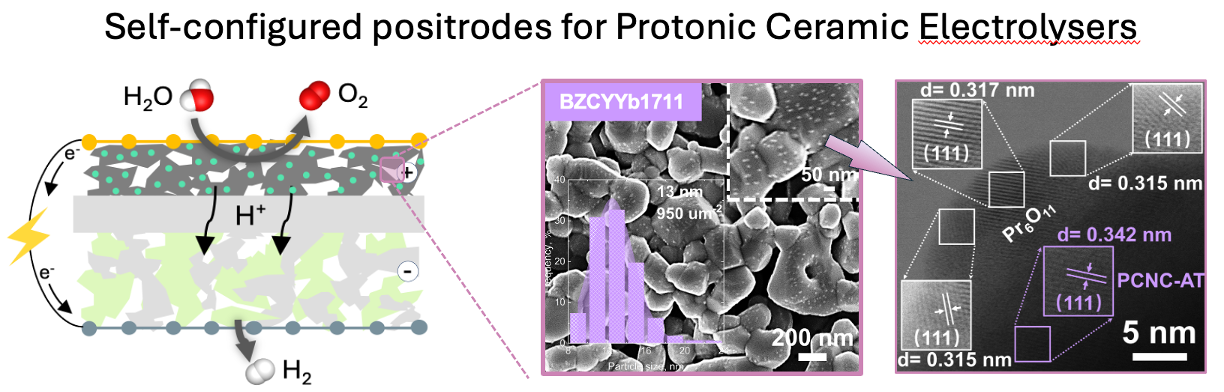
An important challenge for the development of such PCEC’s is splitting the steam with as little energy as possible, to allow hydrogen atoms to be recovered through the membrane. Vassilis Kyriakou, together with his team, developed a new nanoengineered material on the steam-side of the membrane that stimulates this splitting when coupled with the appropriate membrane materials. ‘We discovered a previously overlooked synergy between membrane and electrode materials,’ Kyriakou explains.
With the right combination of materials, the researchers managed to double the production of hydrogen as compared to previous PCEC’s, and moreover, they demonstrated stable operation for at least five hundred hours. Kyriakou: ‘Our research initially had a different direction, but our first findings made us think of a completely new research direction. This created the feeling of falling down a rabbit hole, but it turns out there was a wonderland waiting for us on the other side.’
Reference:
Nannan Li et al., Cross-Interface Diffusion-Driven Exsolution of Praseodymium Oxide Nanoparticles for Enabling Electrolysis at Industrially Relevant Temperatures in Protonic Ceramic Cells. Energy and Environmental Science, 14 October 2026
More news
-
22 October 2026
How someone with bad intentions could employ AI
-
22 October 2026
KNAW Early Career Award for two UG researchers
-