
More ice in Antarctica due to increased snowfall

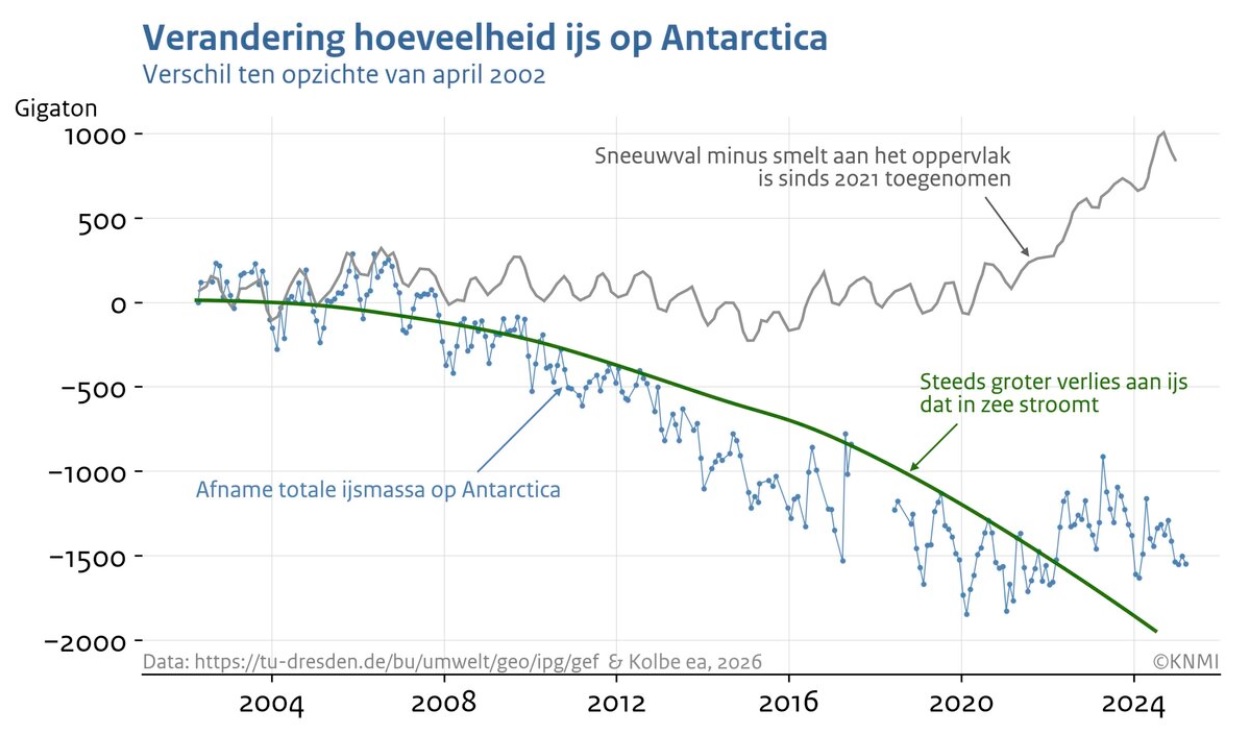
For several decades now, the total ice mass of Antarctica has been declining sharply. This is mainly because the ice shelves – floating extensions of land ice – are melting from below due to the ocean's high temperature, becoming thinner and breaking off. However, measurements show that since 2020, the total ice mass in Antarctica has stopped decreasing. A recent study by the KNMI, the Royal Netherlands Meteorological Institute, in collaboration with the University of Groningen and other institutes, reveals the cause of this striking stagnation: a sharp increase in snowfall. This increase is mainly due to so-called ‘atmospheric rivers’ transporting extra moist air to the ice sheet.
FSE Science Newsroom | Text KNMI
Detailed satellite measurements show a clear long-term decline in the total ice mass of Antarctica since 2002. This decline is not uniform. In East Antarctica, the ice mass is growing, whilst West Antarctica and the Antarctic Peninsula are losing ice. Precise analyses show that floating ice shelves are melting due to warm ocean water, causing them to break off sooner. This appears to be the main cause of the mass loss of the Antarctic ice sheet.
The disappearance of the floating ice shelves means that the land ice flows towards the coast more quickly, causing the ice sheet as a whole to become thinner. The melted ice thus causes sea levels to rise, with major consequences for distant regions such as the Netherlands. However, the loss of ice mass is not uniform, mainly due to variations in the amount of snowfall in East Antarctica.
Tipping point in 2020
In 2020, satellite data show a break in the downward trend that had been observed since measurements began in 2002. Snowfall in Antarctica began to increase so sharply that total ice mass loss has stagnated in recent years. The question was how to explain this sudden increase in snowfall.
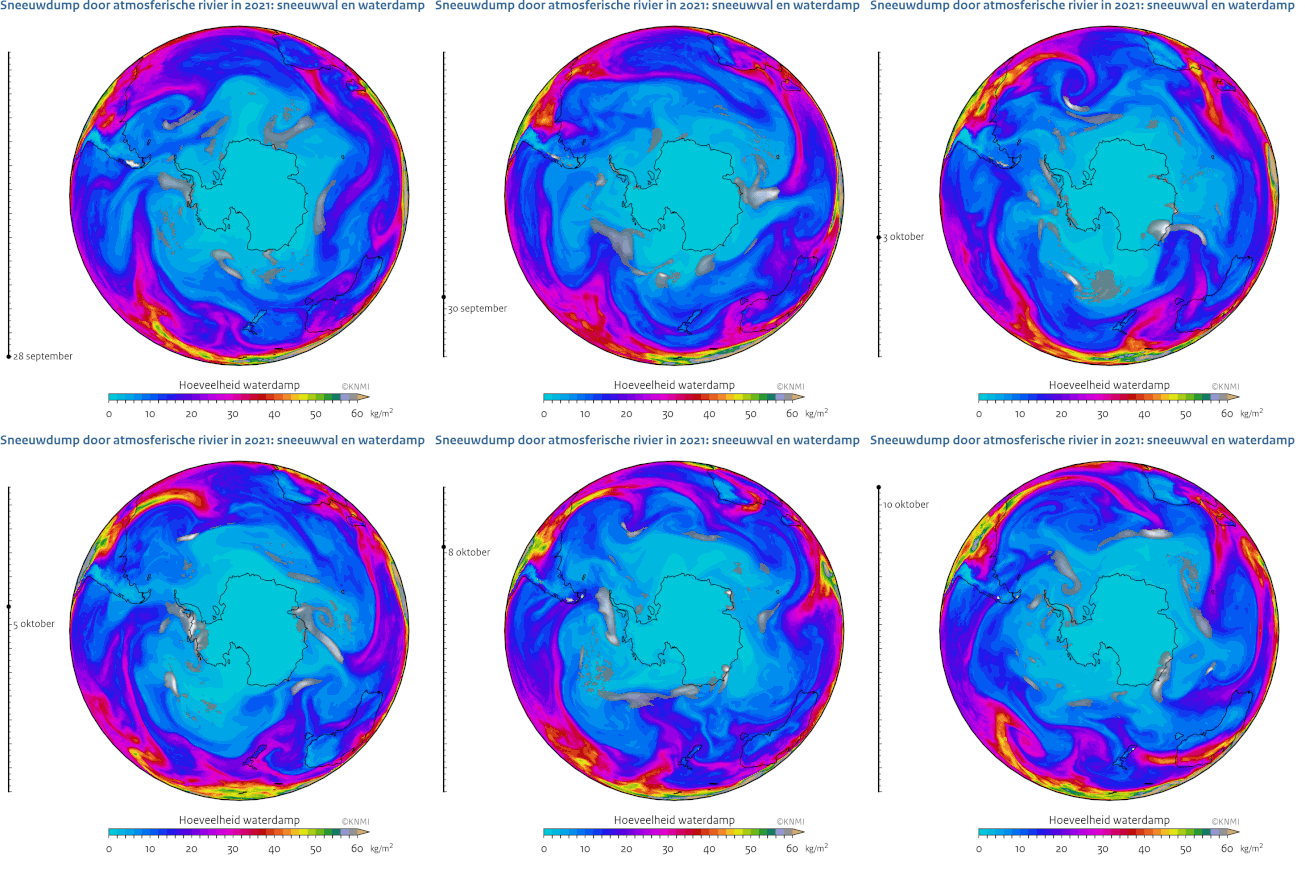
The new study by the KNMI, the University of Groningen, and partners uses high-resolution atmospheric models to accurately simulate the processes that cause precipitation in Antarctica, focusing in particular on atmospheric rivers. These are elongated regions that transport enormous amounts of moisture to the Antarctic continent, causing heavy snowfall there. The study shows that since 2000, both the number and intensity of atmospheric rivers have increased, which may partly explain the increased snowfall.
Role of sea ice
Due to the warming of the Southern Ocean, the amount of sea ice around Antarctica is decreasing. More open water leads to greater evaporation and thus more moisture in the atmosphere. Here, too, the researchers used a high-resolution model to simulate the effect of sea ice on atmospheric rivers. It appears that in the model without sea ice, these ‘rivers’ absorb more moisture from the ocean, leading to an increase in snowfall on the continent. The decline in sea ice thus contributes to more precipitation on the continent, and consequently to an increase in Antarctica’s ice mass.
However, the increased activity of atmospheric rivers appears to play a greater role than changes in the amount of sea ice. There are still many details and other relevant processes that need to be investigated further to definitively explain the tipping point in snowfall around 2020. The future will tell whether the increase in snowfall is temporary or indeed marks a change in the long-term trend.
Reference: Marlen Kolbe, Jose Abraham Torres Alavez, Ruth Mottram, Marwan Katurji, Richard Bintanja & Eveline C. van der Linden: Atmospheric rivers and winter sea ice drive recent reversal in Antarctic ice mass loss. Communications Earth & Environment, online 3 February 2026
More news
-
25 September 2026
NASA selects infrared space telescope PRIMA featuring Dutch technology
-
-
24 September 2026
Arjan van der Schaft receives IEEE Control Systems Award