
Self-driving chemistry for cleaner oceans, green reactions and modern medicines

In the chemistry labs of the University of Groningen, five brand new robotic platforms are preparing samples, measuring properties and analyzing results. As part of the national growth fund Big Chemistry, these robots are employed to study surfactants: molecules that sit at boundaries between water, oil, air or solid surfaces. ‘The goal is to gather reliable and meaningful data,’ explains Nathalie Katsonis, Chemistry Professor and Groningen lead of the project. ‘It’s the first step towards the use of Artificial Intelligence in our labs. AI can help us search faster for safer alternatives to persistent chemicals like PFAS, or for greener chemical reactions.’
FSE Science Newsroom | Text Charlotte Vlek | Videos AV-services RUG
Surfactants are the active agents in your dishwashing liquid or laundry detergent, encapsulating dirt or grease. The encapsulation allows it to be washed away with water. These surfactants are molecules that form a stable outer surface on droplets, foams or coatings. This is a useful mechanism in detergents, but also in medicines, for instance, to help the active ingredients dissolve in water. However, surfactant behaviour is still difficult to predict. Small changes in acidity, light, or other factors can shift a mixture from stable to unstable.
The researchers in Groningen aim to gather a large body of data about surfactants. This will allow them to spot trends and investigate new hypotheses about surfactant behaviour. In their labs, five robotic platforms will perform countless experiments and register the outcomes. Katsonis: ‘If PhD students were to perform this many experiments, it would take much longer. But what’s important too is that these machines perform all experiments in the exact same way each time, delivering consistent results. This leads to a consistency in the data that manual work cannot match.’
The aim is not simply to place robots next to chemists. The aim is to develop new ways of working that can become self-driving: machines that prepare samples, measure properties, analyze results night and day, and suggest the next most informative experiment. Katsonis: ‘This will be an entirely different way of doing research. The cycle of an original idea, an experiment and a test in the lab will stay. What changes is that hypotheses become sharper, because they are guided by large quantities of reliable information, not only by intuition and trial and error.’
This research is part of the Growth Fund consortium Big Chemistry. Read more below about what is already happening in the Groningen labs right now, and see the robotic platforms in action!
Ocean Cleanup
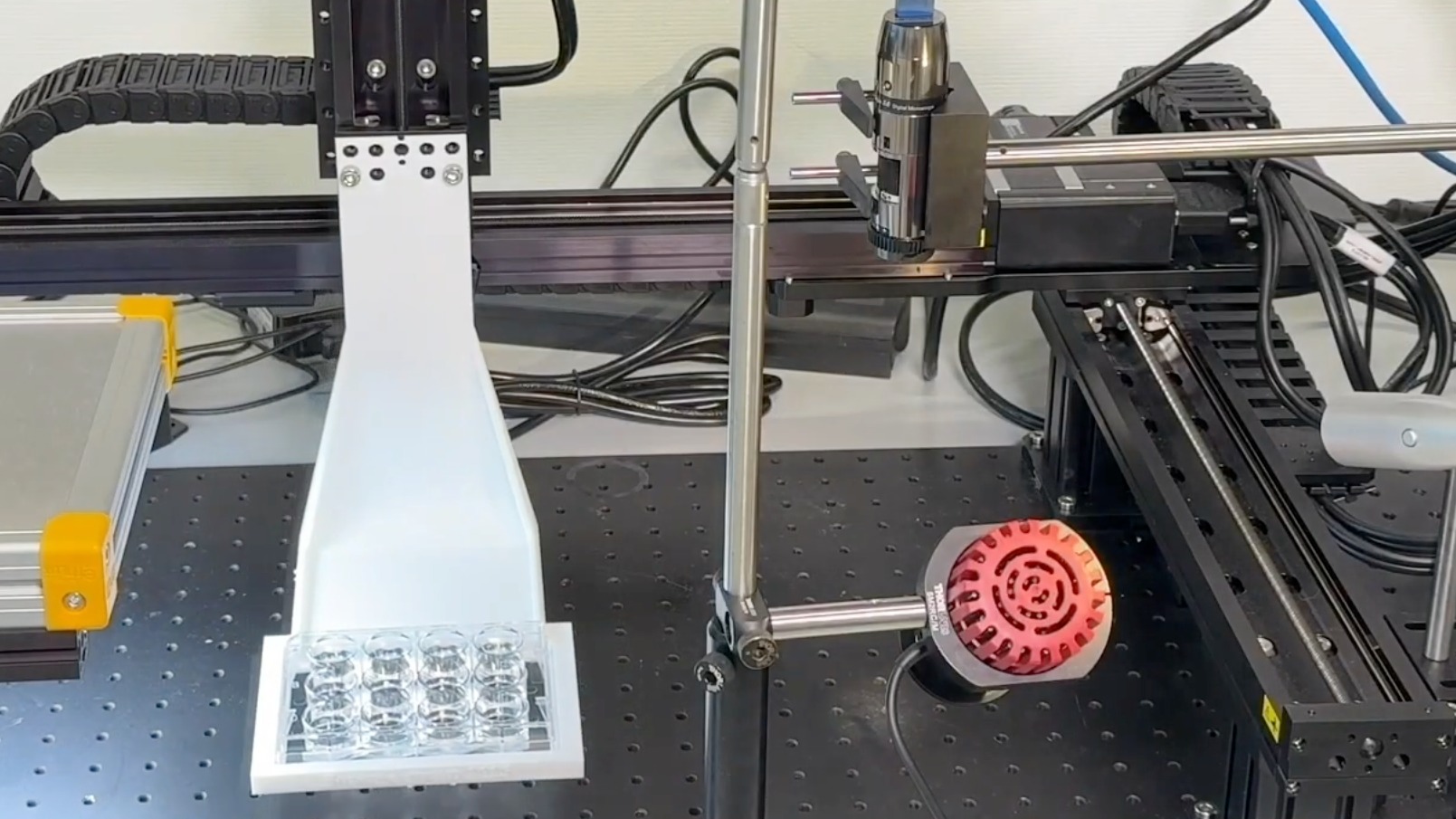
Nathalie Katsonis and Wesley Browne study how polluting oil layers oxidize and spread on seawater under the influence of sunlight. Indeed, an oil spill is not chemically inert: sunlight and seawater change its composition over time. Therefore, this automated research line holds a lot of test tubes with a range of seawater samples and oil under a UV light. At set intervals, the machine moves them to a camera that inspects the test tubes. Image recognition registers the change of the oil over time in all these different samples.
Katsonis and Browne want to use this information to select the surfactants that can clean up oil in various situations. ‘Such surfactants break a large area of oil into smaller droplets. If you know the exact composition of the oil, you can also make an informed choice for the best surfactants, and the right amount.’
In this video, the automation is demonstrated by Manee Patanapongpibul. Voice-over from Bente Reus.
Improving Vaccine Stability
RNA vaccines use messenger RNA (mRNA) to stimulate an immune response in the body. The stability of such an mRNA molecule depends both on its sequence (the order of molecular building blocks) and on the protective environment of surfactants around it. This automated research line uses light to investigate the structure of so-called chiral molecules. Chiral molecules have a particular “handedness”, much like a left and right hand. The two ‘hands’ can have very different properties, even though they are made of the same types of atoms. RNA is built from chiral molecular components and adopts a chiral three-dimensional structure. By analysing how RNA interacts with light, the instrument can provide information about how the molecule is folded and organised, and how its structure changes under different conditions.
Tibor Kudernac and his team use this automated research line to study the stability of RNA molecules. With the outcomes, they want to map how mRNA stability depends on RNA sequence as well as the vaccine composition: which sequences survive best, how can we best protect them, and under which conditions they degrade.
In this video, the automation is demonstrated and narrated by Bente Reus.
Greener chemical reactions in water
Many (chemical) products use hydrocarbons in their production process, relying on fossil-based sources. Replacing these hydrocarbons with alternative substances could lead to greener production processes. With this robot, Robert Pollice and Ben Feringa are testing out various catalytic reactions, in which one substance (the catalyst) helps speed up a reaction between other substances.
In particular, Pollice and Feringa study how surfactant molecules organize themselves into tiny clusters of surfactant molecules, which affects how well they work as catalysts.
In related projects, Ben Feringa and Adri Minnaard search for bio-based surfactants for renewable cleaning products.
In this video, the automation is demonstrated and narrated by Lisa Fang and Emil Hodzic.
The effect of acidity changes on surfactants in products
Consider shampoos, detergents, food emulsions or pharmaceutical formulations: the acidity (or pH) of these complex mixtures cannot be predicted, yet it determines whether molecules remain dispersed, whether droplets stay stable, whether foams persist and whether active ingredients are protected or degraded. For surfactants and amphiphiles specifically, acidity is not simply a fixed number: it changes with concentration, salt content and the way molecules assemble.
With this self-driving laboratory, Nicolas Cissé, Big Chemistry Postdoctoral Fellow, wants to measure how diluting or mixing amphiphiles modifies their acidity across many conditions. The results of these measurements will help in understanding when a mixture of surfactants is stable, where it becomes fragile, and how to redesign if needed.
In this video, the automation is demonstrated and narrated by Nicolas Cissé.
More news
-
24 September 2026
Arjan van der Schaft receives IEEE Control Systems Award
-
17 September 2026
NWO-KIC funding for new route to sustainable biocatalysts
-
15 September 2026
Enzymes break down textile fibres into useful resources