
What a bacterium teaches us about solar cells

Even in extreme circumstances, the green sulfur bacterium can still convert light into energy – and that could be a source of inspiration for a new generation of solar cells. Physicist Thomas La Cour Jansen of the University of Groningen studies how the structure of this unique bacterium allows it to harvest energy from light so efficiently.
FSE Science Newsroom | Charlotte Vlek
The bacterium can even harvest energy from the infrared light that is emitted by black smokers near ocean rifts
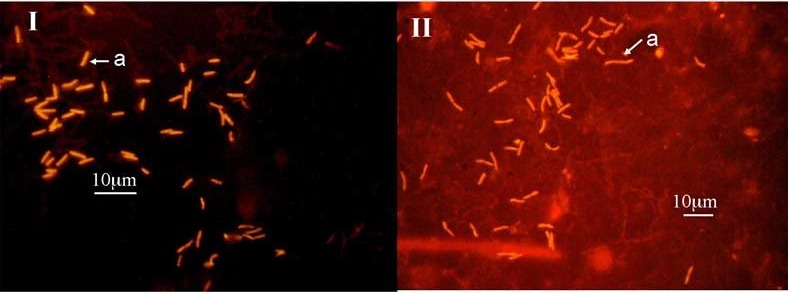
‘At a hundred metres below sea level, there is little sunlight. Yet, the green sulfur bacterium can still harvest energy from that little bit of light,’ Jansen reports. ‘And the bacterium can even harvest energy from the infrared light that is emitted by black smokers near ocean rifts.’ The bacterium uses many colours of the light spectrum to generate energy and manages to very efficiently transport this energy internally.
How is it that nature does this so well? That’s what Jansen is investigating, by finding out the structure of the green sulfur bacterium as accurately as possible and by finding connections between structure and function. He does this with computer models that simulate the bacterium at the level of single dye molecules and with molecular models that predict exactly which colour of light the bacterium can absorb and how that results in energy transport.
Spirals, tubes, lamellae
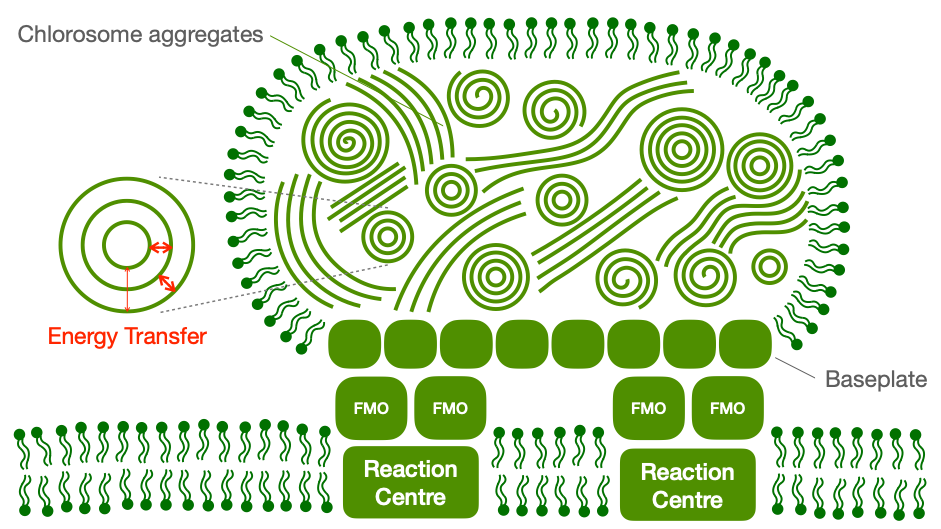
Jansen discovered that the green sulfur bacterium harvests energy from light so efficiently due to a combination of several different structures within. The bacterium harbours dye molecules organized in all kinds of shapes – spirals, tubes, and lamellae – all packed closely together. ‘Such a varied structure allows the energy from light to travel in various directions without being obstructed,’ Jansen explains. ‘You can compare it to a multilane highway: energy can easily move forward without getting stuck behind a slow truck, as a manner of speaking.’
Already, artificial materials exist that have such a helpful structural organization, Jansen reports. Such as, for instance, Cy3, a type of artificial red dye from the family of cyanine dyes. Together with colleague Maxim Pshenichnikov, Jansen studied Cy3 and concluded that the material forms a similar sort of ‘multilane highway’ for the energy absorbed from light.
It is the structure of the green sulfur bacterium that helps facilitate efficient energy transfer and by studying this structure-function relationship, Jansen is also learning how solar cells might be improved. In particular, electrons tend to return to the closest atom that is missing an electron – a phenomenon called electron-hole-recombination. If that happens, the electric charge will be lost. With his computer models, Jansen showed that for organic solar cells, the layered organization of the organic molecules, similar to that observed in the bacterium, can help to ensure that the electrons keep flowing in organic solar cells. And that they can deliver their energy to where it needs to be.
Dark states
The green sulfur bacterium has even more helpful features, for example dark states. These are states that do not absorb light but they also don’t lose any energy. They take energy from neighbouring light-absorbing states and they can transport the energy to where it needs to end up. So, these dark states are like a storage space for energy. And that is helpful, Jansen explains: ‘Atoms that absorb energy from sunlight always emit some light too. But if they hand over their energy to these dark states, it will not be lost and it will be transported to the right place. So yes, that could be quite useful for solar cells.’
Read more:
Jan Anton Koster jokingly calls himself the ‘device doctor’. Fellow researchers from all over the world can approach this professor at the University of Groningen if they want to know why their solar cell is not as good as they had hoped.
Chemist Loredana Protesescu of the University of Groningen is working on more stable, lead-free perovskites and has recently received a grant to develop an ink that contains all components needed for a solar cell, such that it only needs to be applied to a surface before use.
From fundamental research on new classes of materials to everyday applications: throughout her career, professor of photophysics and optoelectronics Maria Antonietta Loi has proved that this transformation doesn’t have to be difficult. Next to perovskites, she is currently focusing on quantum dots, which according to her can have very important applications in photodetector technology: ‘I expect that quantum dots devices may become soon a very important player in the detection of infrared light.’
More news
-
10 September 2026
Searching for the first generation of stars
-
10 September 2026
Wouter Vansteelant appointed Scientific Director of BirdEyes
-
08 September 2026
How do you spot a nice wool coat in a heap of discarded textiles?