
Materials scientists help to better understand diseases
Biochemist Patrick van der Wel and physicist Wouter Roos are applying their expertise in materials science and their specialised equipment to medical research. Among other things, Van der Wel discovered how protein clumps form in Huntington’s disease, whilst physicist Wouter Roos identified vulnerabilities in viruses in order to combat them more effectively.
FSE Science Newsroom | René Fransen
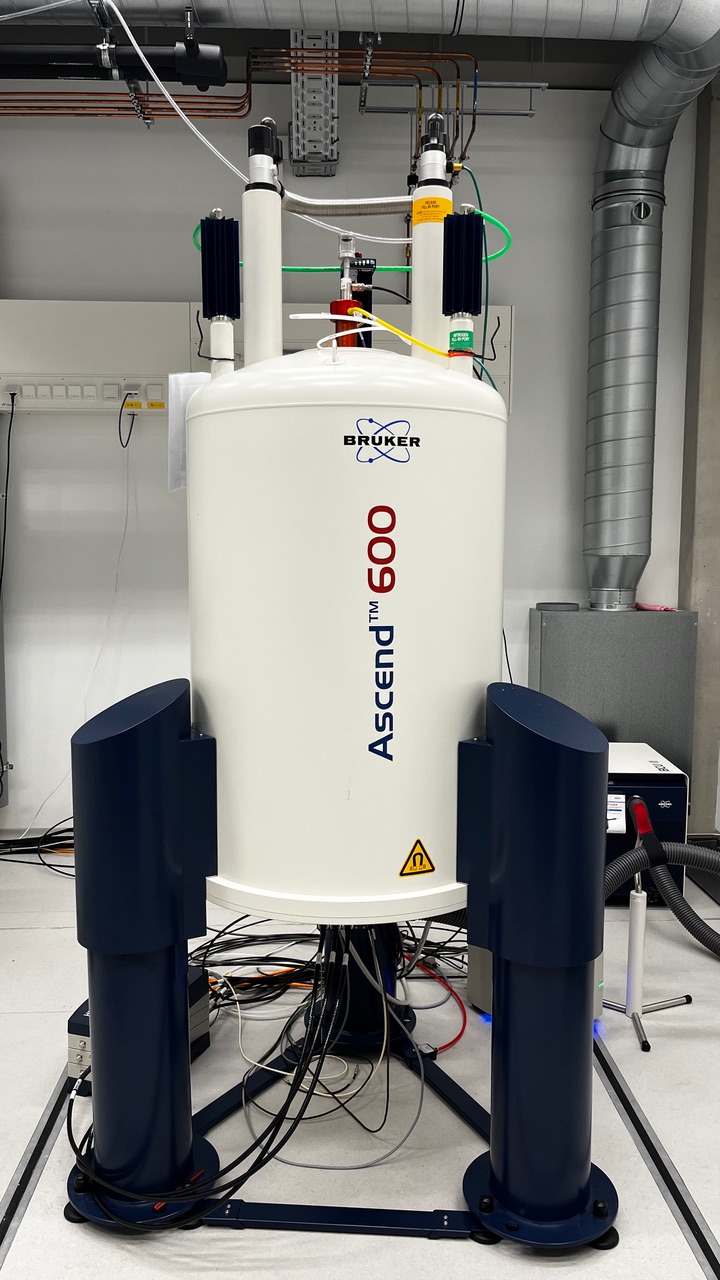
As a materials scientist, Van der Wel had to learn the ‘language’ of medical scientists. He attends medical conferences not only to listen, but also to explain what he does: ‘People like me need to make clear what our work can mean for medical research.’ Throughout his career, Van der Wel has specialised in a technique that reveals how molecules are structured and how they are connected to one another: solid-state NMR spectroscopy. This technique is comparable to an MRI scan of the body, but for molecules. It allows you to ‘see’ how the building blocks of a material are connected.
This technique is widely used in materials science, and Van der Wel employs it at the Zernike Institute for Advanced Materials (ZIAM), for example, to study the structure of new materials for solar cells. ‘However, most applications focus on biological materials.’ It is particularly useful in the medical field: there are quite a few diseases in which proteins form harmful clumps within cells, and it is therefore of interest to map out the bonds between those protein molecules.
Protein clumps and Huntington’s disease
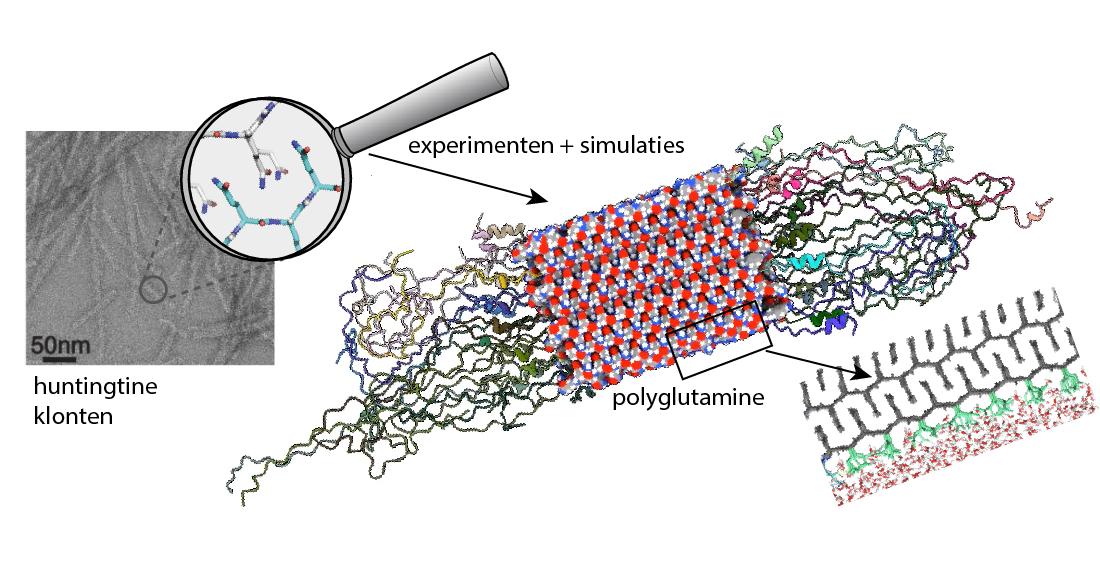
An example is Huntington’s disease, a hereditary brain disorder that Van der Wel studies. It is caused by a genetic defect that results in the formation of a protein with an abnormal structure. This forms clumps in brain cells, which eventually die as a result. Using solid-state NMR, Van der Wel was able to determine how the protein clumps form, which may point the way to a method of preventing clumping.
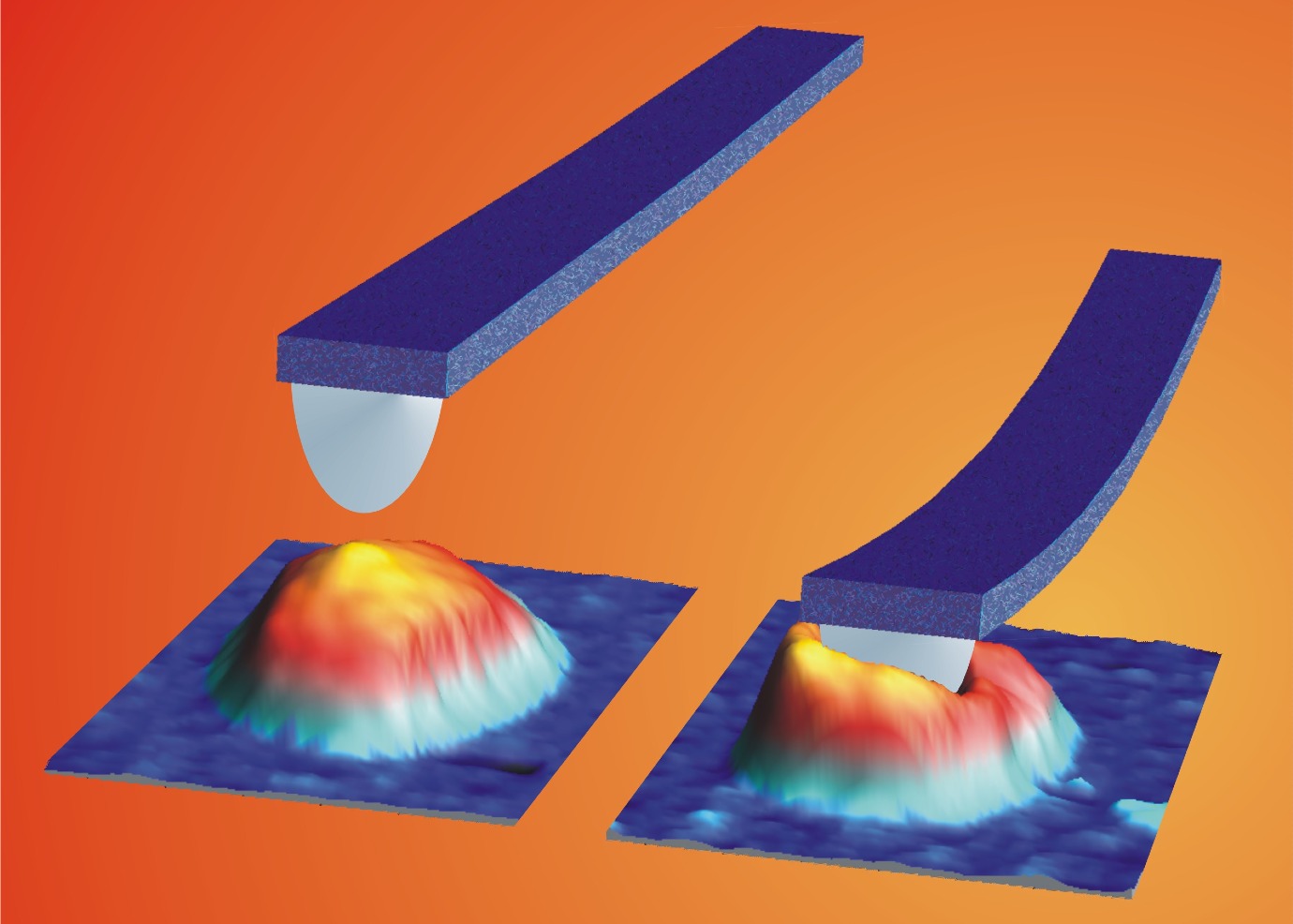
In this work, he also collaborated with his close colleague, physicist Wouter Roos. Roos also applies specialised techniques for materials research to medical questions. One of these is the Atomic Force Microscope (AFM), a device that scans molecules using an extremely thin tip.
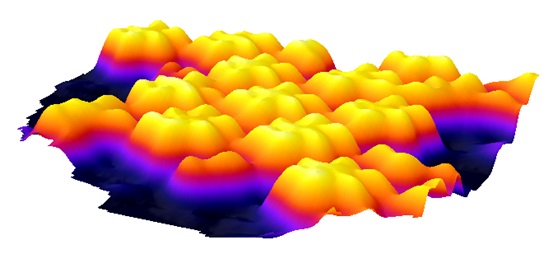
The tip measures between 1 and 10 millionths of a millimetre. With this, an AFM ‘senses’ the attractive and repulsive forces between the tip and the material being scanned. ‘Together with Patrick, I investigated the protein clumps that form in Huntington’s disease,’ explains Roos. ‘Those clumps grow into rods, and using the AFM, I could see that new rods were growing on top of the original rods. As a result, the formation of rods quickly accelerates! When we carried out that experiment, this was still just a hypothesis, but now it has been proven.’
Optical tweezers
Roos also uses his instrument to measure the mechanical properties of viruses. He does this by positioning the AFM tip on a virus particle and then applying pressure. This allows him to see how flexible the virus particle is and at what force it breaks. ‘We have investigated the effect the environment has on those mechanical properties,’ explains Roos. ‘What effect do salt, acidity or the presence of certain proteins have? In this way, I try to identify the virus’s weak spots, which we can use to combat it.’
He is also investigating how viral particles are formed from their individual components. Roos: ‘We use a strand of a virus’s genetic material, to which we add proteins that package this genetic material inside the virus.’ The genetic material triggers the formation of a new viral particle. As it is packaged, the strand folds up – and thus becomes shorter. ‘Using an instrument called optical tweezers, we can accurately measure that process and the forces at play.’ In his research into virus formation, he also examines how antiviral drugs disrupt this process. ‘Virologists may be able to develop new antiviral drugs with that data.’
Coronavirus and AIDS
Van der Wel and Roos are thus tackling a wide range of medical issues. In addition to the protein clumps associated with Huntington’s disease, Van der Wel is also studying other aggregating proteins. His expertise has also been called upon by medical scientists studying Barth’s syndrome, a fatal metabolic disorder.
In 2025, Roos received a European ERC grant, which he will use to study the coronavirus and the AIDS virus. ‘These are the causative agents of the two biggest pandemics of the past fifty years. It is a dynamic field with a vibrant community of researchers.’ And as a physicist, he can now make his own unique contribution to this.
This is the first part of a two-part series on technology in health research.
More on the research by Patrick van der Wel:
How an unfolding protein can induce programmed cell death
Materials scientist finds clue to treat deadly hereditary illness
More on the research by Wouter Roos:
ERC Advanced grant for Wouter Roos
Physical virology shows the dynamics of virus reproduction
New target for antibiotics promises treatment for resistant superbugs
More news
-
18 November 2026
NWO-KIC for smarter production of medical-grade contact lenses
-
17 November 2026
Insects react differently to light
-
13 November 2026
Royal Honour for Jan Post