
Hubble solves merger mystery from Milky Way’s early years
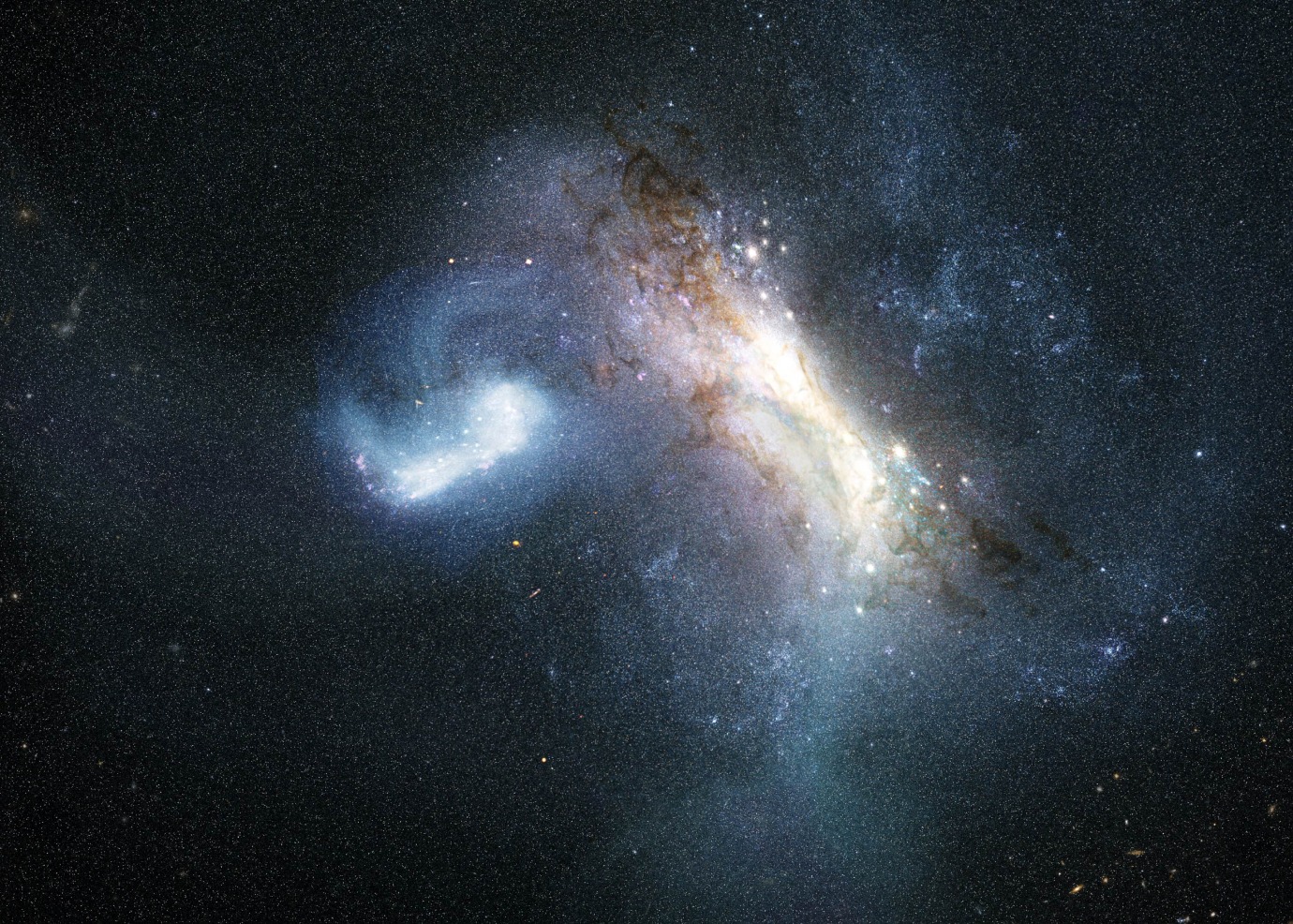
Our home galaxy, the Milky Way, grew to its current size in part by consuming smaller galaxies. Now, new data from the NASA/ESA Hubble Space Telescope show definitive evidence of a dwarf galaxy merging with the young Milky Way galaxy in the earliest phases of its evolution. This finding extends our knowledge of our galaxy’s history 1.8 billion years farther back in time than before. The results were published on 17 August in the journal Nature Astronomy.
Text: ESA / FSE Science Newsroom
The Milky Way today is a massive spiral galaxy, home to hundreds of billions of stars. However, our galaxy wasn’t always so large; it has grown by forming new stars from its gas clouds as well as collecting stars through mergers with other galaxies. The most recent merger in the Milky Way’s history was with the Sagittarius dwarf galaxy, beginning over 6 billion years ago and still ongoing today. And 10 billion years ago, the Milky Way galaxy consumed another dwarf galaxy called Gaia-Sausage-Enceladus, as a team led by University of Groningen astronomer Amina Helmi discovered.
But our galaxy’s history didn’t start then. An international team of astronomers, including Helmi and her team, uncovered definitive evidence of an earlier merger that occurred about 11.8 billion years ago, just 2 billion years after the Big Bang. They analysed 39 globular clusters, roughly spherical collections of tens of thousands to a few million stars, in the heart of our galaxy. These can act as cosmic archaeological sites that preserve stars from other galaxies the Milky Way galaxy has collected. The astronomers expected this sample to contain globular clusters that formed within the young Milky Way galaxy as well as those collected from the Gaia-Sausage-Enceladus dwarf galaxy about 10 billion years ago.
Sensitive observations
However, using Hubble’s sensitive observations, the team determined there was a third population of globular clusters in the inner regions of our galaxy. These clusters are older than the group collected in the Gaia-Sausage-Enceladus merger, but younger than those born in the Milky Way. Therefore, they must have come from a separate and even earlier merger. While other teams have postulated this merger, the evidence has never been so clear. The Milky Way galaxy absorbed a dwarf galaxy containing roughly 500 million times the mass of the Sun in stars.
Such a large merger so early in the Milky Way galaxy’s formation has profound implications for our galaxy's evolution. ‘Some past studies have argued that the earliest phases of our galaxy’s evolution were defined by stars born only in our galaxy’, explains Davide Massari from the Astrophysics and Space Science Observatory of Bologna in Italy, lead author of the Nature Astronomy paper: ‘Here, we have shown that stars born in external galaxies also need to be considered.’
Reference: Davide Massari et al. Evidence of a massive accretion event 1.8 billion years before the Gaia-Sausage-Enceladus merger. Nature Astronomy 17 August 2026
In September, Amina Helmi will receive the prestigious 2026 Kavli Prize for her groundbreaking research into the history of the Milky Way.
More news
-
05 October 2026
How a swarm of mini-robots could save our infrastructure
-
01 October 2026
10th anniversary of Ben Feringa’s Nobel Prize
-
01 October 2026
Making stardust in the lab