
Tiny pheromones deciphered

The Trichogramma turkestanica is one of the smallest insects we know, and it produces only tiny amounts of pheromones to communicate with other members of the species. Because of those minute amounts, it was long thought to be impossible to elucidate exactly what molecules such a pheromone is composed of. But researchers of the University of Groningen, Wageningen University, and the University of Regensburg have nonetheless succeeded in doing just this, thereby showing that it is possible to identify molecules on the basis of just nanograms. The results were published on May 22nd in Scientific Reports.
FSE Science Newsroom | Charlotte Vlek
The Trichogramma turkestanica is a type of parasitoid wasp, only about 0.4 mm long, which lays its eggs in the eggs of moths. Like most insects, the Trichogramma turkestanica produces pheromones to communicate with other members of the species – for instance, to locate one another, and for mating. However, due to its small size, the pheromones are produced in only tiny amounts.
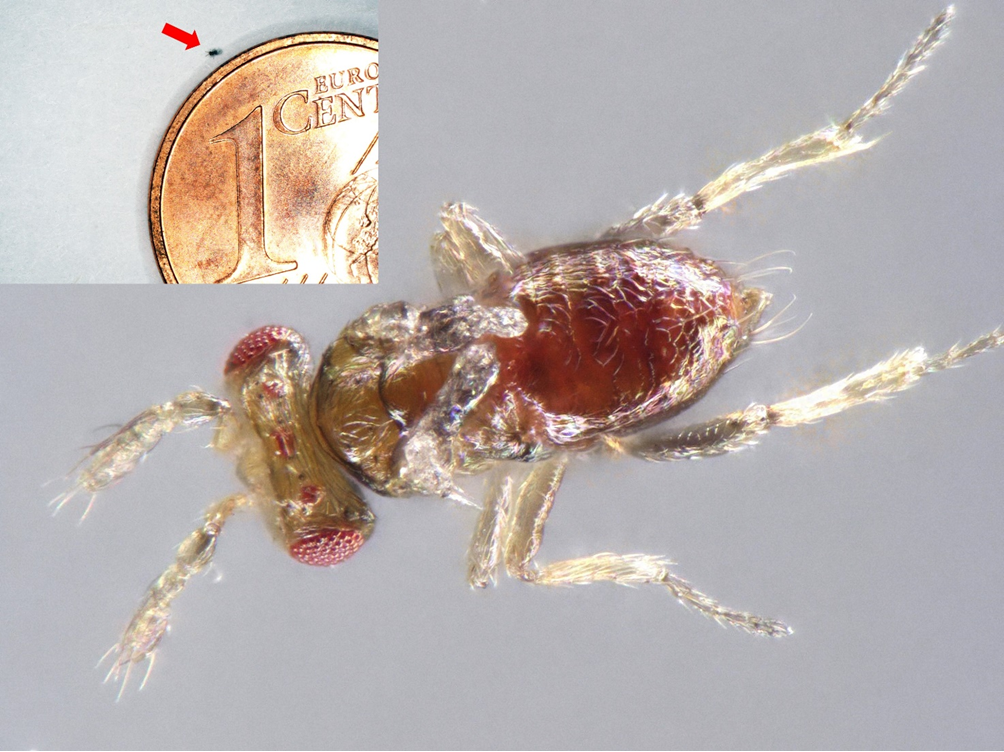
To elucidate the exact composition of such a pheromone, the team proceeded to breed many wasps in the lab, then collected the volatiles, followed by careful separation and analysis. This allowed them to partially resolve the structure of the pheromone.
The next step was to synthesize the putative pheromone, which made it possible to elucidate the structure completely. ‘The synthesis was complex, and there have been several failed attempts,’ says Adri Minnaard, Professor of Bio-organic Chemistry. 'This is the work of many master students and trainees, and my colleague Dr Teris van Beek made a Herculean effort. In all, the whole project spanned a large number of years and involved many researchers, as is clear from the author list.’
On a side note, Minnaard remarks that these tiny wasps themselves are perfectly able to detect such very small amounts of the pheromone. This is in the order of attograms: a number with fifteen decimals. ‘This is really unprecedented, and it is currently not understood how this is possible.’ And the next step for the researchers is already set out for them: ‘Although the male species uses this pheromone to locate the female, it turned out that it apparently needs yet another compound to initiate mating. So the search has not yet ended.’
Reference:
Absolute configuration, improved synthesis and femtogram-level behavioral activity of the sex pheromone of the minute parasitoid wasp Trichogramma turkestanica. Scientific Reports, May 22, 2026. doi: 10.1038/s41598-026-46414-z
More news
-
25 September 2026
NASA selects infrared space telescope PRIMA featuring Dutch technology
-
-
24 September 2026
Arjan van der Schaft receives IEEE Control Systems Award