Ice rinks are open, but the chances of an Elfstedentocht are increasingly slim

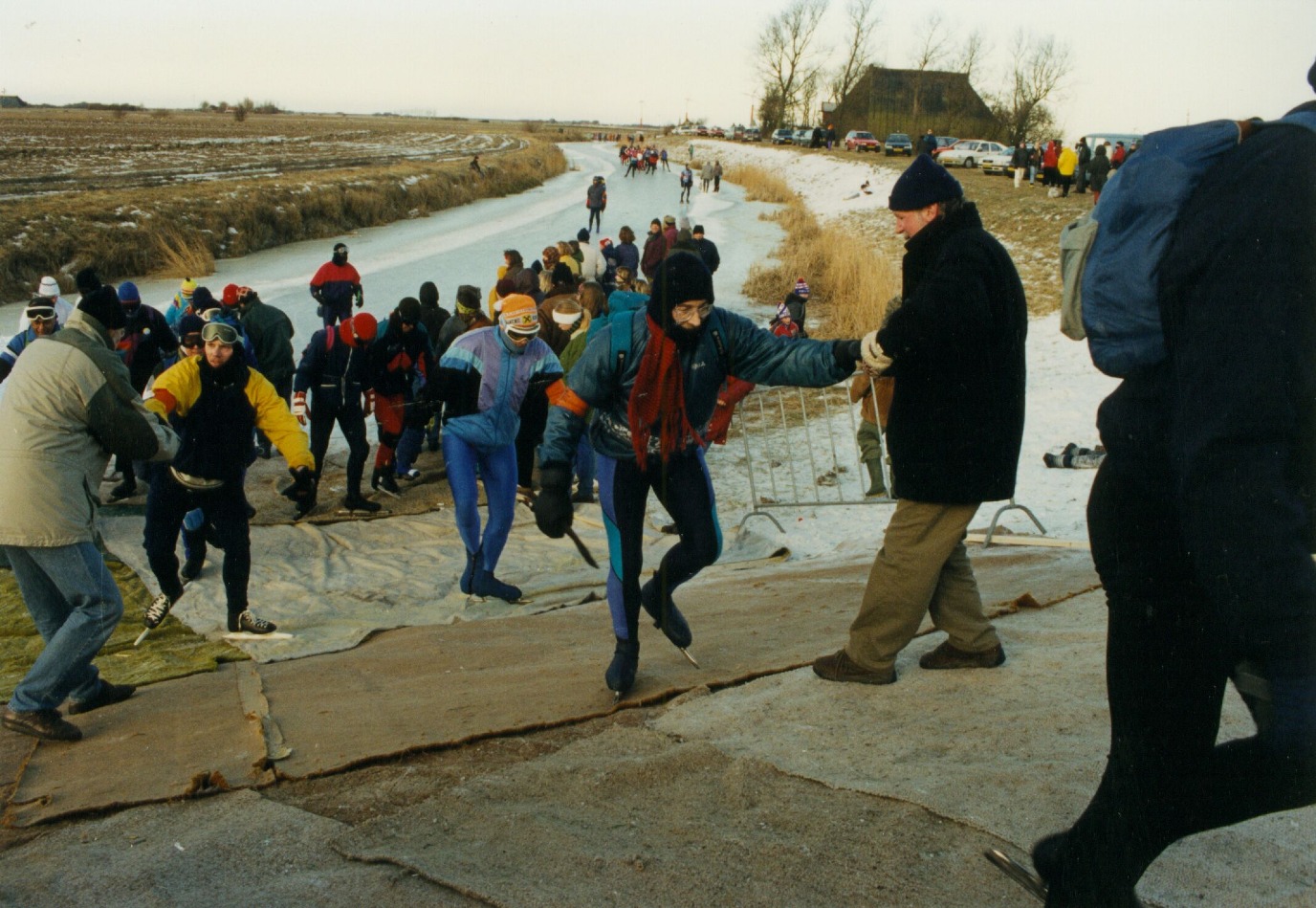
A few cold days are enough to open natural ice rinks. For genuine natural ice to form on ditches and canals, more and longer periods of cold weather are needed. And for the ‘tour of tours’ passing through eleven Frisian towns, there must be a prolonged period of severe frost. But climate change is making this increasingly unlikely, explains Professor Richard Bintanja, an expert in climate and environmental change.
FSE Science Newsroom | René Fransen
In 1901, the chance of an Elfstedentocht (Eleven cities tour, an almost 200-kilometer skating tour) taking place was around 20 to 22 per cent each year. But by 2023, that chance – based on winter temperatures in the decades leading up to that year – was no more than 3.1 per cent per year. The cause of this decline is global warming. Bintanja explains: ‘These earlier estimates were based on rules of thumb: at a certain number of degrees of frost, you get a certain amount of ice growth.’
In the height of summer, Bintanja – who is also affiliated with the KNMI – published a scientific article together with colleagues in which they analysed the likelihood of an Elfstedentocht taking place this century, based on climate data (for high, average and low greenhouse gas emissions) and two different models for ice growth in ditches and canals. ‘All based on the fundamental laws of nature governing global warming and the formation and melting of ice.’
The results of these calculations will not please ice enthusiasts: even if greenhouse gas emissions remain relatively low over the coming decades, we can expect no more than 1.6 to 1.8 tours by the year 2100. The reason for this decline is fewer cold winters, a consequence of global warming. ‘Of course, there won’t be any half-races, so we’re talking about one Elfstedentocht, two at most,’ explains Bintanja. ‘And that race will have to happen soon, because in the second half of this century, due to continuing global warming, the chance of an Elfstedentocht seems minimal.’
When an event like the Elfstedentocht can no longer take place because of global warming, this makes its consequences much more tangible.
Snow throws a spanner in the works
The models used in the study are not particularly detailed. ‘According to our model, the race could have gone ahead in 2012, as the ice on the canals and waterways should have been thick enough given the cold. But at the time, a lot of snow had fallen in the south-western corner of Friesland, which reduced ice growth on that part of the route. Our model cannot accurately simulate those details.’
A silver lining in this gloomy story: the researchers argue that the drastically reduced likelihood of an Elfstedentocht is a good way of making people realise how important it is to combat further global warming. Bintanja: ‘Climate warming is, after all, a somewhat abstract concept. What does it mean if the temperature rises by one and a half degrees? The fact that a quintessentially Dutch event like the Elfstedentocht may no longer take place because of global warming makes its consequences much more tangible.’
An Elfstedentocht every year
The only chance Bintanja sees of having more Elfstedentochten in the near future is if the relatively warm Gulf Stream weakens further. This Atlantic Meridional Overturning Circulation (AMOC) is weakening due to global warming and meltwater from Greenland. As a result, less warm water is being transported to north-western Europe, causing the northern part of our continent – including the Netherlands – to cool slightly (or warm up less quickly).
Bintanja and his colleagues are not yet entirely sure what this might mean for the future of the Elfstedentocht, but it could work out well for skating enthusiasts. ‘In an extreme scenario where the AMOC comes to a standstill, it might get so cold that we could hold an Elfstedentocht every year.’ Follow-up research is in progress, and the researchers hope to have more clarity in the course of next year.
More news
-
24 November 2026
Materials scientists help to better understand diseases
-
18 November 2026
NWO-KIC for smarter production of medical-grade contact lenses
-
17 November 2026
Insects react differently to light