
Extreme micro-organisms and their viruses in the lab

Professor Tessa Quax of the University of Groningen studies microorganisms that live in extreme environments, such as in hot springs or very salty water. Many of these microorganisms are so-called archaea: they are ancient, but more closely related to us than you might think. In particular, Quax studies the viruses that infect these archaea: ‘Through them, we can learn about the mechanisms of a virus infection, and about the evolutionary history of viruses.’
FSE Science Newsroom | text Charlotte Vlek | photography AV-services RUG
They live in extreme environments, such as the hot springs of Yellowstone National Park (US) or the Dead Sea, but also on your skin and in your intestines. Archaea are micro-organisms that are really different from bacteria – they even have their own domain in the tree of life. Nevertheless, they are related to human cells in an important way: Presumably, cells with a nucleus, like we humans have, started out as an archaeon that absorbed a specific bacterium.
Similar to our cells and to bacteria, archaea can also be infected with a virus: there are numerous archaea viruses around. By studying these, Quax learns about the various mechanisms that viruses employ to enter a cell – and after having multiplied – to leave the cell. And that gives insight into how these mechanisms might work in us humans.
You have to keep them all happy
It can be quite a challenge to work with archaea and their viruses in the lab, Quax describes. ‘Because we work with archaea from very extreme environments, we have to mimic these circumstances in the lab too. That means you would need to heat your microscope to about sixty or eighty degrees, or work with a very salty solution.’ Quax quite enjoys these practical challenges in her work. ‘And nobody has done this before, so there is much to discover in our field!’


Quax explains that it is very important to ensure that the archaea in the lab are healthy before infecting them with a virus; otherwise, you do not get a realistic image of the effect. Right now, she has various cultures in her lab, in which she grows a sort of symbiotic combination of small archaea that live on a larger archaeon. These archaea were taken from a hot spring in Japan. Quax studies how the symbiotic relationship helps the large host when it is dealing with a virus. ‘But that can be quite complicated, because you have to keep them all happy: large archaea, small archaea and the virus.’
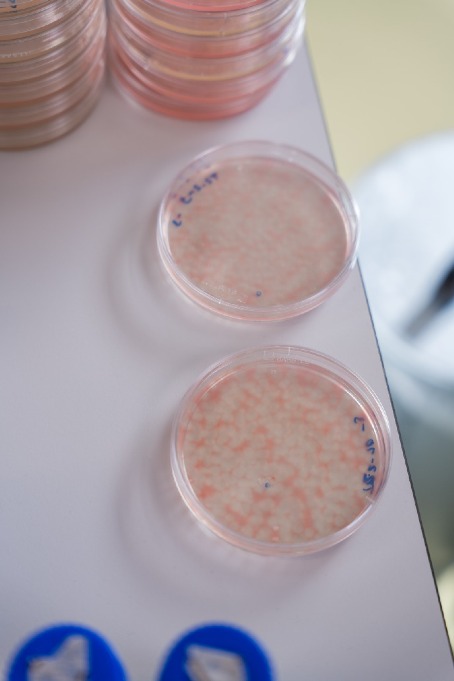
This is really pioneering work, Quax says: ‘Other researchers have grown various combinations of these symbiotic archaea, but not yet in combination with a virus.’ So far, it seems that the virus struggles when the host has a symbiotic relationship with these smaller archaea. ‘We think that the symbiosis changes the outside of the cell,’ Quax describes. Apparently, through this, the small archaea make their symbiotic partner better equipped against the infection.
Long-term infections and lunar landers with legs
What makes archaea-viruses interesting is that they come in all kinds of shapes, and that they sometimes treat their host a lot less destructively than ‘our’ viruses do. ‘We see archaea-viruses that are round or a bit lemon-shaped, that stay in the host long-term and even prevent it from getting infected by other, more destructive viruses. So that is quite favourable for the archaea. We would like to understand how this mechanism works.’
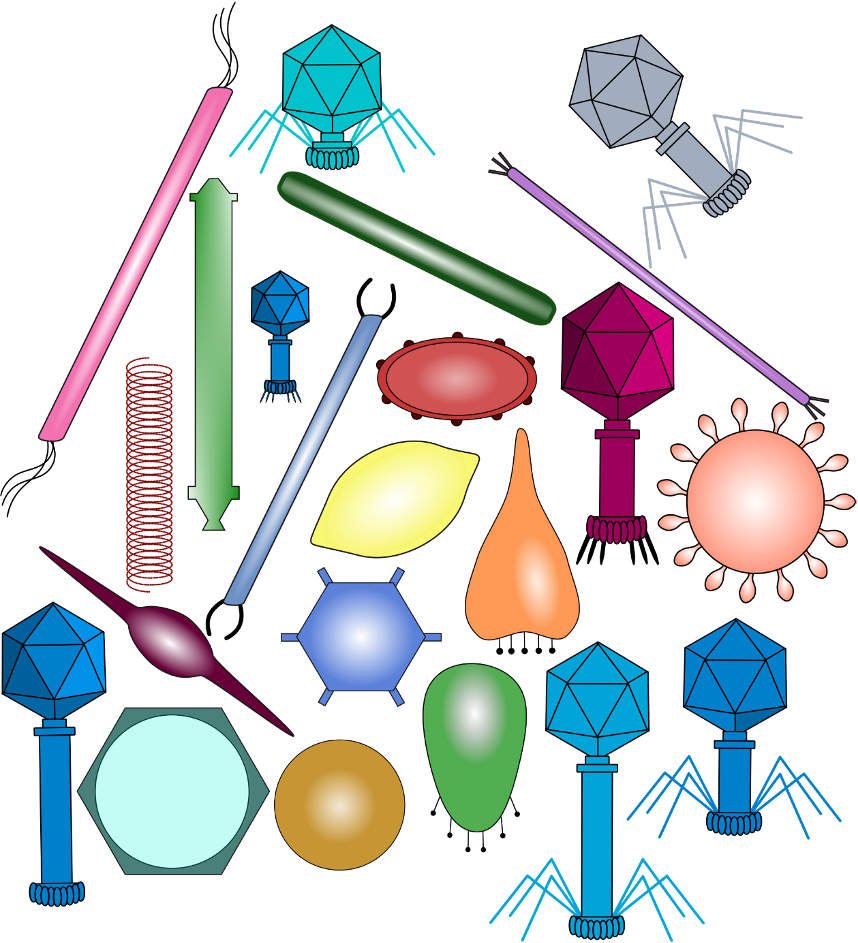
But there are also archaea viruses that do resemble ‘our’ viruses, or viruses that can infect bacteria. An example is the typical ‘lunar lander’-shaped bacterial viruses: a sphere with legs that can attach to the outside of a cell wall. Quax unravelled the exact structure and mechanisms of an archaea virus with such a lunar lander shape, taken from a salty lake in Senegal. The most important question was: how does a virus like this enter the cell, and how, after multiplying, does it leave?
‘These results tell us something about the evolution of viruses,’ Quax explains. Because even though the viruses target different organisms (archaea versus bacteria), they do resemble each other quite a lot. ‘That implies that the two viruses independently came to the same physical appearance. Or maybe they were already present when early life appeared on Earth? We do see that such an archaea lunar lander has sort of spikes at the top. Possibly, this is needed because an archaea-virus has a lower chance of running into a good host in the environments where it lives. With legs below and spikes above, the virus can latch on to a cell quickly and later reposition itself in the right position.’
More news
-
17 September 2026
NWO-KIC funding for new route to sustainable biocatalysts
-
15 September 2026
Enzymes break down textile fibres into useful resources
-
10 September 2026
Searching for the first generation of stars