
Rutherford, Ernest
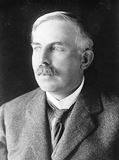
The New Zealander Ernest Rutherford, 1st Baron Rutherford of Nelson (1871 - 1937), son to a farmer and mechanic, was a physicist and chemist.
He discovered the radioactive element radon.
He introduced the concepts of radioactive half-life, and the differentiation and naming of alpha, beta and gamma radiation.
He postulated the hydrogen nucleus to be a new particle, which he dubbed proton.
He demonstrated the nuclear nature of atoms by measuring the deflection of alpha particles passing through a thin gold foil. He observed very high deflection angles, which was not expected according to any theory of matter at that time. As he would say:
It was almost as incredible as if you fired a 15-inch shell at a piece of tissue paper and it came back and hit you.
Rutherford's interpretation of the data led him to propose the nucleus, a very small, charged region containing much of the atom's mass. It replaced the plum pudding model devised by Joseph John Thomson, and resulted in the Bohr model which was the basis for the quantum mechanical atomic physics of Schrödinger and Heisenberg.
He lent his name to Rutherford scattering. The chemical element 104 rutherfordium (Rf) is named in his honour.