Skip to ContentSkip to Navigation
University of Groningenfounded in 1614  -  top 100 university
Education Bachelor's degree programmes International and European Law
Header image International and European Law

International and European Law

Our LLB programme in International and European Law is specifically designed for students who wish to pursue a professional career in an international legal environment.

All states have laws and their own legal system, and in most countries you can only study national law at the university level. Our LLB programme in International and European Law is specifically designed for students who wish to pursue a professional career in an international legal environment; it gives students an academic training in law without merely taking a national legal system as a starting point by offering students a general understanding of what 'law' is and how it functions in different legal contexts. The core aim is to give students an understanding of the content and functioning of international and European law in the context of its development, and also of its application in an international, public, private economic, or policy-making environment.

In year 2 you can choose to pursue a specialised track in Technology Law.

Please visit Faculty of Law webpages for full information on the programme here.

For Dutch-speaking students, please note this programme is different from the 'Internationaal en Europees Recht' track within the Rechtsgeleerdheid programme and does not offer civiel effect in the Netherlands.

Facts & Figures
Degree
LLB in International and European Law
Course type
Bachelor
Duration
36 months (180 EC)
Croho code
56829
Language of instruction
English
Start
September
Faculty
Law
Studie in Cijfers

Why study this programme in Groningen?

The programme provides an international pespective and does not focus on one national legal system. It offers both European law and public international law and, from year 2 onwards, also a possibility to choose a Technology Law track.

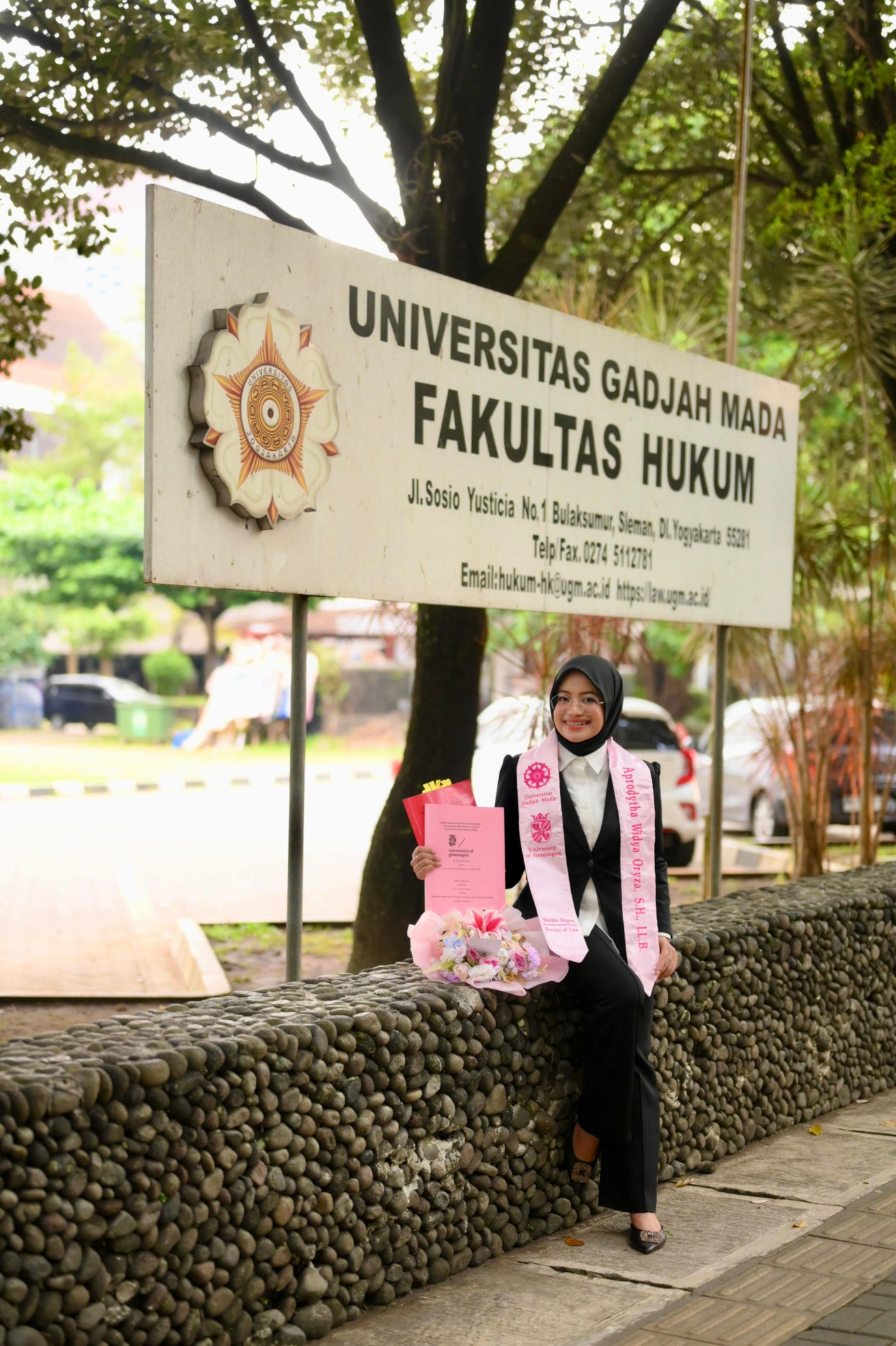
All students will go abroad for a full semester to one of the Faculty's partner institutions, which are located all over the globe. This programme also offers a dual degree with Universitas Gadjah Mada in Indonesia.
When completing the LLB programme, you will have access to all specialised English-taught LLM programmes the University of Groningen offers.

Please visit the webpages of this LLB programme for more information on the programme.

Programme

The programme touches upon all fields of law, starting with a general introduction into law in which the Dutch system is used as an example, an introduction into Legal English and research skills and in year 1 you will already be taught the basics of European law and public international law.

You can find the entire schedule of courses and the build-up of the programme on this page, including the description of all courses taught in the LLB programme.
Semesters
CoursesCourse Catalog >1a1b2a2b
Introduction to Legal English and Research Skills (5 EC)
Law and Legal Skills: the Dutch example (10 EC)
Criminal law (10 EC)
Legal History (5 EC)
Contract and Tort Law (5 EC)
Introduction to International and European Law (10 EC)
Comparative Constitutional Law (10 EC)
Introduction to Technology Law (5 EC)

In year 2 students pick a specialisation: either they continue with International and European Law or they choose to join the Technology Law track.

You can find the entire schedule of courses and the build-up of both tracks on this page , including the description of all courses taught in the LLB programme.
Semesters
CoursesCourse Catalog >1a1b2a2b
Law of the European Union (10 EC)
Property Law (5 EC)
Law, Power, and Politics (5 EC)
Public International Law (10 EC)
Administrative Law and Market Regulation (10 EC)
Research seminar (10 EC)
Markets and Regulation (5 EC)
Private International Business Law (5 EC)

All students spend the first semester of year 3 at one of our partner institutions, which are located all over the globe. When returning to Groningen in semester 2, they continue in their chosen track and write a Bachelor's thesis dealing with a topic of their choice within the scope of the programme.

You can find the entire schedule of courses and the build-up of both tracks on this page , including the description of all courses taught in the LLB programme.

If you are curious about the partner institutions of the Faculty of Law you can go to in year 3, please check our International Exchange Search Engine ( IESE ). For more information about the semester abroad, please check this page .
Semesters
CoursesCourse Catalog >1a1b2a2b
Semester abroad (30 EC)
Commercial Dispute Resolution (5 EC)
Competition Law in the Digital Market (5 EC)
Research Colloquium (10 EC)
European Judicial Protection (5 EC)
The Contemporary Value(s) of International Law (5 EC)

Study load

40 hours of class and self-study per week on average

The programme is only available in full-time mode.

Programme options
Honours College (honours program)

The Honours College offers talented and motivation students the opportunity to develop to a greater extent.

It entails participating in an extra (honours) programme of 30 ECTS next to students' regular 180 ECTS degree programme plus several other activities that will be undertaken and organized with honours students from other degree programmes.

Technology Law (graduation track)

The Technology Law track, together with the general legal knowledge in international and European law, covers a wide range of technology related legal topics.

The track is designed in light of the understanding that technology operates across jurisdictions and, as a result, regulatory responses have to occur at the interface between domestic, regional and international law.

Study abroad

  • Study abroad is required
  • For an average of 20 weeks

Every student goes abroad in the first semester of year 3.

The semester abroad, together with the Bachelor's thesis, is where you get to shape the programme to your preferences. The programme has no optional courses as such, but the semester abroad is free for you to fill with (law) courses. The only condition: you cannot have taken similar courses in Groningen already. Do check out the partners abroad to see if they have courses available of your interest.

Entry requirements

Admissible Dutch diploma profiles

  • VWO Natuur & Techniek
  • VWO Natuur & Gezondheid
  • VWO Economie & Maatschappij
  • VWO Cultuur & Maatschappij
  • HBO propedeuse

    International and European Law (Haagse Hogeschool)

  • academic propedeuse

Admission requirements

Specific requirementsMore information
previous education

You can find the previous education requirements here: https://www.rug.nl/rechten/education/international-programmes/llb/application/

language test

You can find the English language proficiency requirements, and situations where exemption may be considered, here: https://www.rug.nl/rechten/education/international-programmes/llb/application/

other admission requirements

The programme has a compulsory matching activity. If you are interested, the (online) matching activity will help you in deciding if our LLB programme is a good fit for you.

You can find more information about the matching here . Please make sure to click the English flag at the top. The Dutch information on this page is applicable to the 'Rechtsgeleerdheid' programme.

Choice of degree programme check

The degree programme will organize a matching procedure. Attendance is compulsory. The advice is not binding.

Registration procedure

Please make sure to apply in Studielink before 1 May and upload your documents before that time. You will also have to join the compulsory matching activity .


Selection procedure

In addition to meeting the admission requirements , students need to upload the necessary documents and join the compulsory matching activity .


Application deadlines

Type of studentDeadlineStart course
Dutch students01 May 202601 September 2026
01 May 202701 September 2027
EU/EEA students01 May 202601 September 2026
01 May 202701 September 2027
non-EU/EEA students01 May 202601 September 2026
01 May 202701 September 2027

Please make sure to have uploaded all your documents before 1 May.

Admission requirements

Specific requirementsMore information
previous education

You can find the previous education requirements here: https://www.rug.nl/rechten/education/international-programmes/llb/application/

language test

You can find the English language proficiency requirements, and situations where exemption may be considered, here: https://www.rug.nl/rechten/education/international-programmes/llb/application/

other admission requirements

The programme has a compulsory matching activity. If you are interested, the (online) matching activity will help you in deciding if our LLB programme is a good fit for you.

You can find more information about the matching here . Please make sure to click the English flag at the top. The Dutch information on this page is applicable to the 'Rechtsgeleerdheid' programme.

Registration procedure

Please make sure to apply in Studielink before 1 May and upload your documents before that time. You will also have to join the compulsory matching activity .


Selection procedure

In addition to meeting the admission requirements , students need to upload the necessary documents and join the compulsory matching activity .


Application deadlines

Type of studentDeadlineStart course
Dutch students01 May 202601 September 2026
01 May 202701 September 2027
EU/EEA students01 May 202601 September 2026
01 May 202701 September 2027
non-EU/EEA students01 May 202601 September 2026
01 May 202701 September 2027

Please make sure to have uploaded all your documents before 1 May.

Tuition fees

NationalityYearFeeProgramme form
EU/EEA2025-2026€ 2601full-time
non-EU/EEA2025-2026€ 13500full-time
EU/EEA2026-2027€ 2695full-time
non-EU/EEA2026-2027€ 14000full-time

Practical information for:

After your studies

Job prospects

The Faculty conducts an alumni survey regularly in which we check where the alumni of our programmes are currently working. If you are interested in the results, please check this page. It also gives you some information about the general job prospects of this LLB programme.

For Dutch-speaking students: this programme does not offer civiel effect in the Netherlands. Please see the' Internationaal en Europees Recht' track, which is part of the 'Rechtsgeleerdheid' programme.

Research

Research

The Faculty of Law conducts research in very many fields of law.

Almost all teaching staff have an appointment to both teach and do research. The Faculty's research is organised into several research programmes. In addition to this, the Faculty houses several Centres of Expertise.

All Faculty researchers are linked to or more of these programmes and/or centres and as a result, students will always hear the latest information with regard to academic research done in the area of their LLM.


Apply nowBrochureEventsContact
Web classesMore information
Bachelor's Open Daydiverse locatiesMore information

Study associations

Nexus

Nexus Student Association Groningen is the student association (studievereniging) for the LLB programme in International and European Law and related master programmes.
These programmes mainly consist of international students and, therefore, Nexus is very internationally orientated. Besides organizing activities to integrate internationals into Dutch culture, such as a political debate with local parties in English, Nexus also aims to provide members with the chance to obtain a social network, participate in the organization of guest lectures or informal activities, attend debating trainings, trips and workshops, all in a multicultural environment.
https://www.nexusstudentassociation.com/

DSLA

Decentralized Student Association (DSLA) is an association focused on curating and fostering the education and futures of students interested in Technology Law.
DSLA aims to connect law, computing science, and artificial intelligence students, therefore giving DSLA a cross-faculty element. DSLA is an internationally friendly association, and has a number of exciting tech-based events all year round including day excursions around the Netherlands, international trips, moot courts, pub quizzes, debates, monthly socials for our members, and more.
https://www.dslagroningen.org/

European Law Student's Association Groningen

ELSA Groningen is a Netherlands-based local group of the world's largest law student association. Serving more than 300 Dutch and international members, we help law students better integrate into our faculty and professionally develop into future lawyers or integrate into different legal pathways.
https://www.elsagroningen.org
Student profile

We are looking for students who are motivated to engage critically with (international and European) law. Our students are typically:

  • interested in what is going on in the world
  • keeping track of current events
  • socially committed
  • interested in law
  • willing to actively participate
  • keen to widen their knowledge
  • motivated to work in an international field
  • interested in history and social issues
  • able to transition to independence
(Binding) study advice
  • A minimum of 45 EC in the first 12 months (binding)

You will be offered study advice after the first year of study. You can expect a positive result if you have earned more than 45 ECTS credit points (out of a total of 60 ECTS). If you have earned fewer than 45 ECTS and are issued a negative result, you will not be allowed to continue with your degree programme.

You will receive preliminary study advice in December to make sure that you know where you stand. Please contact your study advisor as soon as possible if you have any questions about the BSA system. N.B. Some degree programmes use a tutoring system; please check with your study advisor.
Study support

To support you while studying, the Faculty ensures that the schedule is feasible, that mentors, lecturers, and the study advisers provide active study supervision, that exams are marked quickly and that lecturers and the study advisers are readily contactable. The programme includes a workshop Starting your Academic Career, in which you will be taught by a senior student, which aims to teach you good study behaviour right from the start of your degree.

The Faculty will offer a (compulsory) introduction session with all new students of the Faculty's English-taught programmes and induction sessions for you and your working group members. These are led by the study advisers.

The study advisers are available for all matters that might occur and will hinder your studying. These can be personal issues, unexpected circumstances, but also when you need some help in planning or time management. The study advisers will contact you every once in a while, but you are also more than welcome to join them during their office hours or to ask your question through email. If it looks like you will incur study delay, please contact the study adviser yourself. The study adviser can help you with your planning, and also advise you confidentially about study problems and/or personal problems.

If you are interested in making your social network at the start of your programme a bit bigger, the Faculty has a programme set up for this as well: the Buddy Network Law.
Related master's programmes