
Recycling and waste streams in the lab
While scientific research often leads to important breakthroughs, laboratory work also comes with environmental impacts, including high energy use, waste generation, and intensive resource consumption. Researchers at RUG are working to make lab practices more sustainable through practical measures and collaboration.
Barriers include established routines, safety regulations, and logistical complexity. By introducing innovations such as material reuse, more efficient resource use, and improved procedures, more sustainable lab environments are emerging, benefiting both research quality and the environment.
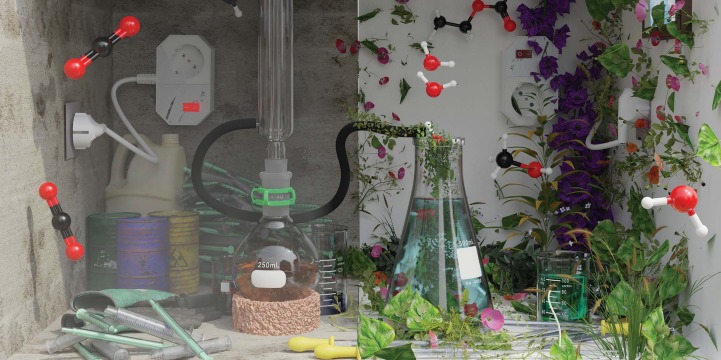
When science goes green
Laboratories are some of the most resource-intensive places within universities. Energy and water use, chemical waste, single-use materials and equipment replacement all have a negative environmental impact. How can behavioral interventions help scientists go greener?
A 2024 paper by University of Groningen scientist Thomas Freese and co-authors found that laboratories may account for as much as 60 to 65% of university energy consumption, and about 60% of water use.
UG launches first pilot for lab plastic monostreams recycling in the Netherlands
Until recently, like everywhere else, all laboratory plastic from the University of Groningen (UG) laboratories was incinerated after use. Because lab plastic is usually contaminated, it was therefore always considered unsafe for recycling, even after sterilisation.
The Green Labs group of the Faculty of Science and Engineering (FSE) and the Green Office have joined forces to solve this challenge, making the UG the first university in the Netherlands to recycle plastic monostreams.
Northern Consortium Care2Change: recycling and healthcare
A large consortium with just about all northern hospitals, local governments, knowledge institutions such as the University of Groningen and the Hanze university of Applied Sciences, and a number of healthcare companies, will cooperate in a project on sustainable healthcare, titled Care2Change.
As a collective, Care2Change promotes the conscious and economical use of healthcare products. This creates less waste. The consortium examines how all kinds of products can be reused that would otherwise be thrown away and how products that are thrown away can be recycled to raw materials that can be used in other applications.
Blog Oskar Roemeling (FEB): Decarbonizing Surgical Care
Decarbonizing Surgical Care: A Path Towards Sustainable Healthcare
Decarbonizing surgical care is both a challenge and an opportunity. Hospitals can lead by example, demonstrating that it is possible to reduce emissions without compromising patient care quality. Our study underscores the importance of a systemic approach—one that integrates organizational change with individual responsibility. As we strive to meet climate targets, the healthcare sector has the potential to not only heal individuals but also contribute to the health of our planet.
University of Groningen frontrunner in green labs movement
Although scientific research often leads to important breakthroughs and insights, laboratory research also involves unintended negative environmental impact, such as high energy consumption, the production of hazardous waste, and the use of resources.
In the Royal Society of Chemistry Sustainability Journal, Nobel prize winner Ben Feringa and his colleagues share a perspective article with a comprehensive literature review and a case study at the University of Groningen over the past years. The article was written with the intention to enhance lab sustainability and offer advice for other researchers worldwide looking to do the same. The publication advocates for leadership and systemic change in laboratory practices and research approaches.
Read more about Feringas article and examples of sustainablity in the lab