
Influencing autonomous robots for a wide range of applications
From tailor-made shaving tools to personalized healthcare: the potential of autonomous robots, especially when they work in teams, is huge. How do we control the decisions these complex systems make so that they can operate safely and efficiently? Professor of Networks and Robotics, Ming Cao (Faculty of Science and Engineering), and his team are working hard to find out.
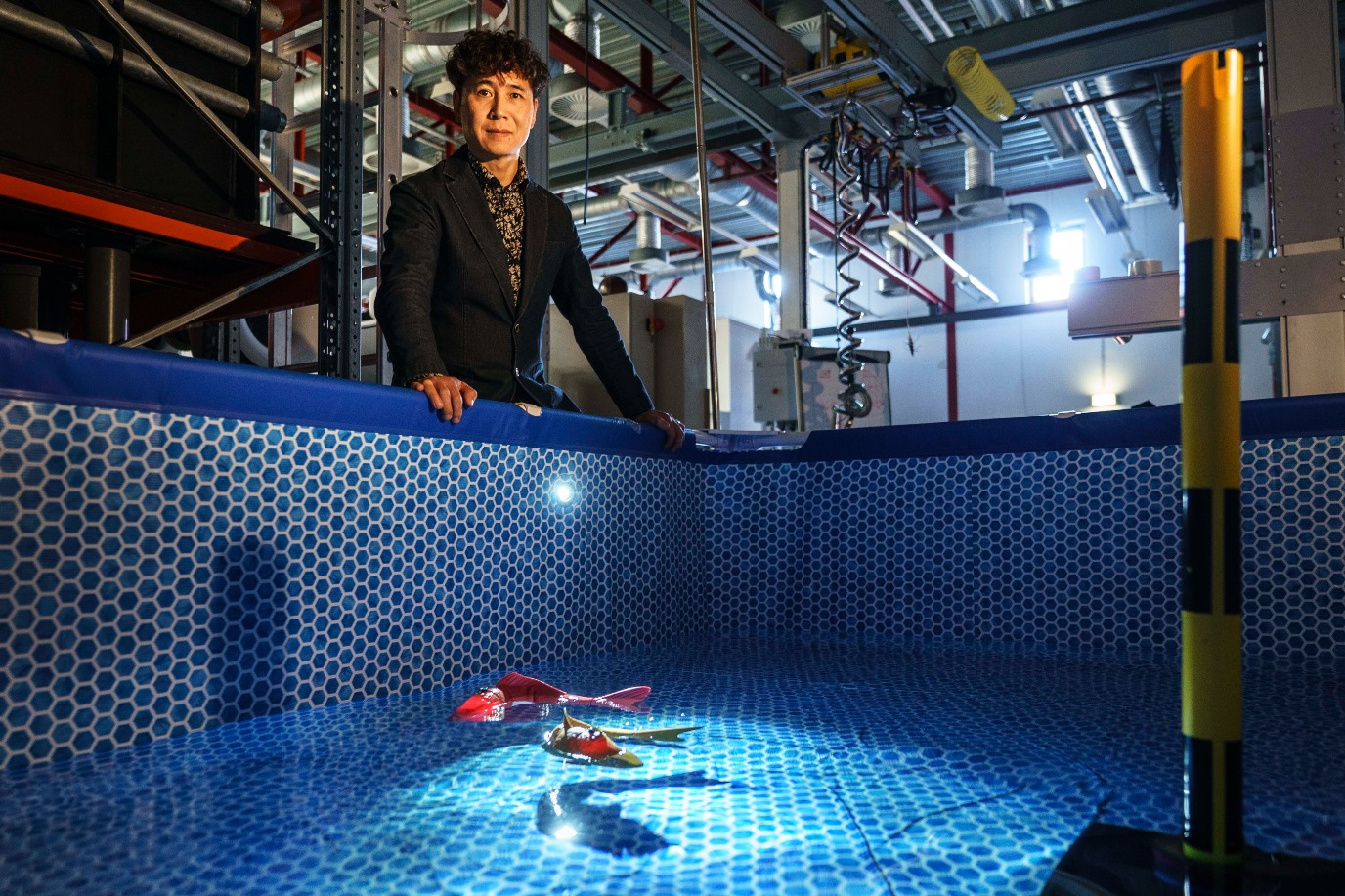


What are autonomous robots? Cao explains: ‘As opposed to machines that need to be operated by humans to do their task, autonomous robots can operate without human intervention. They can make their own decisions within a specific context by using data collected by sensors. Especially when these robots operate in teams, there are lots of possible applications.’
With an increasing demand for these applications, more than ever it is important to be able to influence the decisions autonomous robots make. Cao elaborates: ‘These robots operate in a specific context. If, for example, you have a team of autonomous robots cooperating in a car factory and they usually do not work around humans, any human who comes close to them could create a safety hazard. In these situations, we need to make sure that the robots recognize humans and decide to stop operating, for example.’
Safety is an important concern. But being able to influence how the robots make decisions within different contexts also comes with a lot of potential. One example that Cao offers is that of razors. These are currently mass-produced, with customers choosing what suits them best. However, according to Cao, in the future, it will be possible to have robot teams building completely personalized razors based upon someone’s facial features. For this, the robots need to be able to constantly make decisions based on new information, and they need to be able to cooperate according to this. Cao and his team are working on the programming that could make these and other applications, such as personalized healthcare, possible.
Biology offers inspiration to Cao and his research: ‘Though it is difficult to replicate on an engineering level, the way fish swim in schools and simultaneously react and collaborate to mislead intruders is a great example of how I want teams of autonomous robots to operate. I am still looking into how we can use the knowledge we have about fish for our programming purposes, but it still provides a great example of the work that we do to the outside world. And robot fish can potentially work as mobile sensors in seaports, canals and water pipelines, for example to detect leaks. This is a new direction we are looking at.’
Text: Corporate Communication | Thomas Vos
Photos: Reyer Boxem
Every two weeks, UG Makers puts the spotlight on a researcher who has created something tangible, ranging from homemade measuring equipment for academic research to small or larger products that can change our daily lives. This is how UG researchers contribute solutions to the big scientific and societal challenges. Previous portraits for Makers can be found on the overview page.
For decades, engineering teaching and research at the UG has been part of a wide array of strong disciplines, and from a national point of view, our collaboration with the four technical universities is becoming increasingly intensive.
More information
More news
-
17 September 2026
NWO-KIC funding for new route to sustainable biocatalysts
-
15 September 2026
Enzymes break down textile fibres into useful resources
-
10 September 2026
Searching for the first generation of stars