
God Bless America, How Religious Language Shapes United States Politics
Christian language in White House press conferences, prayer in the Pentagon, the president saying God watches over American soldiers in the war against Iran. While doing historical research for my bachelor’s thesis in Religious Studies on Native American Pueblo tribes, I discovered using the ‘right’ religious language was as powerful a 100 years ago as it is now.
Many speeches of American presidents end with ‘God bless America’ or a variation of this since President Richard Nixon first used it in 1973 (Domke & Coe, 2008). But religious language already played an important role in American politics more than a 100 years ago, when the Native American Pueblo Dance Controversy was a hot topic in the state of New Mexico.
The Pueblo Dance Controversy
In the 1920s, influential Protestants believed Native American ceremonial dances were uncivilised, sexual immoral and degrading to women (Wenger, 2009). They convinced the Bureau of Indian Affairs, a federal government agency responsible for Native American policy, that these dances were un-Christian and therefore should be forbidden. In 1923 this Bureau of Indian Affairs banned all Native American dance ceremonies, and enforced violations with corrective penalties.
However, the Pueblo tribes in New Mexico did not accept this. Pueblo tribal leaders worked together with Catholic missionaries to reverse the ban on their ancient traditional ceremonies. They had some unexpected allies; local business owners who were concerned that the dance ban would affect tourism, and a group called ‘new feminists’ who saw the ceremonial dances as progress towards women’s expression of sexual desire (Jacobs, 1996). Together they made a case that the Pueblo ceremonial dances were not un-Christian at all, they even argued that the dances were very much like Christian worship. And they succeeded.
Catholics and the Pueblo tribes
During the seventeenth and eighteenth centuries, under Spanish colonial rule, most Pueblo tribes were converted to Catholicism. According to historian of American Religion Tisa Wenger, for the Pueblo the word religión meant Catholicism, while their own indigenous communal ceremonies were called costumbres, or customs. The word ‘religion’ does not even exist in Native American languages. The Catholic missionaries in New Mexico saw no threat in these customs. They believed that over time the Pueblos would deepen their Catholic commitment and their ceremonies would naturally disappear. But instead, indigenous and Catholic rituals gradually mixed.
Later, in the early 20th century the United States grew more Protestant and more anti-Catholic. The Protestants had the majority in political power, and the Catholics very much wanted the Native American Pueblo to remain part of their community. So, claiming the Pueblo dances as public expressions of Catholic faith and prayer was not only in the interest of the Pueblo tribes, but in the interest of the Catholic community too.
Using the ‘right’ religious language
The alliance of Pueblo tribal leaders, Catholic missionaries, feminists and business owners successfully argued the Pueblo customs were comparable with Christian worship. By using Christian language such as ‘God’, ‘prayer’ and ‘worship', they demanded protection under religious freedom in the American constitution. They translated the customs of the Pueblo minority to the religious language of the majority in power. By doing so, the ceremonies became something Christians were familiar with and understood (Martínez-Ariño & Griera, 2020). It made the Pueblo dance ceremonies acceptable for them. Today, many Protestants in the United States still reject the compatibility of the dance ceremonies with Christianity, while many Catholics embrace them as part of Native American Catholicism (Wenger, 2009).
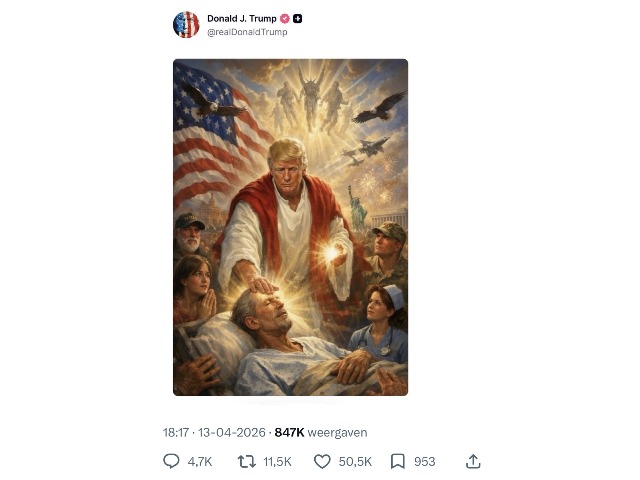
Language influences how political decisions are understood and accepted by the public, especially when it is language familiar to a country’s religious majority. In United States’ politics the language of the Christian majority is still very present. How can your war be other than just when God is on your side? And seeing your president depicted as the saviour of your country, in religious images you are familiar with, might make him more relatable and instantly recognisable in that role.
Religious language can be a powerful tool that supports a story depending on how it is used. The Pueblos used it to preserve their ancient traditions. What story the current US administration is trying to tell the public by using Christian language and images is still up for debate. That might be an interesting research topic for future historians.
Sandra Boerema-van Meel is a BA student in Religious Studies at our faculty.
Read more on the topic?
-
Domke, D., & Coe, K. (2008). The God Strategy: How Religion Became a Political Weapon in America. Oxford University Press.
-
Jacobs, M.D. (1996). Making Savages of Us All: White Women, Pueblo Indians, and the Controversy over Indian Dances in the 1920s. Frontiers: A Journal of Women Studies, Vol. 17(No. 3), 178–209.
-
Martínez-Ariño, J., & Griera, M. (2020). Adapter la religion: Négocier les limites de la religion minoritaire dans les espaces urbains. Social Compass, 67(2), 221–237.
-
Wenger, T. (2009). We Have a Religion: The 1920s Pueblo Indian Dance Controversy and American Religious Freedom. University of North Carolina Press.