
Skip to ContentSkip to Navigation
University of Groningenfounded in 1614  -  top 100 university
Education Master's and PhD degree programmes Linguistics - Research Natural Language Processing - Research
Header image Natural Language Processing

Natural Language Processing

How do you build Large Language Models? How do humans experience Natural Language Processing (NLP) applications in their daily lives? And how can we design language technologies that are transparent, trustworthy, and capable of capturing nuance—whether it is subjective framing, subtle translation errors, or emerging forms of misinformation?

Natural Language Processing is at the core of today's digital world. Machine Translation supports multilingual communication, conversational agents and advanced search systems help us navigate information, and generative AI assists with tasks ranging from creative writing to data analysis. Research in NLP is essential for making these technologies more accurate, responsible, and aligned with human needs.

Our two-year Research Master in Natural Language Processing offers rigorous, interdisciplinary training that integrates Linguistics and Computer Science. You will gain strong technical skills in machine learning, language modelling, text processing, and computational semantics, together with a deep understanding of human language, linguistic theory, and experimental research methods. The programme prepares you to contribute to cutting-edge research in academia or industry, and to critically evaluate the social and ethical impact of NLP technologies.

It is also possible to combine the study of the regular programme with the Information Science master.
Facts & Figures
Degree
MA/MSc in Linguistics (research)
Course type
Research master
Duration
24 months (120 EC)
Croho code
60817
Language of instruction
English
Start
Faculty
Arts

Why study this programme in Groningen?

  • Join one of Europe's leading centres for Natural Language Processing. The Computational Linguistics group within the Center for Language and Cognition Groningen (CLCG) is internationally recognized with strong and regular presence at major CL and AI conferences.
  • Study in a programme that covers the full breadth of NLP. Research topics include grammar engineering, computational semantics, machine translation, dialogue modelling, social-media analysis, information extraction, and digital-humanities applications, giving you broad exposure and flexibility.

  • Benefit from intensive, personalized supervision. The Research Master offers small-group teaching, close mentoring from experts, and a strong focus on developing advanced research skills in computational methods, corpus analysis, and experimental design.

  • Work within a vibrant, international, multidisciplinary environment. The programme brings together linguistics, computer science, and cognitive science, and is embedded in an active research community that encourages collaboration across domains.

  • Experience life in one of Europe's most student-friendly cities. Groningen is known for its lively academic atmosphere, high student population, and supportive community, offering an ideal environment for focused study and personal growth.

Programme

Semesters
CoursesCourse Catalog >1a1b2a2b
Advanced Machine Learning (FSE) (5 EC, optional)
Language Models and Applications (10 EC)
Linguistic Analysis (10 EC)
Research Training (5 EC, optional)
Societal Aspect of NLP (5 EC)
Advanced Topics in NLP (5 EC)
Corpus Linguistics (5 EC)
Language Brain and Cognition (10 EC)
Research Training (5 EC)
Language Technology Project (5 EC)
Semesters
CoursesCourse Catalog >1a1b2a2b
Semantic Web Technology (5 EC)
Research Seminar (5 EC)
Research Training (or Internship) (10 EC)
Computational Semantics (5 EC)
Deep Learning (FSE) (5 EC, optional)
LOT Winter / Summer School (5 EC, optional)
Thesis
Programme options
Master's placement (specialization)

During this Master's track, you can follow a placement for 10 ECTS credit points.

It is your responsibility to find a placement yourself, but the Mobility Office can offer help with this where necessary. Click the link above to find examples of placements completed by other Master's students.

Study abroad

  • Study abroad is required

Students in the local programme can participate in regular Erasmus exchanges.

Entry requirements

Admission requirements

Specific requirementsMore information
previous education

Prospective students with a Bachelor's degree in Linguistics or another relevant Bachelor's degree are admissible to this master's track. Examples of these types of Bachelor's programmes are:

  • Computer Science
  • (Computational) Linguistics
  • Artificial Intelligence
  • Digital Humanities
  • Language Technologies
  • Cognitive Science
  • Mathematics, or relevant disciplines

Students are also admissible if they have completed a pre-master in Information Science or taken the Information Science minor at University of Groningen.

Proven coding skills and (basic) knowledge of machine learning are essential requirements.

grade list

An excellent academic record: An overview of the results achieved so far within the Bachelor's degree programme and/or other university degree programmes is required.

Curriculum Vitae (CV)

A Curriculum Vitae (CV)

language test

Additional English language requirement: A VWO diploma or a subject certificate for VWO English (mark 6 or higher), minimum requirement of TOEFL iBT 100 (with a minimum score for speaking and writing of 25 (each)), or an IELTS score of 7 (with a minimum of 6.5 on all items).

reference letter

Names and contact of two referees.

(motivation-) letter

A letter outlining the prospective student's motivation for selecting the programme and Research Master's track, including their expectations and interests.

other admission requirements

Admission to the local programme is carried out by the Admissions Office and the Admission Board.

Students who have not yet completed their Bachelor can be given provisional admission.

Transfer options

Transferring from...

Study programmeOrganizationTransition
Cognitive Science and Artificial IntelligenceAll Research universities

Additional requirements

More information:

Please note that this programme has a selection procedure.

Artificial IntelligenceAll Research universities

Additional requirements

More information:

Please note that this programme has a selection procedure.

Computing ScienceAll Research universities

Additional requirements

More information:

Please note that this programme has a selection procedure.

Artificial IntelligenceAll Research universities

Additional requirements

More information:

Please note that this programme has a selection procedure.

Information ScienceAll Research universities

Additional requirements

More information:

Please note that this programme has a selection procedure.

LinguisticsAll Research universities

Additional requirements

More information:

Please note that this programme has a selection procedure.

Computer ScienceAll Research universities

Additional requirements

More information:

Please note that this programme has a selection procedure.

Data Science and Artificial IntelligenceAll Research universities

Additional requirements

More information:

Please note that this programme has a selection procedure.

Registration procedure

Note: it's not possible to start in February. For more information, please contact the study advisor.

The application deadline for both EU and non-EU students is 28 February 2025, if you wish to start the programme on 1 September 2025. You can apply for the track Natural Language Processing through the Language and Communication Technologies webpage.

Admission requirements

Specific requirementsMore information
previous education

Prospective students with a Bachelor's degree in Linguistics or another relevant Bachelor's degree are admissible to this master's track. Examples of these types of Bachelor's programmes are:

  • Computer Science
  • (Computational) Linguistics
  • Artificial Intelligence
  • Digital Humanities
  • Language Technologies
  • Cognitive Science
  • Mathematics, or relevant disciplines

Students are also admissible if they have completed a pre-master in Information Science or taken the Information Science minor at University of Groningen.

Proven coding skills and (basic) knowledge of machine learning are essential requirements.

grade list

Excellent academic record, with a grade of 8.0 or higher on the thesis written for the B.A. or previous M.A. degree.

Curriculum Vitae (CV)

A Curriculum Vitae (CV)

language test

Additional English language requirement: A VWO diploma or a subject certificate for VWO English (mark 6 or higher), minimum requirement of TOEFL iBT 100 (with a minimum score for speaking and writing of 25 (each)), or an IELTS score of 7 (with a minimum of 6.5 on all items).

reference letter

Names and contact of two referees.

(motivation-) letter

A letter outlining the prospective student's motivation for selecting the programme and Research Master's track, including their expectations and interests.

other admission requirements

Admission to the local programme is carried out by the Admissions Office and the Admission Board.

Students who have not yet completed their Bachelor can be given provisional admission.

Registration procedure

Note: it's not possible to start in February. For more information, please contact the study advisor.

The application deadline for both EU and non-EU students is 28 February 2025, if you wish to start the programme on 1 September 2025. You can apply for the track Natural Language Processing through the Language and Communication Technologies webpage.

Tuition fees

  • EER-students: €2695 per year
  • Non-EER students: €19900 per year

Practical information for:

After your studies

Job prospects

After graduation, you are well prepared for a career in Information Technology. You can work on subjects such as machine translation, knowledge and data engineering, expert in Large Language Models and Explainable AI, human-computer dialogue systems, machine learning engineer, computational linguist, among others.

You can also continue your career in research, for instance as a PhD student at a university.

Job examples

  • Data Linguist
  • Computational Linguist
  • Knowledge engineer
  • Data Manager
  • Software engineer
  • Data Analyst/ Data Scientist
  • Language engineer

Research


At the University of Groningen, Computational Linguistics research places the human factor at the centre. Researchers investigate how people experience NLP applications, how language technologies influence perception and communication, and how we can reveal and mitigate the biases and subjectivities embedded in modern language models. This focus guides work on detecting mistranslations, analysing framing in news and social media, and developing more transparent and trustworthy Large Language Models.

We host several pioneering projects that embody this vision. The INCREC project examines the creative process of professional translators to better align NLP tools with literary and audiovisual translation. Framing Events in the Dutch Language explores how linguistic choices shape interpretations of news events, including award-winning research on gender-based violence narratives. The GOLEM project investigates how readers engage with stories, shedding light on what makes narratives compelling. InDeep, a broad interdisciplinary initiative, develops interpretability methods for text, speech, and music, aiming to make large models more accountable. The Polyglot Machines project advances language modelling for low-resource, morphologically rich languages, drawing inspiration from child language acquisition.

This research thrives in a strongly interdisciplinary environment building bridges between NLP and foundational language theory. Courses in computational semantics, language processing, and cognitive modelling provide students with hands-on experience in formal methods and experimental techniques such as eye-tracking. Groningen has also a long tradition of developing and maintaining tools and datasets, such as the Alpino parser, BERTje, the first LLMs for Dutch, HateBERT, one of the most adopted LLM for hate speech detection in English, and the Parallel Meaning Bank, a resource for deep semantic interpretation of texts. Together, these efforts make Groningen a uniquely rich environment for studying NLP: one that combines advanced computational techniques with deep linguistic insight, a strong interdisciplinary culture, and a commitment to understanding, and improving, the relationship between language technology, society, and the human experience.
Apply nowBrochureEventsContact

Contact

  • Ask Your Question Here (please fill in this contact form, we will answer you as soon as possible.)
  • PhD Tommaso Caselli, (Coordinator)
    Email: emlct rug.nl
  • Caroline Dijkema (Study Advisor)
    Email: rema.linguistics.advice rug.nl

I look forward to collaborating with others and contributing to projects that advance NLP technology

I'm Anna Smirnova, and I recently completed my first year of the Master's programme in Natural Language Processing at the University of Groningen. Moving to the Netherlands for my studies was an exciting milestone — it's the first country I've lived in outside my home country, and I absolutely enjoyed the experience. I'm fluent in Russian and English, have some basic knowledge of French, and I am currently learning Dutch.

With a background in Computational Linguistics and some experience in the NLP field, I wanted to dive deeper into its mathematical side, improve my computer science skills, and connect with others who are passionate about NLP and machine learning. When I applied for the Master’s programme, I already knew some people who had completed it, and everything—from the courses to life in the city—felt like the right choice.

Flexible course options
Thanks to the flexible course options, I took classes at both the Faculty of Arts and the Faculty of Science and Engineering, gaining hands-on research experience in different areas of NLP and Computer Science. Along the way, I worked with many enthusiastic professors and students, which made the experience even more rewarding.
I am eager to continue my research journey in Natural Language Processing, whether in academia or industry, with a focus on research. I’m particularly interested in working on real-world problems, developing new solutions, and expanding my knowledge in the field. I look forward to collaborating with others and contributing to projects that advance NLP technology.

Tips
The university and the city offer plenty of opportunities for both personal and professional growth, as well as entertainment. Since NLP is a research Master’s programme, consider working on personal projects or participating in competitions to enhance your skills. Be sure to explore course catalogs, join student group chats, and check out festival and city event calendars. You’ll find many interesting and enthusiastic people who are often ready to welcome and support you.

Student Anna Smirnova

'I gained a lot of experience and confidence in designing and implementing my own research projects'

Hi! I'm Maria Francis, and I spent the first year of my Master's degree in Language and Communication Technologies in Groningen, with NLP as my local host programme. I grew up in Germany, and I speak English and German, plus some Japanese, Dutch, and Italian.
The opportunity to study language from different perspectives
Since high school, I’ve always been interested in language. On one hand, I’m interested in language in an analytical sense - the structure of language and the different ways it can encode meaning. On the other hand, language is primarily a tool for communication, and I find the relation between language, culture, and the ways of life of individuals a beautiful thing to study. In Natural Language Processing, you’ll have the opportunity to study language from these perspectives and more, and you’ll gain experience using this knowledge to solve real problems using machine learning and artificial intelligence. Of course, a Master’s degree in NLP opens doors to a broad range of opportunities, be it in academia or in the industry.

Community feeling
I absolutely loved my year in Groningen. During my courses, I developed a unique and well-rounded perspective on current NLP research by taking in syntax, semantics, cognitive psychology, artificial intelligence, natural language processing, and more. Most courses ended with a practical project, and I gained a lot of experience and confidence in designing and implementing my own research projects. What really stood out to me was the community feeling among the NLP group. The researchers at Groningen are a welcoming, friendly, happy, and open group of people, and you’ll quickly feel at home among them!

Besides studies, Groningen itself is a very charming town with an active student life. There are plenty of events such as live music, open mic nights, and Erasmus get togethers. If you’re the sporty type, you’ll never run out of things to do. You can either go to ACLO and take part in pretty much any sport you can imagine, or you can hop on your bike and take a ride through the gorgeous Dutch countryside.

Tips
The Groningen NLP faculty gives you plenty of opportunities to learn outside of class. Put yourself on the mailing list for NLP-related events and attend the weekly seminars, panel sessions, attend PhD parties, and get to know people!

Student Maria Francis

This Master's programme played a major role in preparing me for a PhD

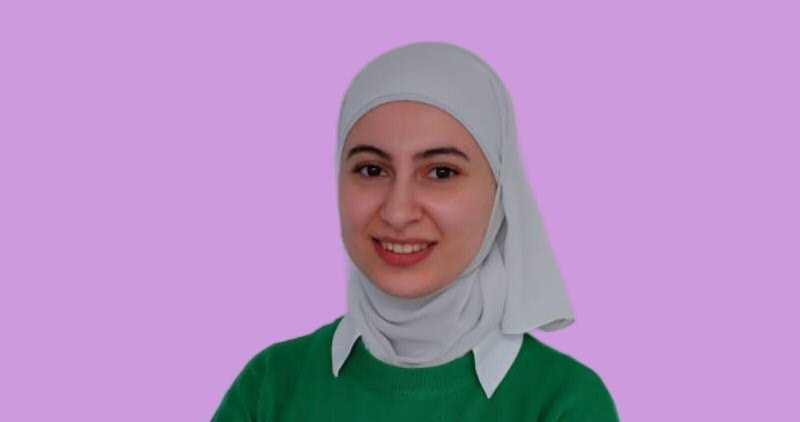
My name is Sara Nabhani, and I'm from Palestine. I studied Computer Science for my Bachelor's degree, where I developed a strong interest in big data and machine learning. Over time, I became particularly drawn to Natural Language Processing (NLP) and its role in bridging human communication with artificial intelligence.

After working as a Data Scientist for three years, mainly on NLP-related projects, I realized how fast the field was evolving and how important research skills were for keeping up with advancements. This motivated me to pursue a Master’s in NLP, which led me to the Natural Language Processing programme of the UG.

The NLP Master’s programme provided me with a strong foundation in both research and practical skills, making me well-prepared for both industry and academia. One of the key strengths of the programme is its research-oriented approach. I learned how to conduct independent research, write academic papers, and effectively communicate my findings—all of which are valuable skills not only in academia but also in industry. At the same time, the programme didn’t just focus on theory; it also emphasized real-world applications. I gained hands-on experience working with NLP frameworks, machine learning models, and large-scale datasets.

A major advantage of the NLP programme is its dual-university structure. Studying at two universities gave me exposure to different teaching styles, research methodologies, and areas of specialization within NLP. It also meant graduating with a double degree, which is a significant advantage in the job market.
I am currently a PhD student at the University of Groningen, specializing in Computational Linguistics. Looking back, I can say that the NLP Master’s programme played a major role in preparing me for this PhD. It gave me the research foundation, technical expertise, and professional connections that made the transition into academia seamless. If I could give some advice to current NLP students, it would be to fully embrace the experience—both academically and personally. This programme offers so many opportunities, and making the most of them will truly shape your journey.

NL Scholarships

The University of Groningen offers NL Scholarships to international students from outside the European Economic Area (EEA) who want to do their master’s in the Netherlands. Read more on the NL Scholarships and on how to apply.

Master's degree programme in Linguistics

The Faculty of Arts also offers one year master’s degree programmes in Linguistics and Information Science.

Study associations

ZaZa

Study association ZaZa is the study association for the study Dutch Language and Culture and Linguistics at the University of Groningen.
As a study association for Dutch Language and Culture and Linguistics, naming the association after our beloved alphabet seemed a perfect fit. After all, what are language and literature without letters? Take the first and the last letter of our alphabet, double them, add a touch of creativity and there it is, our name ZaZa. The goal of ZaZa is to unite students with a passion for the Dutch language/literature and linguistics by organizing both events related and unrelated to our studies. That goal is pursued with the help of eleven active committees, two lustrum committees and two advisory committees.
http://www.zaza-nederlands.nl
Study support

Each Master's degree programme has a study advisor whom you can contact if you have questions or need advice about your degree programme and other study-related matters. Everything you discuss will be treated confidentially. If you have a more complex problem, for example study delay, a performance disability or if you are ill for a long time, you should contact a student counsellor.

In addition, you can also follow various courses at the Study Support section of the Student Service Centre (SSC), for example on study stress and holding presentations.