
Röntgen, Wilhelm Conrad
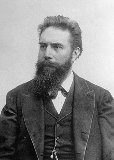
The German Wilhelm Conrad Röntgen (1845 - 1923), son to a merchant and cloth manufacturer, was an experimental physicist.
In 1895, he was investigating the external effects of passing an electric discharge through various types of vacuum tube equipment. He knew that the cardboard covering prevented light from escaping, yet he observed a fluorescent effect on a cardboard screen painted with barium platinocyanide. Based on the formation of regular shadows, he termed the phenomenon X-rays, using the mathematical designation "X" for something unknown.
Maria Salomea Skłodowska and her husband, Pierre Curie, taken by the X-ray work and hearing of Becquerel's findings about radioactivity, came to the recognition that the radiation was generated at the atomic level.
He lent his name to X-radiation and the röntgen, the unit of exposure. The chemical element 111 röntgenium (Rg) is named in his honour.