
Societal impact
From Paper to Practice
CDLT develops pilots, tools, and programs that directly contribute to sustainable change in the field.
Our approach:
• Developing practical toolkits for biodiversity and farm profitability
• Running pilots with farmers, supply chain partners, and policymakers
• Acceleration programs for knowledge sharing and implementation
ReGeNL
The Center for Sustainable Agricultural Transition (CDLT) is participating in the ReGeNL program as part of the ReGeNL consortium. This is a transition and research project within the NGF’s Agriculture and Living Environment program, which is funded by the National Growth Fund (NGF). ReGeNL is committed to a vital Dutch agricultural sector by striving for regenerative, profitable, and socially supported agriculture. The guiding principles here are that agriculture must go hand in hand with soil improvement and the restoration of soil life and nature, while the added value per hectare must also grow significantly. ReGeNL’s activities are divided into five action lines and three perspectives. The CDLT is responsible for Action Line 2: Transition Pathways, which supports 1,000 farmers in their transition to regenerative agriculture. Read more about Action Line 2 here.
ReGeNL products
Inspiration Sheet: Inspiration Sheet: Dung separation
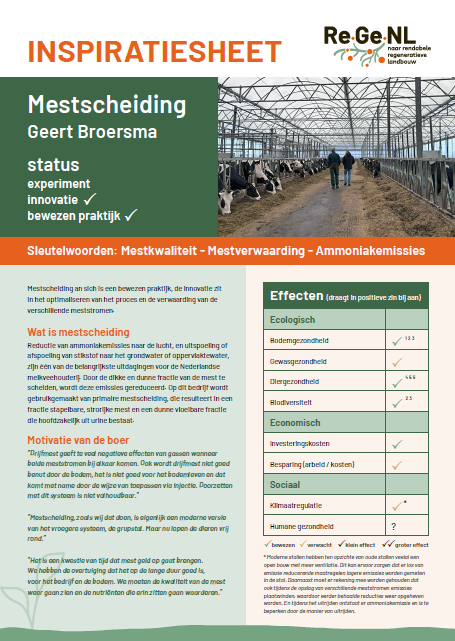
In collaboration with Van Hall Larenstein and Hanze University of Applied Sciences, the Center for Sustainable Agricultural Transition is developing inspiration sheets related to the sustainable agricultural transition.
At Geert Broersma’s dairy farm, primary manure separation is used, resulting in a fraction of stackable, straw-rich manure and a thin liquid fraction consisting mainly of urine. Manure separation is a proven practice; the innovation lies in optimizing the process and adding value to the various manure streams.
The inspiration sheet discusses the farmer’s motivation, the application on the farm, effects on farm management, financial aspects, challenges, and the conclusions drawn so far.
Inspiration Sheet: Practical Measurement Methods for Soil, Manure, and Plants
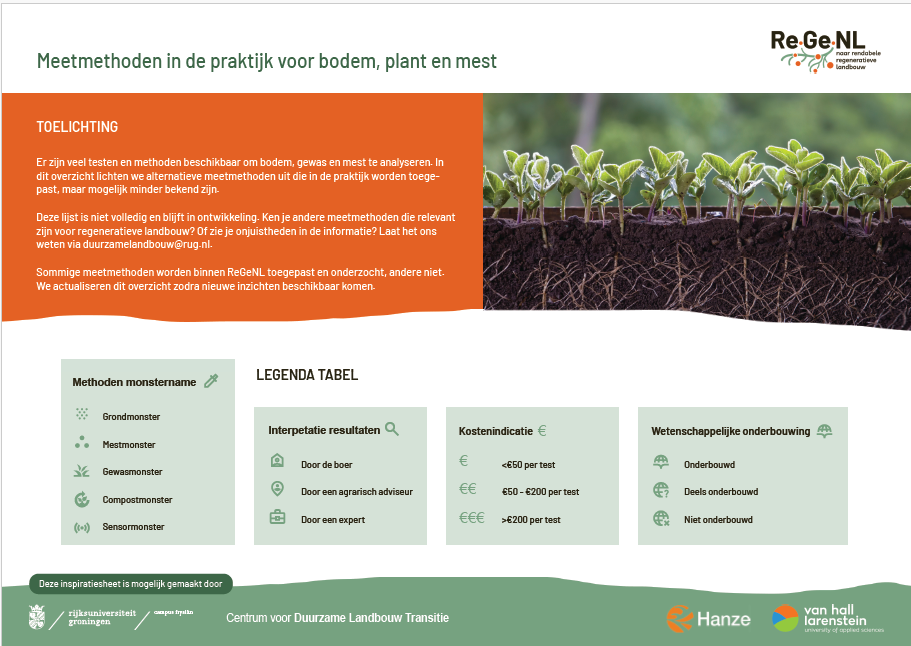
In collaboration with Van Hall Larenstein and Hanze University of Applied Sciences, the Center for Sustainable Agricultural Transition is developing inspiration sheets related to the sustainable agricultural transition.
There are many tests and methods available for analyzing soil, crops, and manure. In this overview, we highlight alternative measurement methods that are used in practice but may be less well known. This list is not exhaustive and is constantly evolving. Do you know of other measurement methods relevant to regenerative agriculture? Or do you see any inaccuracies in the information? Please let us know at duurzamelandbouw@rug.nl. Some measurement methods are being applied and researched within ReGeNL, while others are not. We will update this overview as soon as new insights become available.
Information Brochure for Participants Starting in 2026
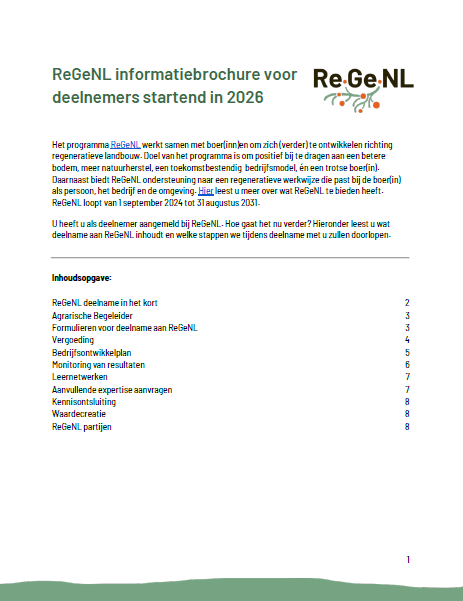
Participants who have registered with ReGeNL will receive an information brochure after registering. What happens next? In the information brochure, participants can read about what participation in ReGeNL entails and the steps they will go through during their participation.
Infographic: Timeline of Participants in Action Line 2
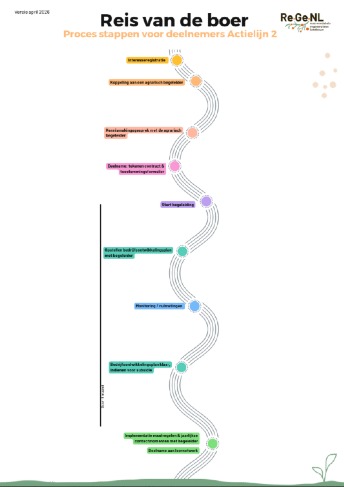
Farmers interested in participating in the ReGeNL program can express their interest by registering. The CDLT will then match them with a suitable agricultural advisor based on their subsector, location, and personal preferences.
After this matching process, an introductory meeting takes place between the farmer and the advisor, following which they conduct a quick assessment of the farm together. The farmer then signs a participation contract and a consent form authorizing the collection and processing of data—partly for scientific purposes, but also to ensure the program is well organized.
Once the contract is signed, the mentoring process begins. Under the guidance of the agricultural advisor, the farmer draws up a farm development plan (FDP), which outlines the planned measures. The FDPs are first reviewed by an agricultural advisor and then assessed by the project team. Upon approval, the farmer becomes eligible for a subsidy. The farm uses a baseline measurement as the starting point for monitoring.
During the implementation of the measures, the farmer is supported through regular meetings with the advisor and by participating in a learning network with other participating farmers.
Quickscan
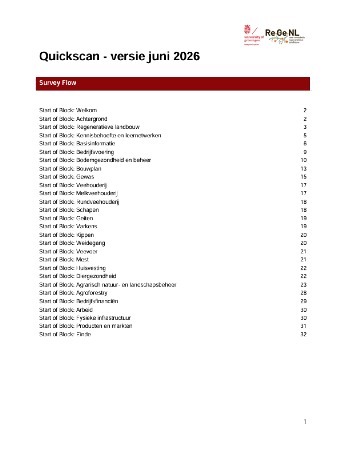
Please note: The product shown on this page is a draft version developed by the CDLT as part of Action Line 2 (Transition Pathways) within the ReGeNL program. This document is not intended for public use or distribution. Participants in the ReGeNL program will receive the final version of the quick scan survey from the ReGeNL program.
Once a farmer has begun participating in ReGeNL Action Line 2: Transition Pathways, they will complete the quick scan. The quick scan is an online questionnaire in which the farmer is asked about the current state of the farm. It covers: the farmer’s motivation, knowledge and learning needs, farm management, information about crops and/or livestock, the farm’s financial situation, and products and markets. Based on the quick scan results, the farmer discusses with their agricultural advisor where they want to take the farm and which regenerative practices and farm interventions are appropriate for that goal. This is further elaborated in the Business Development Plan (BDP).
Business Development Plan (BDP)
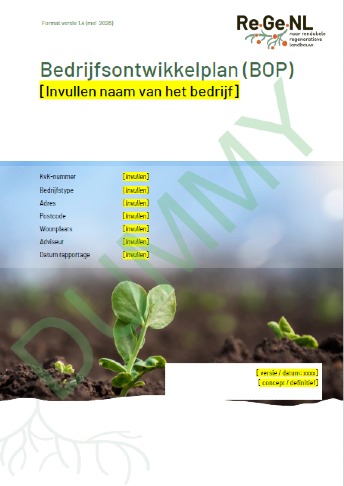
The Business Development Plan (BDP) helps agricultural entrepreneurs formulate a multi-year strategy, translate it into concrete measures aimed at regenerative farming practices, monitor progress, and make adjustments where necessary. This template serves as the basis for the plan. The agricultural advisor may, if desired, include additional sections.
The Business Development Plan includes the following components:
● Description of the current situation, including drivers, motivation, and business data
● Self-reflection
● Concrete steps for the coming years
● Implementation, monitoring, and adjustment
● Value creation
The goal of this business development plan is to take (further) comprehensive steps on the farm toward fully regenerative farming practices. The focus is on optimizing photosynthesis, nourishing the living soil, and minimizing inputs that are harmful to (soil) biodiversity, with the ultimate goal of potentially eliminating the use of these inputs entirely through increased system resilience. Read more here.
Guidelines for SMART Goals in Regenerative Agriculture
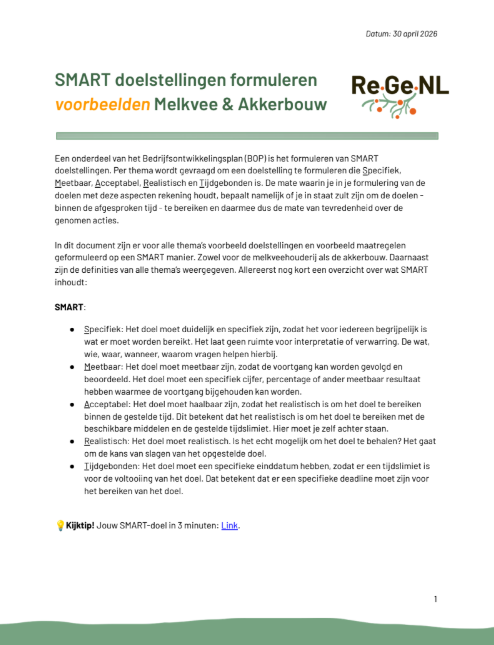
One component of the Farm Development Plan (FDP) is the formulation of SMART objectives across nine themes: soil health, crops, livestock, water and air, biodiversity, carbon footprint, economy, social issues, and a healthy and nutritious diet. For each theme, farmers are asked to formulate an objective that is Specific, Measurable, Acceptable, Realistic, and Time-bound.
The instructions explain how farmers can get started with SMART goals and provide examples for each theme, tailored to both dairy and crop farmers.