
Transition to Hydrogen
Green hydrogen is a promising low-emission technology with a wide range of applications, including in the chemical industry and as a form of energy storage. Researchers at RUG are working on developing and scaling up this technology.
However, barriers such as high costs, infrastructure challenges, and energy losses remain. Through research and collaboration with industry and government, solutions are being explored to improve efficiency and implementation, helping to accelerate the energy transition towards a more sustainable future.
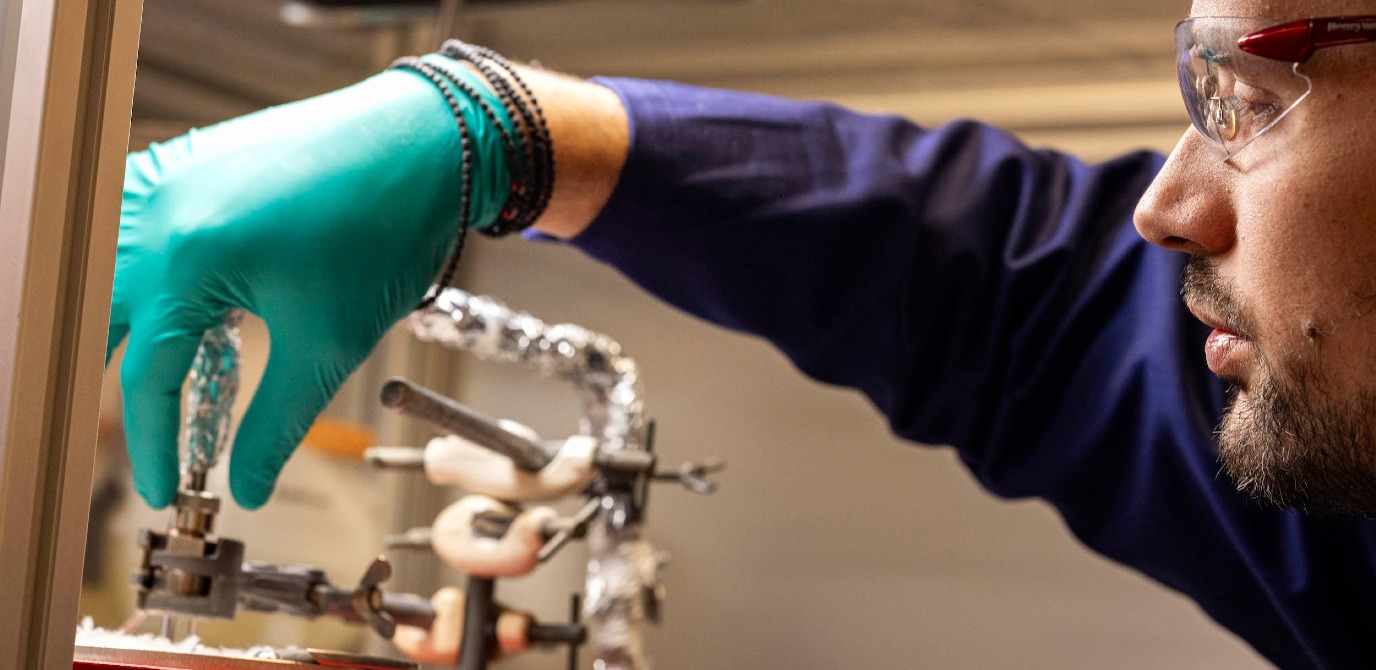
Are we ready for hydrogen?
Green hydrogen holds many promises: it can serve as a ‘battery’ for energy storage, it can be used in the chemical industry, and its only emission will be water vapour. But, unfortunately, green hydrogen is not yet widely used, because the production of grey hydrogen from natural gas is much cheaper. Moreover, it’s not trivial how we could store hydrogen and as an indirect greenhouse gas, hydrogen is not as clean as it looks. Consequently, researchers of the University of Groningen have a lot of work to do.
Making green hydrogen cheaper
A sustainable way to produce hydrogen has been around for a century: electrolysis, which produces hydrogen from water. However, it is still much cheaper to make hydrogen from natural gas. That’s why researchers from the University of Groningen are working on more efficient, affordable, and scalable production of green hydrogen.
Pescarmona, Morales, and Kyriakou all work on developing more efficient forms of electrolysis. They each use different approaches, because right now it’s hard to say which approach will be the best. Pescarmona explains: ‘We’re not yet at the point that we can say: this will be the winning horse. And perhaps the result will be multiple viable technologies.’
Applying hydrogen in cars or toilets
Professor of Energy Conversion Aravind Purushothaman Vellayani is working on systems that use hydrogen to produce electricity – for large factories, for instance. But even your car or your toilet could be capable of producing electricity from hydrogen.
Aravind: ‘The technology is available, but for commercial applications, it is often still too expensive. So, this is where science has a part to play: bridging the gap from fundamental knowledge to applications.’
Hydrogen seeps into nooks and crannies and makes materials brittle
Could hydrogen replace natural gas in the future? Aside from the question of whether this would always be the best choice for specific applications, the infrastructure that we are now using to store and transport natural gas is not readily usable for hydrogen. Because hydrogen is a much smaller molecule than natural gas, it can easily leak. Even worse, despite its small size, hydrogen can affect larger materials and make them as brittle as glass.
Suppose we have managed to produce green hydrogen, with high efficiency and for various applications. If we want to use hydrogen as a ‘green battery’ for storing variable wind and solar power, however, we must be able to store hydrogen for an extended period of time.
Public prefers green hydrogen
The public mainly accepts green hydrogen, produced entirely from renewable energy sources, while blue hydrogen—partly derived from fossil fuels—is less popular. This is shown by research from the University of Groningen and EAWAG, published in Energy Research & Social Science.
The study reveals that a company’s history influences trust in hydrogen production. Firms with experience in renewable energy are seen as more trustworthy than traditional fossil-fuel companies such as Shell or BP.
When evaluating hydrogen projects, consumers focus primarily on sustainability.