
Sasha Ivashchenko and Thijs van der Laan win Ben Feringa Impact Award 2026
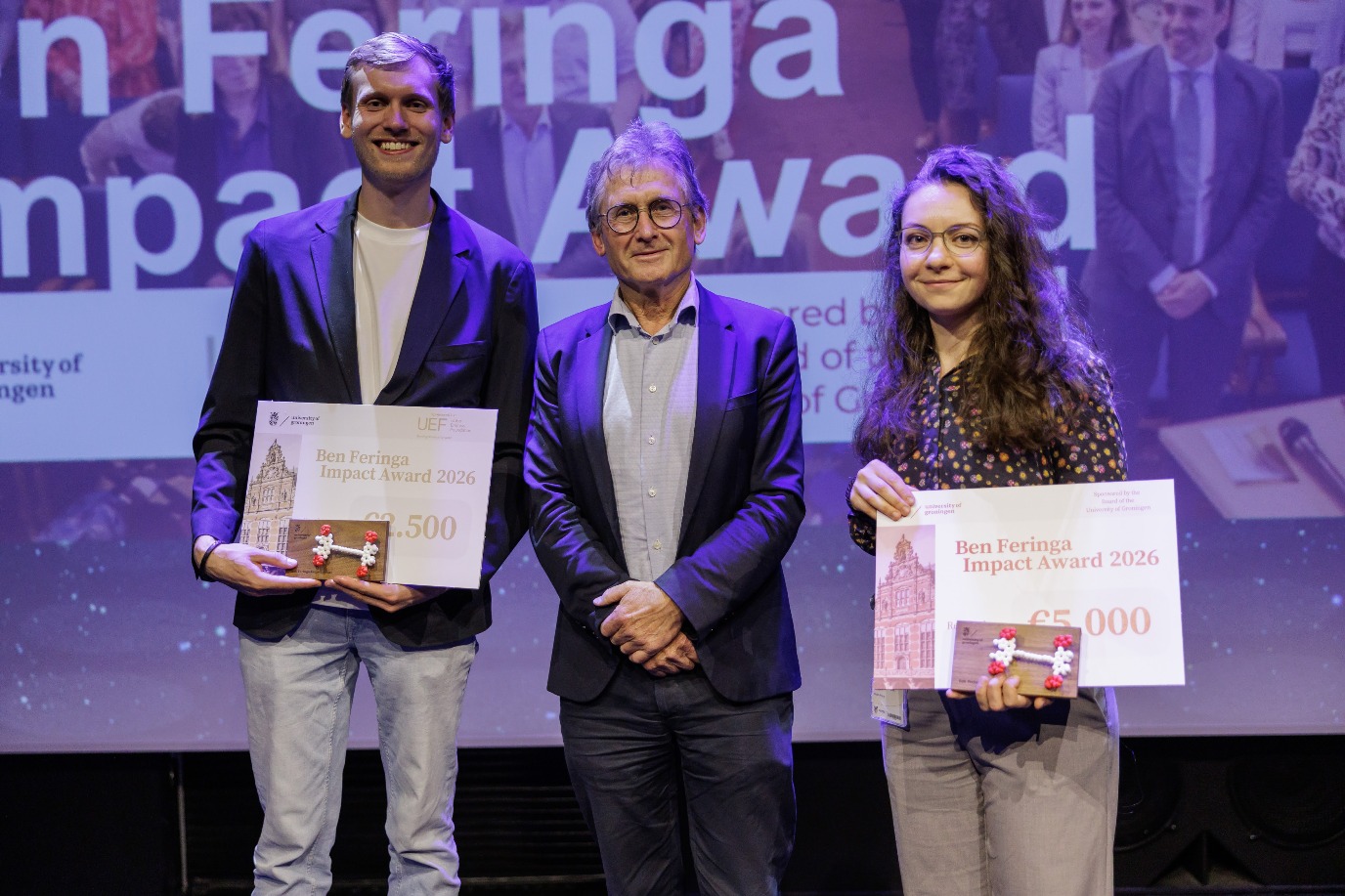
On Tuesday 9 June, the Ben Feringa Impact Award 2026 was presented. The 6th edition of the annual award ceremony took place at Forum Groningen. Sasha Ivashchenko won the award in the researcher category and Thijs van der Laan was presented with the prize in the student category.
Researchers
Sasha Ivaschenko (Faculty of Medical Sciences/UMCG) won the award for her project “Revolutionizing Pediatric and Prenatal Cancer Imaging: 90% Dose Reduction with Total-Body PET/CT” that focuses on making PET/CT imaging safer for children with cancer and other serious diseases.
Children and pregnant patients undergoing cancer treatment often need repeated PET/CT scans, yet children are up to ten times more sensitive to radiation than adults. With child-cancer survival rates exceeding 80%, reducing radiation exposure is crucial to prevent secondary cancers later in life. Using innovative total-body PET/CT technology, this UMCG project optimizes PET/CT imaging for these vulnerable groups. The project reduced radiation exposure by over 90% for pregnant women and young children, and shortened scan times to one minute (from 15-20 minutes), eliminating the need for anesthesia. This breakthrough sets a new standard in pediatric and prenatal imaging worldwide, significantly improving safety, comfort, and long-term health outcomes.
The jury was very impressed with this project. It addresses a very important topic while also demonstrating clever design and high relevance. The jury praises Sasha Ivashchenko's ability to clearly articulate why her method outperforms existing practices. This is a significant achievement in a field where changing established workflows can be challenging.
Students
Thijs van der Laan (Faculty of Science & Engineering) was presented with the award for his project “AI-phasia: Next-Word Prediction for Pauses and Paraphasias in Agrammatic Anomic Aphasic Speech Using Unidirectional Large Language Models” that focuses on AI-assisted communication for people with aphasia.
Aphasia is a common language disorder after brain injury, causing severe word‐finding difficulties and hesitations, and often hard‐to‐understand speech. The winning project investigates whether next‐word prediction models can practically support these speakers in real conversations. Model outputs were assessed both quantitatively and by human raters, who judged many predictions as contextually appropriate and potentially usable in therapy and daily life. Clinicians responded positively when the results were presented at the AfasieNet conference, resulting in nine rehabilitation centres to join the collaboration. The project offers a realistic route towards tools that can cue word retrieval during everyday communication and, in the longer term, could be adapted for other groups with word‐finding problems, such as people with dementia and older adults.
The jury was very enthusiastic about this project. Firstly, it stands out for its clear and compelling writing, centered around a brilliant idea that captures the essence of AI as a language model. The jury is impressed by how the positive impact of AI is illustrated, demonstrating just how innovative and valuable this technology can be. The thesis of Thijs van der Laan was used as a pilot study for a larger research project that was recently awarded a NWO-Veni grant. The project also got attention from Museum NEMO and the Dutch broadcasting organisation NOS.
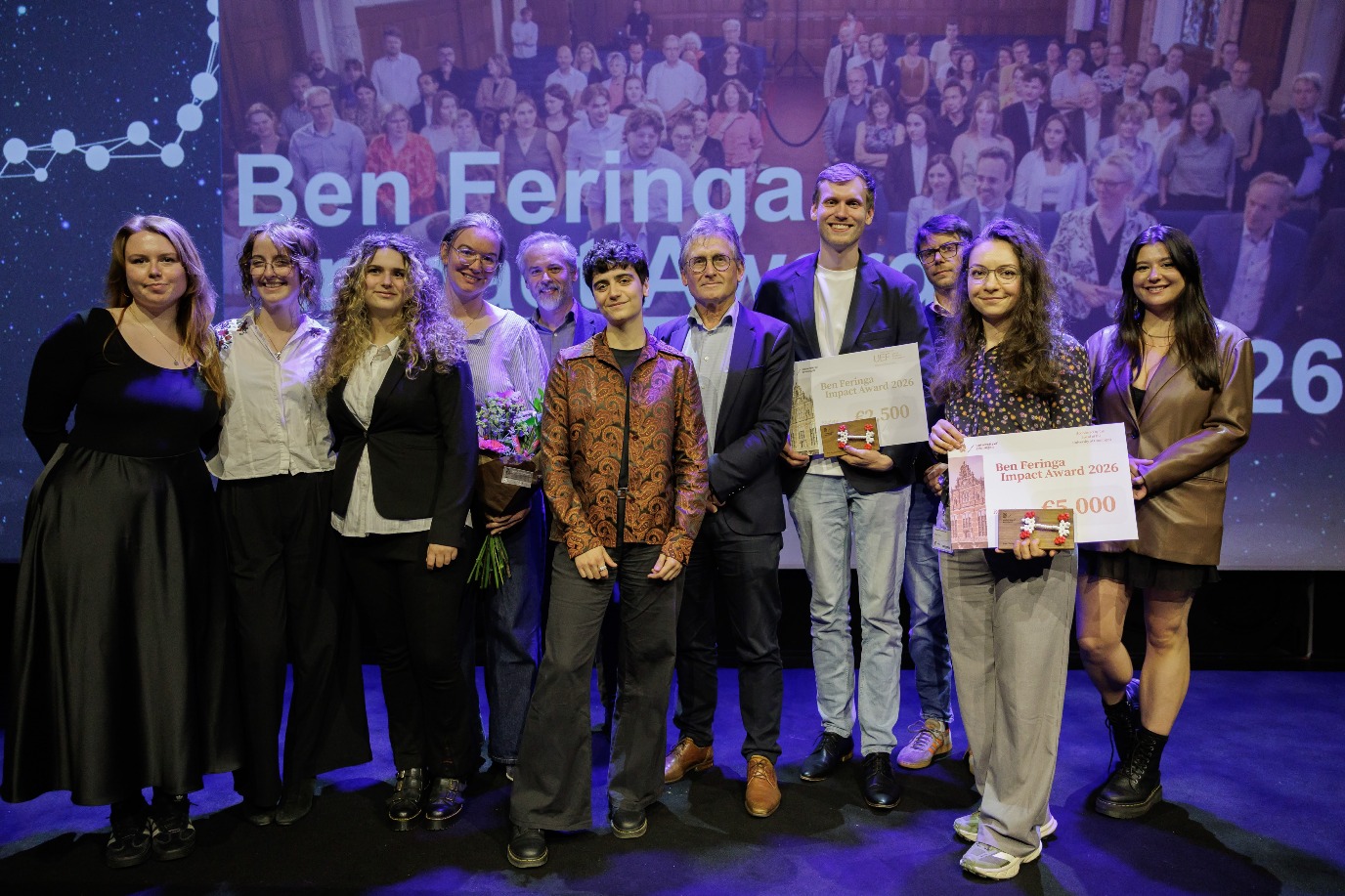
Ben Feringa Impact Award
Every year, the University of Groningen distinguishes special achievements of its researchers and students in the field of knowledge utilisation with the Ben Feringa Impact Award. This honours scientists and students with exceptional focus on knowledge utilisation. Knowledge utilisation refers to linking scientific research to professional (non-academic) and/or societal (including economic) practice. The winning project in the student category will receive a prize of €2,500 to be freely spent. This amount will be financed by the Ubbo Emmius Fund. The winning project in the researchers category will receive a prize of € 5000 to be spent on further knowledge utilisation.
The jury for assessing the nominations for the Ben Feringa Impact Award 2026 consisted of Francesco Picchioni (RUG/FSE), Bettina van Hoven (RUG/UCG), Lana Fahham (RUG/CvB), Joost van Egmond (Science journalist, Trouw), en Nienke Homan (President KNVCI/CEO Impact Hydrogen).
More news
-
-
03 September 2026
Ming Cao reappointed as scientific director of the Jantina Tammes School
-
01 September 2026
Evrim Ursavas appointed scientific director Wubbo Ockels School