
Science for Society | Goldmine of data for general use
Scientists work day by day on solutions to a variety of problems. From new drugs to smart farming techniques, our research helps society move forward. But this is not always immediately visible. In the Science for Society series, we use stories about impactful innovations, products and ideas to show that science works!
Text: Gert Gritter, Corporate Communicatie UG
From the OECD to President Biden’s administration: parties at home and abroad are eagerly making use of the unique databases of the Groningen Growth and Development Centre (GGDC) at the University of Groningen. They contain freely accessible data on macroeconomic developments in various countries. The most remarkable feature is that this information dates back to the early twentieth century and, in some cases, even further. It provides indications concerning policies that have been effective or ineffective in the past, along with possible reasons.
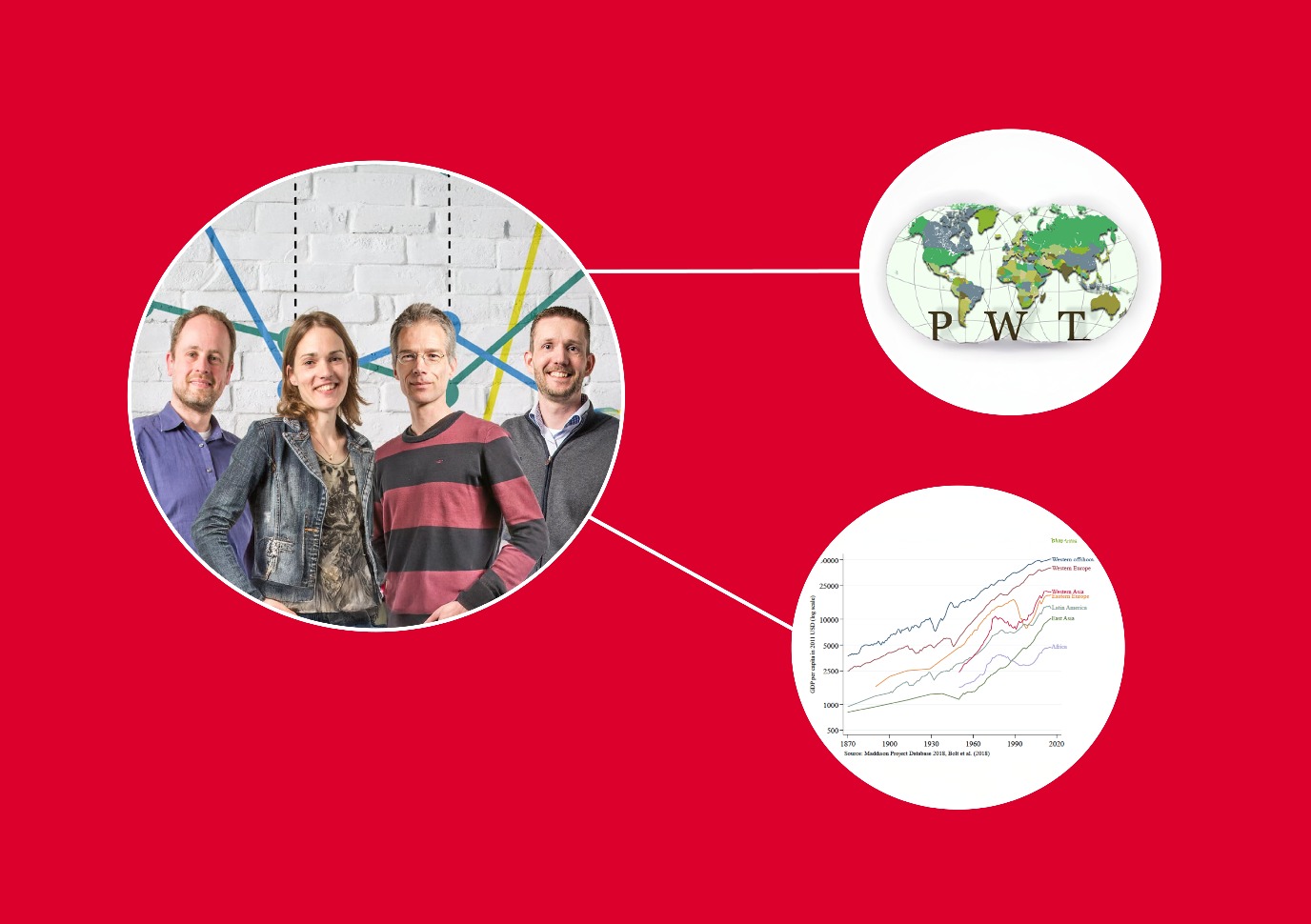
Partners and clients
Part of the Faculty of Economics and Business, the GGDC database is consulted by a variety of parties in the Netherlands and abroad, with more than 3.4 million hits since 2010. These parties include ministries, EU committees, the World Bank, the Asian Development Bank, and the OECD. Media outlets (e.g. The Wall Street Journal and The Economist) are also showing interest, as are commercial companies. We even received an email from the Biden administration: they had used data from the Maddison project to place the economic performance of the US in a historical and comparative perspective.
Three databases
The GGDC owes its existence and reputation to the British economist Angus Maddison (1926–2010), who was affiliated with the University of Groningen from 1978, even after his retirement. He focused on quantitative macroeconomic history and was the first to quantify long-term economic performance for all regions of the world within a consistent framework.
Analysis and comparison of this information can provide a key to discovering patterns and finding explanations. Examples could include why some countries are more prosperous than others and why government policies are or are not successful. The GGDC’s Maddison Historical Statistics have become internationally renowned. Furthermore, the centre develops and maintains the Penn World Tables (PWT), in collaboration with the University of California, Davis (UCD). This allows a range of comparisons, including the GDP of 183 countries over a 76-year period. Finally, the GGDC includes the World Input-Output Database (WIOD).
ERC Consolidator Grant
Together with three colleagues, Jutta Bolt is a leading expert at the GGDC. In December 2025, she was awarded a Consolidator Grant from the European Research Council (ERC), worth two million euros. This grant will enable Bolt, Professor of Global Economic History, and her team to study employment in Africa between 1920 and 2020. Which can then be linked to more contemporary data on employment in the Economic Transformation Database, also hosted by the GGDC.
Healthcare in Africa
Bolt specializes in macroeconomic developments in Africa, focusing on areas such as healthcare. ‘We collect data from medical reports, some of which were written by colonial administrators and missionaries. We draw on these data to investigate which diseases occurred and in which locations. We also link this to geographic factors (for example, how these diseases spread and what role railways played in this). Equally important is what the disease prevention policy was and whether it was successful. In Africa, governments have now gained considerable experience in dealing with serious diseases. measures were introduced without major protests and seemed to be more widely accepted.’
Trends
Bolt notes, ‘I do not know of any institution that has as much data as the GGDC. We have since grown into a research centre that studies the interaction between globalization, technology, and trends. Our focus is on measuring and analysing global economic prosperity. We provide information in the form of easily accessible datasets, along with comprehensive documentation. The data are made public so that researchers and policymakers from around the world can analyse them in detail.’ The GGDC’s data files are constantly being updated, including by Bolt, who enjoys travelling to archives in Africa with her team. They scan the material in large numbers and then digitize the data, so that archives are made accessible on a large scale. ‘Passionate historians have been collecting data since 1950. It is always exciting to discover new things. Finding the data is tricky, but once you have them, there are no limits!’
More information
Jutta Bolt, Robert Inklaar, Bart Los, and Gaaitzen de Vries are the leading experts at the GGDC
Do you want to know more about Science for Society? Check out the overview page for the previous editions.
More news
-
-
03 September 2026
Ming Cao reappointed as scientific director of the Jantina Tammes School
-
01 September 2026
Evrim Ursavas appointed scientific director Wubbo Ockels School