
‘Going to court is the last resort; there is so much more you can do before that.’
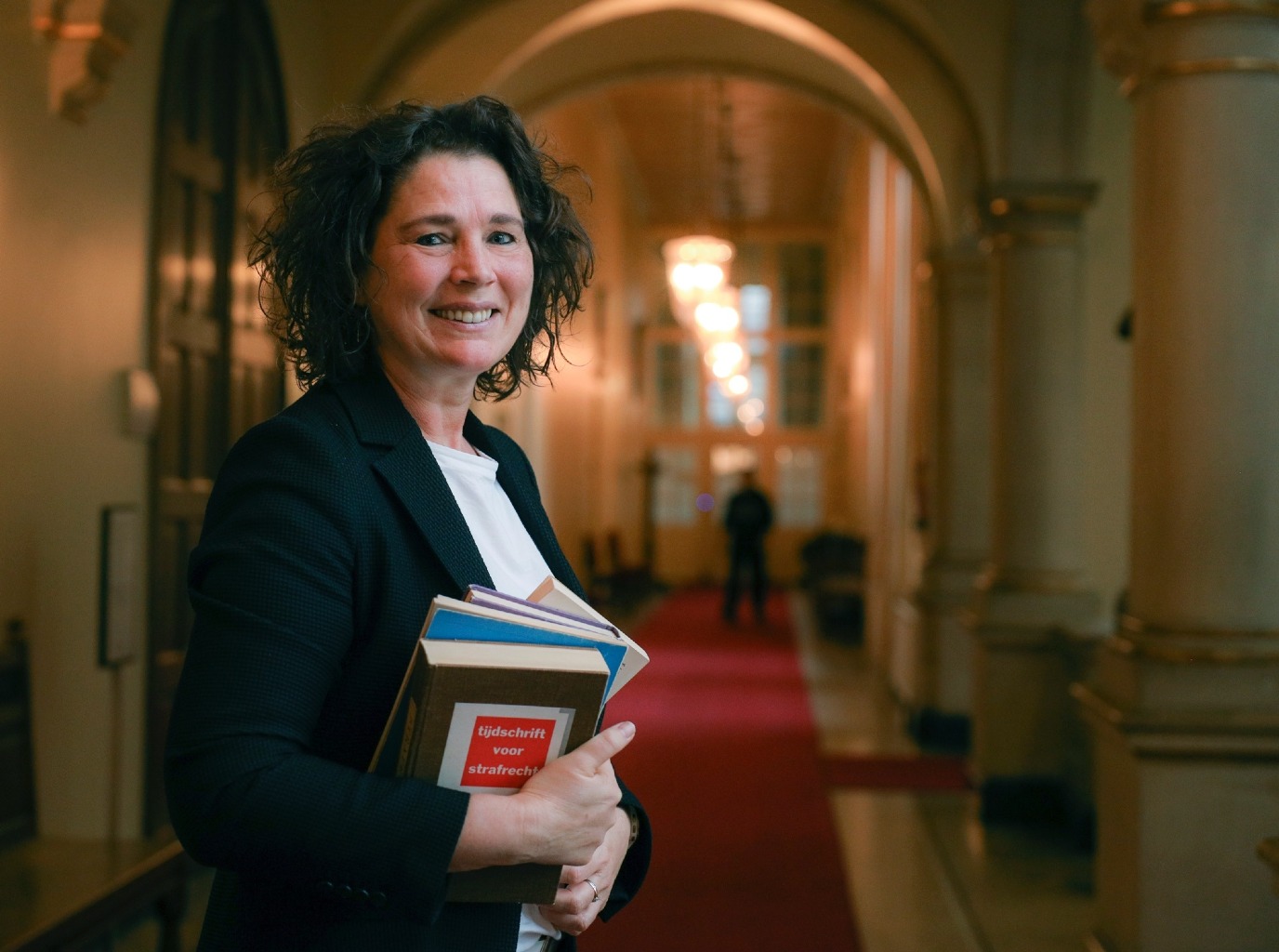
As a 12-year-old, assistant professor Ester Post spent months hunched over the newspapers in the library of her hometown, Urk. It was the autumn of 1987, and the media were completely fixated on the kidnapping and — as became apparent much later — the murder of Ahold CEO Gerrit Jan Heijn. The young Post followed every twist and turn.
Text: Esther van der Meer, Faculty of Law / Photos: Henk Veenstra
‘I was fascinated by the perpetrator — and by the attitude of Gerrit Jan Heijn’s wife during the case. When it was all over, her story was beautifully narrated in a book entitled ‘De Verzoening’ (Reconciliation).’
Victims and perpetrators
Post’s childhood fascination with victims and perpetrators remained undiminished, although it remained unchanneled for some time. She commenced her legal studies relatively late, at the age of 27, and then worked in advocacy for a few years before embarking on a Master’s degree in criminal law in Amsterdam.
‘My Master’s included a minor in forensic criminology. That really captured my interest. Why do people do terrible things, and how can we prevent casualties? Those were the key questions I wanted to find answers to.’

In 2023, she obtained a doctorate. Her thesis was on the history of forensic care in the Netherlands. These days, the main objective of forensic care is to prevent perpetrators from reoffending. But has that always been the case? Was that the key objective when TBS (detention under hospital orders) was first introduced in 1928? And what was the thinking behind the introduction of forensic care as a condition of a conditional sentence in 1915? ‘I was an external PhD candidate, doing my research on top of my day job. You need to really like your subject to carry that off. And I did really like it.’
Post is now an assistant professor, substitute judge, and owner of BOO strafrechtelijke vraagstukken, a bureau that addresses criminal law issues. ‘I would find it a bit dull to limit myself to just one thing. What I have now is a perfect combination of research, teaching, and practice. I wouldn’t want to miss out on any of them.’
In Groningen, she teaches subjects including juvenile criminal law and sanctions law, and also gives the masterclass in Penology (the study of punishment). For her own bureau, she has co-authored a bill to make electronic detention a primary punishment. She has joined forces with a mental health care practitioner to conduct research into how caregivers can best deal with workplace violence. And she is involved in different projects to do with the re-integration of former prisoners.
Seven lessons
She is currently working on the public edition of her thesis on the history of forensic psychiatry. It will be entitled ‘Seven Lessons’. Publication is due this year.
And there are certainly plenty of lessons to be learned. For example, consider how forensic care is applied, and the role that the ‘severity’ of the disorder plays in that context. Under the current system, a mental disorder is a prerequisite for imposing TBS. But should that remain the case?
‘If you consider the goal, which is to prevent recidivism, a disorder is not generally, in and of itself, a strong predictor of recidivism. And the focus of forensic care tends not to be on treating the disorder itself but on influencing risk factors. If that’s the focus, shouldn’t we always be working with perpetrators of, say, violent or sexual offenses to reduce the risk factors, regardless of whether they are deemed to have a mental disorder?’
99.85 percent
Since the turn of the century, incidents of malpractice in secure psychiatric units have led to such units being subjected to tight scrutiny. In turn, this has led to a further tightening of legislation and regulations — all despite the fact that of the 80,000 - 90,000 leaves granted each year, 99.85% go smoothly and recidivism does not occur.
Crimes such as the murder of Anne Faber by psychiatric patient Michael P. have attracted wide criticism from society and politicians alike. In recent years, TBS has become more common — a trend dubbed ‘the Michael P. effect’. At the same time, stricter legislation has made it more difficult to transfer a prisoner from prison to a psychiatric facility for treatment, as was the case with Michael P.
‘The outflow of patients from secure psychiatric units is low. After 8 to 9 years, only about 50 percent have completed their treatment. And there have been cuts to forensic care. Currently, 250 convicted criminals are waiting for a place in a secure psychiatric unit. This situation is clearly far from ideal.’
Citizen engagement
Post would like to see more consideration given to the consequences of new measures and budget cuts. She also believes it would be worthwhile to explore how greater public support can be generated for the criminal justice system as a whole. How, for example, can we get citizens more involved and give them an insight into how criminal proceedings work?
She also believes in the potential of restorative justice to assist both in preventing offenders from reoffending and to help victims come to terms with what has happened to them. Restorative justice offers the victim and the perpetrator the opportunity to talk to each other about what happened. ‘In sex offences and cases involving serious violence, the perpetrator and the victim are often known to each other. In such cases, figures indicate that they may feel the need to meet and talk. I’m interested in finding out how we can put restorative mediation to even better use.’
Early intervention
Post has this to say about crime and its prevention: ‘I agree with the recently deceased criminal defence lawyer, Stijn Franken, who said: “If you want to reduce crime, you have to invest more in mental health care.” We know that a fair percentage of people who end up in the criminal justice system have a history of mental health issues. And it is no secret that the mental health services sometimes lack the capacity to offer people with serious mental health problems the help they need.’
Ideally, we need to go back even further than that. 'We should be addressing what happens in homes, neighbourhoods, schools. If we want to prevent people from going astray, we need to intervene much earlier. If we’re honest, by the time the courts get involved, it’s already too late.’
Forensic careForensic care includes mental health care, addiction treatment, and care for people with intellectual disabilities. It is provided to individuals with a psychological or psychiatric disorder or an intellectual disability who have committed a criminal offence and are at risk of re-offending. Each year, thousands of people receive forensic care. TBS comprises only a small percentage of all forensic care programmes. A judge can impose a TBS order subject to certain conditions. The offence must be punishable by a prison sentence of at least 4 years, or it must be on the list of other offences specified by law. The offender, tried under adult criminal law, must have a mental disorder and must constitute a threat to the safety of others and/or the general safety of persons and goods. There are 11 TBS clinics in the Netherlands, with the capacity to treat a little over 1660 people. More than 70% of TBS patients do not re-offend within five years of completing their treatment. In December, the TBS clinics launched a joint campaign aimed at presenting society with a more nuanced image of TBS patients – see ‘Het gezicht van tbs’ (Dutch only). |
More information
More news
-
21 September 2026
Disinheritance is about much more than money
-
31 August 2026
A digital game of cat and mouse
-
03 August 2026
Opinion: ‘AI must not take the place of the judge’