
The power of movement
You put on your coat, grab your bag and walk out the door without thinking twice. Just popping to the supermarket, the bus stop or for a walk in the park. But what if every kerb, crossing or roadwork suddenly became a major obstacle?
Text: Djoeke Bakker, Ubbo Emmius Fund / Photos: Reyer Boxem
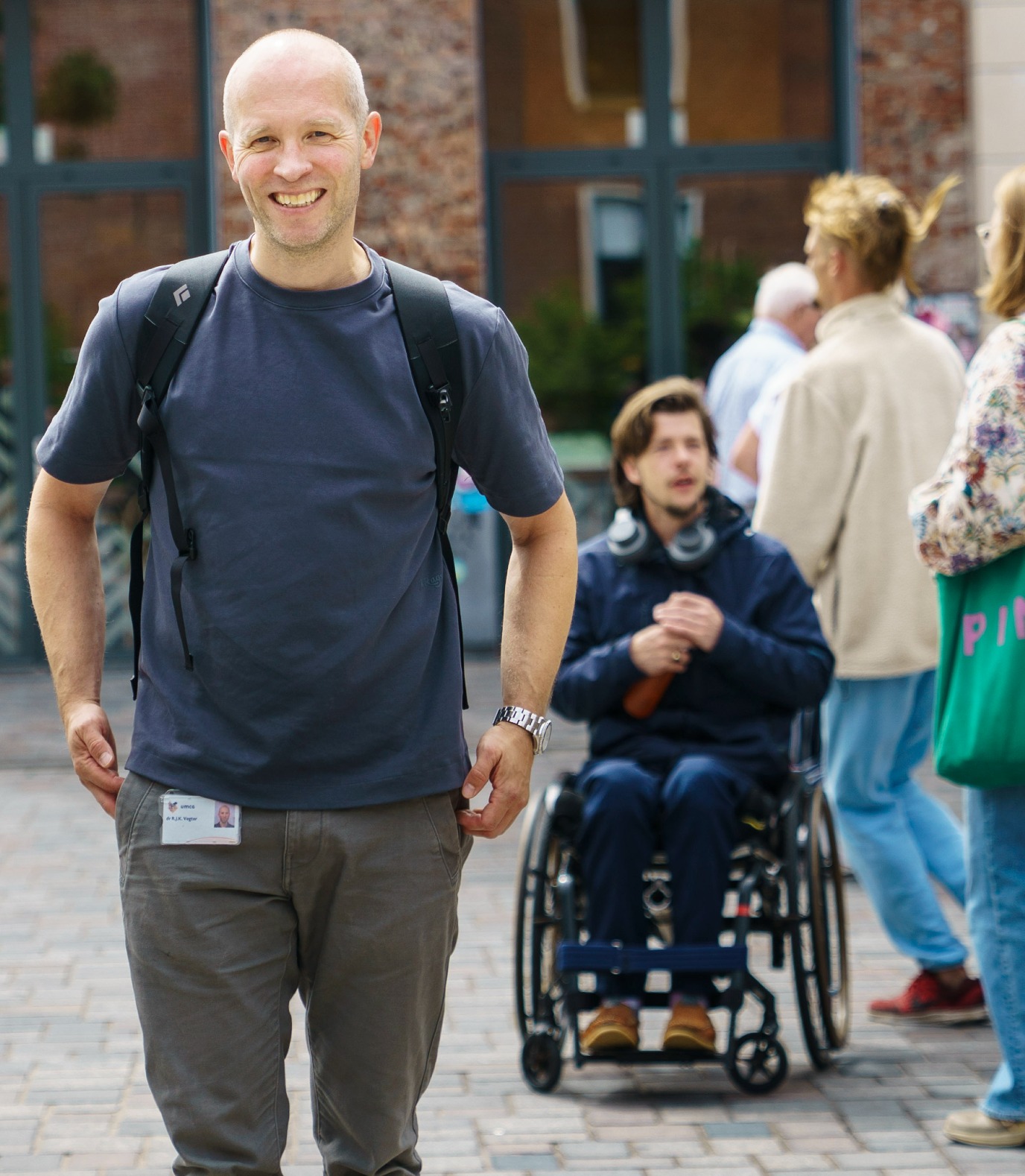
For people who depend on a wheelchair, walker or other mobility aid, mobility is anything but a given. It is not just about covering distance, but also about healthy physical activity, freedom and independence. How accessible is our society, really? Movement scientist Riemer Vegter is investigating this question together with colleagues from the University Medical Centre Groningen (UMCG) and the Faculty of Spatial Sciences. The project, Disabled City, is funded by the M20 programme of the Ubbo Emmius Fund. The researchers are studying the influence of aids, physical effort and infrastructure on the freedom of movement of people with disabilities.
Accessibility is more than technology
Accessibility is often expressed in numbers: how wide a door is, how steep a bridge, how many lifts a building has. But according to Vegter, mobility is far more complex than that. ‘Mobility is not just about measuring and planning,’ he explains. ‘It is about freedom, about feeling welcome somewhere. A wheelchair user may be able to reach a bus stop on paper, but if the pavement is full of bumps or the bus driver does not take the time to help, that is not real accessibility in practice.’
That is why the researchers are not only examining infrastructure but also how people actually move around their environment. Which routes do they choose? Where do they get stuck, and why? To find out, they conduct so-called walk-along interviews: conversations held while participants move through their own surroundings. By combining GPS data, observations and personal interviews, the researchers gain a better understanding of the barriers people face and the choices they make.
Mobility varies between municipalities
Another important factor is municipal policy. In the Netherlands, municipalities are responsible for providing mobility aids such as wheelchairs. ‘You would expect every municipality to make the same choices based on the same information,’ says Vegter. ‘But in practice, we see major differences.’ Through his research, he aims to provide municipalities with tools to make better-informed decisions that promote healthy mobility. ‘Sometimes you can improve something on the side of the aid, and sometimes on the side of public space,’ he explains. ‘Ultimately, that benefits both the user and society as a whole.’
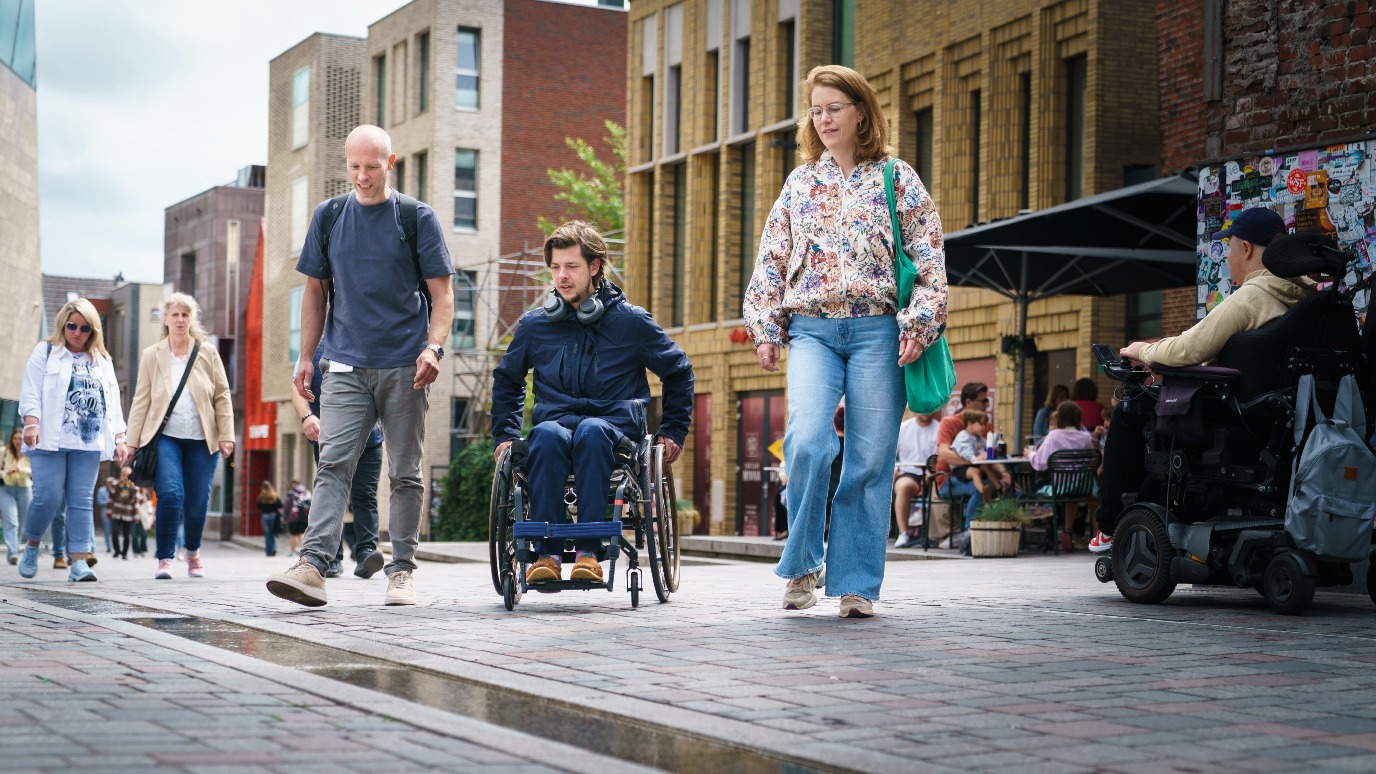
Freedom of movement is personal
What someone needs to feel free varies greatly from person to person. Some want to navigate a shopping centre with ease, while others seek out nature. ‘There is no standard solution for mobility,’ Vegter emphasizes. ‘Some people need a lightweight wheelchair to be fast and manoeuvrable, while others need a more robust model for rougher terrain. But above all, it is about people maintaining control over their own mobility.’ This calls for a different way of thinking about accessibility: not from a technical checklist, but from the experiences and needs of the users themselves. ‘Just because someone can get somewhere does not mean it is easy, pleasant or stress-free.’
Research that leads to change
The aim of Disabled City is not only to identify problems but also to provide solutions. By linking new insights to urban planning and assistive technology policy, municipalities can make the living environment truly more accessible. ‘Our research is designed to bring about change,’ says Vegter. ‘Accessibility should not only be well organized on paper but also genuinely experienced by the people who depend on it.’ At the same time, he remains realistic about the scale of the issue. ‘This research is a small piece of a much larger puzzle. Mobility should not be a luxury, but a matter of course.’
This project is funded by the Ubbo Emmius Fund and is embedded in the Aletta Jacobs School of Public Health.
More news
-
08 September 2026
Verhuizing supermarkt Koudum gevolgen voor dorpshart
-
08 September 2026
Groningen residents want mobility hubs with shops and meeting points
-
07 September 2026
Can building on water help combat the housing shortage?