

Minor Climate Change and Inequality: ‘What stood out most to me was how engaged the lecturers were’
Technology is only part of the solution for a successful transition to a fair and sustainable society. That is an important insight for the first cohort of students in the minor Climate Change and Inequality, an interdisciplinary minor at the University of Groningen that ran its first edition this academic year (2025-2026). A lecturer, two students, and a stakeholder from the Gemeente Groningen share their stories. ‘The combination of personal experience and academic knowledge is most valuable.’
Text: Jelle Posthuma
The minor is designed to bridge the gap between different disciplines at the University of Groningen, says Gorazd Andrejč. He is an assistant professor of philosophy of science and religion, and one of the initiators and a coordinator of the minor. The technological insights to counter climate change already exist, Andrejč states. ‘We have the solution. If we for example cover part of the Sahara with solar panels, there is enough energy for the entire world. But that does not happen.’
Different perspectives
An important explanation is that the challenges are not only technical, scientific, or economic in nature, but also moral, social, legal, and political. This requires connecting different perspectives. Interestingly, FSE researchers (Faculty of Science and Engineering, ed.) were quick to recognise the importance of the minor, Andrejč states. ‘They also recognize that technological solutions alone are not sufficient.’
Lina Volkmann, a bachelor student of Minorities and Multilingualism at the University of Groningen, was part of the first group of the minor. She was particularly drawn to the combination of science courses and social and humanities courses. ‘I wanted to follow a program that focused more on the scientific and technical side of climate change. This minor addresses the scientific aspects of climate change, such as how global warming works, while also linking them to inequalities and power structures related to climate change. I found this combination of natural sciences and social perspectives very engaging and exciting.’
Another student who completed the minor this academic year, Robyne Kerver (International Relations), always wanted to be engaged in the social side of climate change. In the minor she learned about other perspectives, ‘including scientific ones. Often the scientific and social aspects are dealt with quite separately from one another, so it was great to address them together and bring them in relation to each other.’
Unequal distribution
A key part of the minor is climate change and inequality. The global impacts of climate change are unevenly distributed and will lead to even more inequality in the future, Andrejč explains. ‘Rich countries have contributed unequally to climate change while poor countries have a small footprint but experience major consequences.’ He cites the floods in Bangladesh as an example. A poor country that is severely affected by climate change.
According to Volkmann, the lectures provided important insights into the inequality. ‘I discovered how important indigenous knowledge is in addressing climate change and how challenging but also essential it is to distribute green energy fairly. What stood out most to me was how engaged the lecturers were. For example, when I asked a question about the waste management system, we even watched a video in the next class to explore it more deeply. This engaged and quick response made a strong impression on me.’
Challenge based
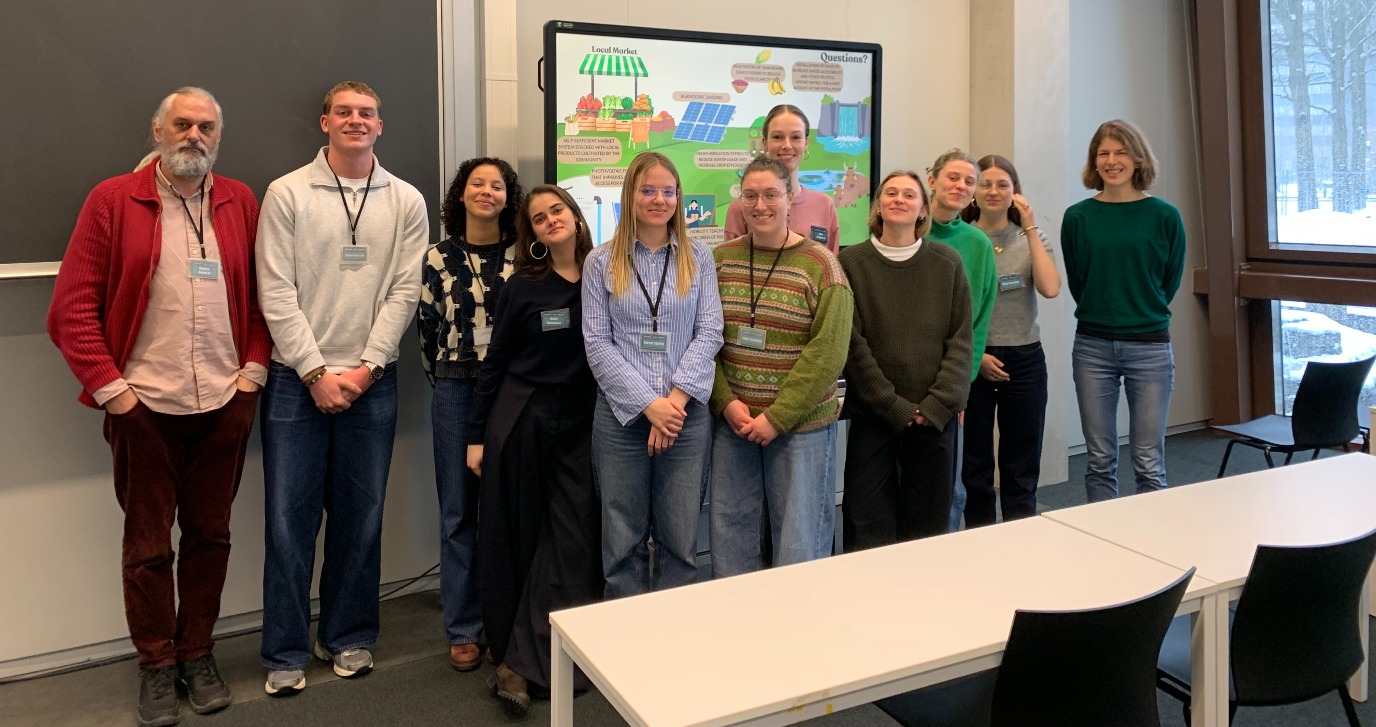
The minor consists of two parts. In the first block, students gain fundamental knowledge about global inequality and climate change through lectures. In the second block, students work on so-called challenge based projects. The first group of students was divided into two groups that worked together on two real problems provided by stakeholders from society. Ultimately, the students write a policy paper on the problem based on the knowledge gained in the first block.
The projects are very diverse. One group worked on an energy related topic in the Groningen neighborhood of Selwerd. The second group looked further afield. They received a project from an influential organisation in Africa focused on a major political and security issue caused by climate change in Karamoja Cluster and the pastoralist communities there, a cross-border area whose geographic location is shared between four countries (Ethiopia, Kenya, South Sudan, and Uganda). Eventually the students presented their findings to the stakeholders. Andrejč: ‘The students did fantastic work. There is a strong ‘’hunger’’ from stakeholders for the students' knowledge and solutions. This provides important encouragement for the way we structured our minor.’
According to Kerver, who worked on the project on Karamoja Cluster, ‘The project sheds light on how incredibly complex the issues are there. Different countries and regions are involved, there are recurring conflicts and problematic governmental attitudes or policies. It was insightful to learn about this but also difficult to find solutions, which was something our project set out to do. You are forced to take different types of measures, step outside of the usual portrayals of climate change and its effects, in order to bring about workable solutions.’
Volkmann, who worked on the Selwerd project, explains how she learned to write a policy paper during the minor but also developed other skills. ‘We had good discussions and collaborated with external parties and in an interdisciplinary team. What made it appealing to me is that it is a university-wide minor. You are therefore in an interdisciplinary group with students from different programs, which leads to interesting discussions and new perspectives. I consciously chose something different from my own study and the working methods within my faculty. This minor was a perfect fit for that goal.’

Academic knowledge and experience
Annemarie Hofman-Tualena, project manager ‘aardgasvrije wijken’ at the Gemeente Groningen, explains that the minor project in the Selwerd neighborhood was centered on involving residents. The municipality aims to make the neighborhood CO2 neutral and free of natural gas by connecting houses to the district heating network. These are neighborhoods where inequality and energy poverty play a major role. Ultimately it is up to the residents to decide whether to connect their homes to the heating network and under what conditions, Hofman-Tualena emphasizes. ‘We are guests in their neighborhood. Residents experience it in their own way. There are concerns, for example, about digging up the street. We do not need to pass judgment on that. In the end it is about consensus.’
That is why it was crucial that the minor students went into the neighborhood, the municipal project manager continues. ‘Go and experience it yourself, was my message. Only then will you find out what is going on in the neighborhood. The combination of personal experience and academic knowledge is most valuable.’ She also advised the students to involve residents in a creative way. ‘In the case of the energy transition we are not really used to that. Look at the way the public is involved in the cultural sector, for example. The audience becomes part of the performance. That is something we can learn from. We need to look beyond the limits of our technical perspective.’
In their presentation the students offered concrete solutions. An important starting point of their recommendations was to connect with existing initiatives. Hofman-Tualena would like to apply the students' insights in the near future. ‘They mentioned, for example, the knitting club in Selwerd. Residents already gather there and can start a conversation about the energy transition. A knitted scarf is of course an excellent opportunity to talk about warmth.’ For Hofman-Tualena, the diversity of the students was a revelation, extending beyond their academic backgrounds. ‘In the past when I was studying, I was the only woman in the class. Now five women gave me a presentation on the energy transition. That is diversity!’
Comfort zone
The minor is a collaboration of the faculty of Religion, Culture and Society, the faculty of Arts and the faculty of Science & Engineering (FSE), and is accessible to all University of Groningen students. The scientific part is structured so that all students, be they from humanities, social sciences or natural sciences, can follow the study material. ‘At the beginning of the minor we compiled a concise list of concepts for students to study,’ Andrejč explains. According to him, the multidisciplinary approach pushes students out of their comfort zone, what helps to broaden the learning process.
The Wubbo Ockels School was important for the inception and launching of the minor. Without the School’s support it would have been more difficult to start the minor, says Andrejč. ‘The train is now on the tracks and we can continue independently.’ In the first year of the minor, a small but dedicated group of students took the minor and completed it very successfully. For the coming academic year, Andrejč expects more students. ‘We are gearing up for further enlargement,’ he concludes.
More news
-
-
03 September 2026
Ming Cao reappointed as scientific director of the Jantina Tammes School
-
01 September 2026
Evrim Ursavas appointed scientific director Wubbo Ockels School