
KNG Lezing 1891 - Inside the Insect Brain: How Tiny Minds Navigate a Complex World

On Tuesday evening, 10 March, Elisabetta Chicca (University of Groningen) delivered a public lecture exploring how insects navigate complex environments with remarkable efficiency despite their tiny brains.
Navigation without maps
Insects can move through dense spaces such as forests or flower fields without collisions. Chicca presented research suggesting that they rely on optical flow, the perceived motion of the environment, rather than explicitly detecting obstacles.
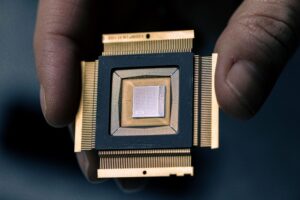
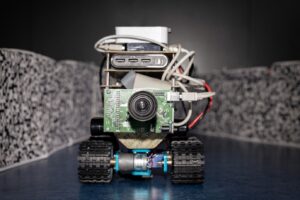
Inspired by this principle, researchers developed a robot with a neuromorphic, brain-like system that moves toward areas with the lowest visual motion. This allows it to automatically find safe paths, squeeze through narrow gaps, and avoid obstacles with surprising reliability.
A stable sense of movement
The lecture also addressed how insects estimate their own movement, known as egomotion. By combining visual information with internal sensory signals, insects can maintain stable navigation over time.
Models and robotic experiments show that visual cues help correct errors from internal signals, resulting in more accurate and robust motion estimates.
Inspiration for future technology
This research demonstrates how efficient biological strategies can inspire new approaches in robotics and artificial intelligence. By learning from insect brains, scientists aim to develop systems that are both powerful and energy-efficient.
The lecture was held in English and can be rewatched online via YouTube.
More news
-
-
03 September 2026
Ming Cao reappointed as scientific director of the Jantina Tammes School
-
01 September 2026
Evrim Ursavas appointed scientific director Wubbo Ockels School