


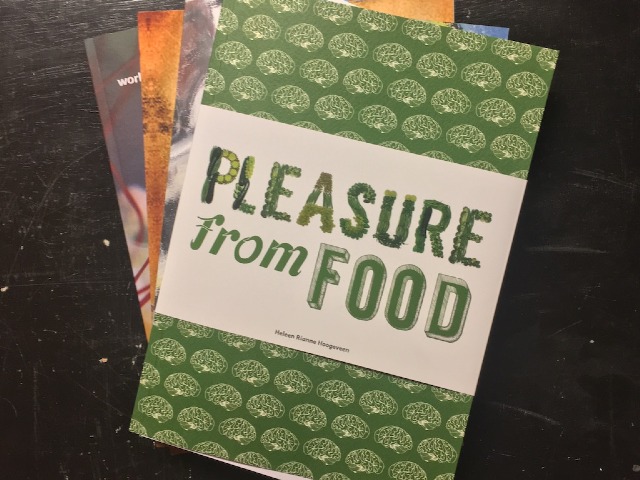
Pleasure from Food - Insights from brain responses to taste
Date:07 December 2016Author:Heleen Hoogeveen
The desire to understand the neuronal mechanisms underlying changes in food pleasantness is becoming increasingly relevant in order to maintain adequate dietary intake in young and older adults. Our research shows that emotion and cognitive mechanisms, in addition to sensation, should be taken into account to understand food pleasantness with age.

Vicarious learning of a researcher
Date:30 November 2016Author:Yannick Hill
Researchers have an extremely high level of expertise within their domain. However, relying on this domain-specific expertise alone might not always be enough to advance a given research areas. Instead, collaboration various different researchers from virtually any domain can improve our work immensely.

Working on the environment: How to motivate people who don’t really care.
Date:23 November 2016Author:Angela Ruepert
Angela Ruepert defends her PhD thesis on 24 November on pro-environmental behaviour at work. Strong environmental values predict such behaviour, but employees with weaker values also act pro-environmentally when the work context makes them focus on the environment.

The pleasure and privilege of doing cognitive science
Date:16 November 2016Author:Sebastiaan Mathôt
A new assistant professor in Experimental Psychology introduces herself by explaining why this is an exciting time for cognitive science. She distinguishes it from neuroscience and points to deep neural networks as an example of cognitive science, computer science and neuroscience working together.

You can't teach an old dog new tricks… but he might you!
Date:09 November 2016Author:Oliver Tucha
A personal experience with our dog Eli made me wonder whether animal-assisted interventions have the potential to support the treatment and care of children with ADHD. A subsequent literature study provided ample indication that several mechanisms of animal-assisted interventions can have a positive effect on several core symptoms of ADHD.

Hate-groups, Trump, and a lot of angry people
Date:08 November 2016Author:Eva Bosgra
Make America great again, or make America hate again? Trump’s campaign has raised many troubling questions. He has at various stages proposed building a wall and purging illegal immigrants, or retweeted the messages of Neo-Nazi fanatics. Yet still, his...

Hello and introduction
Date:03 November 2016Author:Rebecca Heron
Hi fellow colleagues and students, I hope you are enjoying the week! I Just wanted to introduce myself, as I am a new member to the University and will be contributing to the Master in Forensic Psychology as a lecturer.
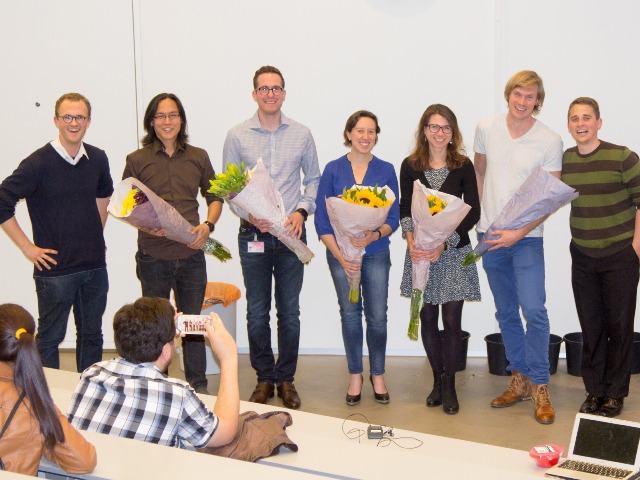
I F***ing Love YOUNG Science Conference
Date:27 October 2016Author:Marco Egle
A few weeks ago, Marco Egle and Timothy Sondej, graduates of the Psychology Bachelor and Research Master students in Groningen, co-organised the I F***ing Love YOUNG Science Conference in Groningen. Their aim was to showcase exciting research projects by...
From practice to theory to practice: Curious Minds in Teacher College
Date:20 October 2016Author:Frank Assies
Researching and implementing educational interventions is a challenge. Combining his experience as a teacher educator and PhD candidate in developmental psychology, Frank Assies explains how he is able to go from practice to theory to practice in shaping a Curious Minds based intervention in Teacher College.

Subtitle Secrets: An Interview with Hanneke Loerts
Date:12 October 2016Author:Tassos Sarampalis
Every quarter, we share articles published in the BCN Newsletter and we are happy today to share an interview with Dr. Hanneke Loerts, lecturer at the Faculty of Arts, who uses eye-tracking, electrophysiological, and behaviour methods to study language acquisition. The interview was conducted and written by Annelot de Rechteren van Hemert.