


Results for tag: Psychometrics
We’re all going to die
Date:02 April 2020Author:Casper Albers
Prof dr Casper Albers reflects on the numbers, and the rhetoric, of the corona crisis. (How do you tell the truth in a way that's helpful both to the public and to policy-makers?)
Citing is Easy, Reading is Hard
Date:06 November 2019Author:Don van Ravenzwaaij
Don van Ravenzwaaij, Casper Albers, Maarten Derksen and Rink Hoekstra discuss how statistical misreporting can be propagated by experts. (Part 2 of our series on citation practices in psychology.)

How to become a “total genius”
Date:06 February 2019Author:Lieke Voncken
What's the difference between a Buzzfeed quizlet and a proper intelligence test? Doctoral candidate Lieke Voncken explains.

All we are saying is give p’s a chance
Date:27 December 2017Author:Casper Albers
Discusses the proposal by Benjamin and 71 co-authors to lower the default significance threshold from 0.05 to 0.005. Explains the false positive rate argument behind it and the trade-off of more false negatives, arguing for giving p-values a chance with a more nuanced view.

The myth of objective statistics
Date:02 June 2017Author:Don van Ravenzwaaij
Argues that statistics is not an objective, finished toolkit but a dynamic field with ongoing debate. Uses Bayesian hypothesis testing and a simple rain-and-umbrella example of priors, likelihoods and Bayes factors to make the case.
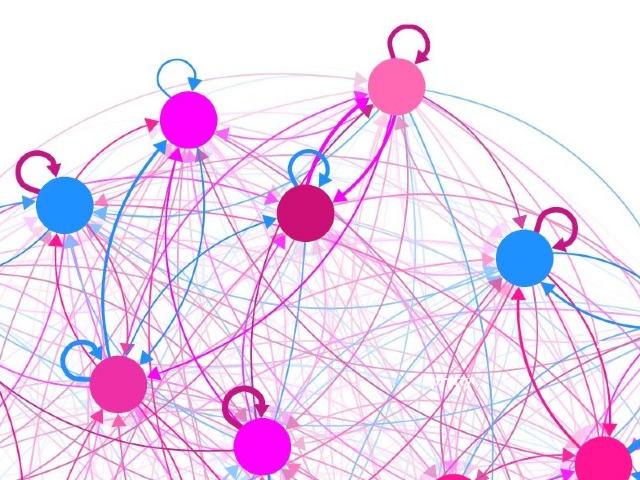
Networks in psychology: more than a pretty picture?
Date:01 February 2017Author:Laura Bringmann
Network analysis enables researchers to visualize the relations between people, objects, and concepts. Here, Dr. Bringmann shows how the technique can be generalized to psychopathology: the complex constellation of symptoms that co-occur with Major Depression can be mapped, and the map itself can be analyzed. This then illustrates an emerging approach to understanding psychopathology.
To p , or not to p
Date:21 December 2016Author:Don van Ravenzwaaij
Everyone uses p -values (in empirical psychological research anyway), but is that the best idea? In this blogpost, I will outline four problems that are associated with using p -values in inferential statistics.

Gaining understanding with exploratory statistical modeling
Date:20 July 2016Author:Marieke Timmerman
Marieke Timmerman, based on her inaugural lecture, discusses the reproducibility crisis in psychology and argues for the value of exploratory research. She outlines how exploratory statistical modelling can be done soundly, with a solid research plan and without HARKing.

Predicting performance: How can we determine whether someone will be successful?
Date:24 February 2016Author:Susan Niessen
Psychologists usually distinguish relevant traits and characteristics, or signs, to predict future performance. Here, I outline an alternative approach to predict whether someone will be successful, namely by sampling actual relevant behavior.

Psychology improves learning: It's still boring, but your test results will be higher
Date:07 January 2015Author:Hedderik van Rijn
Exam grades can be improved by a full grade point if one learns factual knowledge using a method based on learning principles from cognitive psychology. This method, developed in the Experimental Psychology group, is now offered by Noordhoff Publishers as part of their online learning system for secondary education.