


Taking a care-ful approach: Reflections from the 2nd InfraCARE workshop
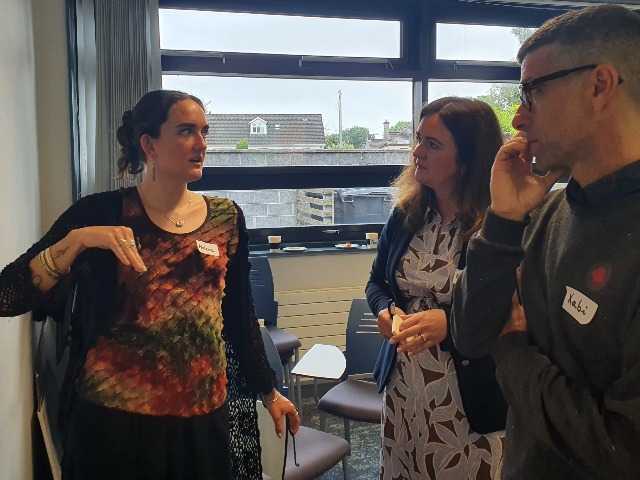
“If you don’t like the weather, wait five minutes.” was a phrase uttered to us as we stood underneath a sky marbled with a repeating pattern of both vivid blue sky and impending storm, rain diving in and out of gaps in the clouds. Galway, Ireland proved itself eager to live up to stereotypes. Underneath all this activity was something else that would capture my interest; the 2nd workshop of the ENLIGHT-funded InfraCARE (Urban Infrastructures for Climate Action Repair) thematic network.
While this saying was undeniably true for the weather, it stuck in my mind as analogous to how academia can sometimes be: while it is often felt that the academic world is in some ways above trends, it is as looped into fashion cycles as the kids walking around lately who look like they’ve been squarely dropped into the present from 1998. AI is one of the most obvious culprits, with many positions and grants geared towards the use of tools powered by AI, although this is already waning. Thus, research trends may come and go, with emphases on different approaches to research and varying tactics to analyse data. If these don’t suit you, you can wait the proverbial five minutes, but there are some things that, when noticed, cannot be allowed to leave the frame: care is one of these. In the furor of activity surrounding the exponentially dire impacts of climate change, it is easy to forget that research must not only be ‘useful’, but also thoughtful, careful, and reciprocal - and that is the aim of the InfraCARE project. Urban centers are, due to population density, urban heat island, and other factors, apt to be some of the regions to experience acute impacts of climate change, and the aim of the workshop I attended in Galway, Ireland, was to examine the methodologies that would allow us to understand the needs of those in vulnerable areas in a mutual, gentle, and non-extractive manner.
As a student assistant on the InfraCARE project, I was both excited and somewhat intrepid, as I have felt throughout my master's studies that having a broad and yet in-depth understanding of methods was not my strong suit. I had also taken part in the InfraCARE project’s kick-off event in Groningen, where I had been left feeling inspired by the project but also with an acute sense of the things that I didn’t understand or feel able to contribute to. This second workshop worked to dispel that feeling, as I became more comfortable with the idea of myself as a ‘bona fide researcher’. Reassured that I wasn’t expected to know everything, I saw fully the value of our interdisciplinary team and admired the way that members of the project were able to bounce ideas off of each other to create a sum greater than its parts. The interactive sessions, which were intimidating at first, became natural thanks to the charm, friendliness, and expertise of the facilitators.
As one of the main foci of the InfraCARE project is to involve early-career researchers, I also had the pleasure of meeting other interested young researchers. I was curious what had drawn them, who had not previously been involved with the project as I had, to apply to attend the workshop, and this is how PhD candidate Júlia dos Anjos Marques approached it:
“As a PhD Candidate, many of the recommendations I receive are to look for meaningful opportunities for growth. For the work I put in to become something that adds to my research as well as to me personally. I can gladly say this was a very meaningful experience, one that went even beyond great references and talks, but that also led to deeper discussion, support, and care.”
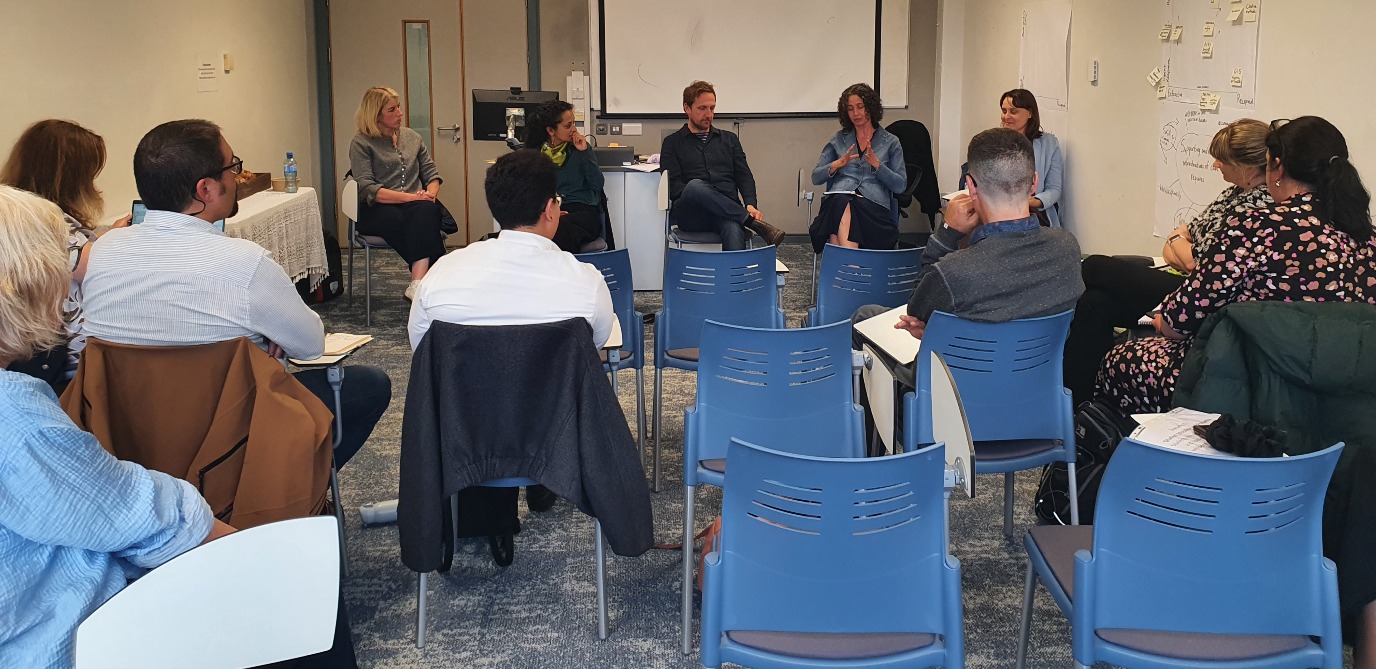
Talks were contributed on individual members’ areas of expertise, and I was particularly interested in Alma Clavin’s work with Repair Acts (repair cafes) in Bristol, UK, as I am always fascinated by the way in which we build relationships with material objects and perceive our autonomy in extending or transforming their useful lifespans. It doesn’t hurt that I’m also a knitter and sewist!
Stepping from theory and methods to practice, we were joined by a panel of folks that were one way or another involved in climate action projects in the local area, sharing their experiences, successes, and failures. From the fact that all of their presentations went over their allotted time, we could see how passionate they were about their subjects and how eager they were that we understand. When we are often fighting what feels like a losing battle in the sphere of climate change and social justice, it is easy to feel alone and unheard, but we were attentive to know what they wanted to convey to us and to also understand how these fit into a greater whole.
I had been unashamedly having an enormously fun time during the workshop, getting immersed in the possibilities for research and ways to productively approach communities, when a closing comment diffused my enthusiasm with a somber note: Are we qualified to do this? Are we competent enough to? This reminded me of the obvious reality that, in our campus rooms and academic workshops, we are attempting to interact and intervene in the lives of real people and communities and that we need even more than they need us. On that note, I share another PhD candidate reflection, that of Porooshat Sabeti:
“Over time, I realised that the knowledge we develop in academic spaces can only become truly meaningful when we find ways to connect it with the public, with lived experience, and with communities.
What stayed with me most was the experience of being in a space where people were genuinely thinking together, with openness, care, deep reflection, and a shared desire to connect critical thinking with practical action. For me, it felt almost like home: a space with people who were asking similar questions, but from different disciplines, places, and experiences. I left the workshop feeling energised, supported, and grateful to have been part of such a meaningful conversation on care, social infrastructure, climate justice, and community engagement."
And so, I left Galway feeling contemplative but still hopeful, motivated, grateful, and aware of just how care-ful we’re going to need to be.
About the author
Research Master student/InfraCARE project assistant