
From a School Project to the Farming of Tomorrow
What will farming look like in the future? For most pre-university (havo) students, it’s a distant concern. That was not the case for 17-year-old Daan. For his final-year research project, he and a classmate investigated how different farming systems affect soil life. He is now applying the insights from their research on his own plot of land, and in September he started the Innovative Plant Cultivation programme at Van Hall Larenstein University of Applied Sciences in Leeuwarden. His story shows how curiosity, practical research and a passion for farming come together in the next generation of farmers.
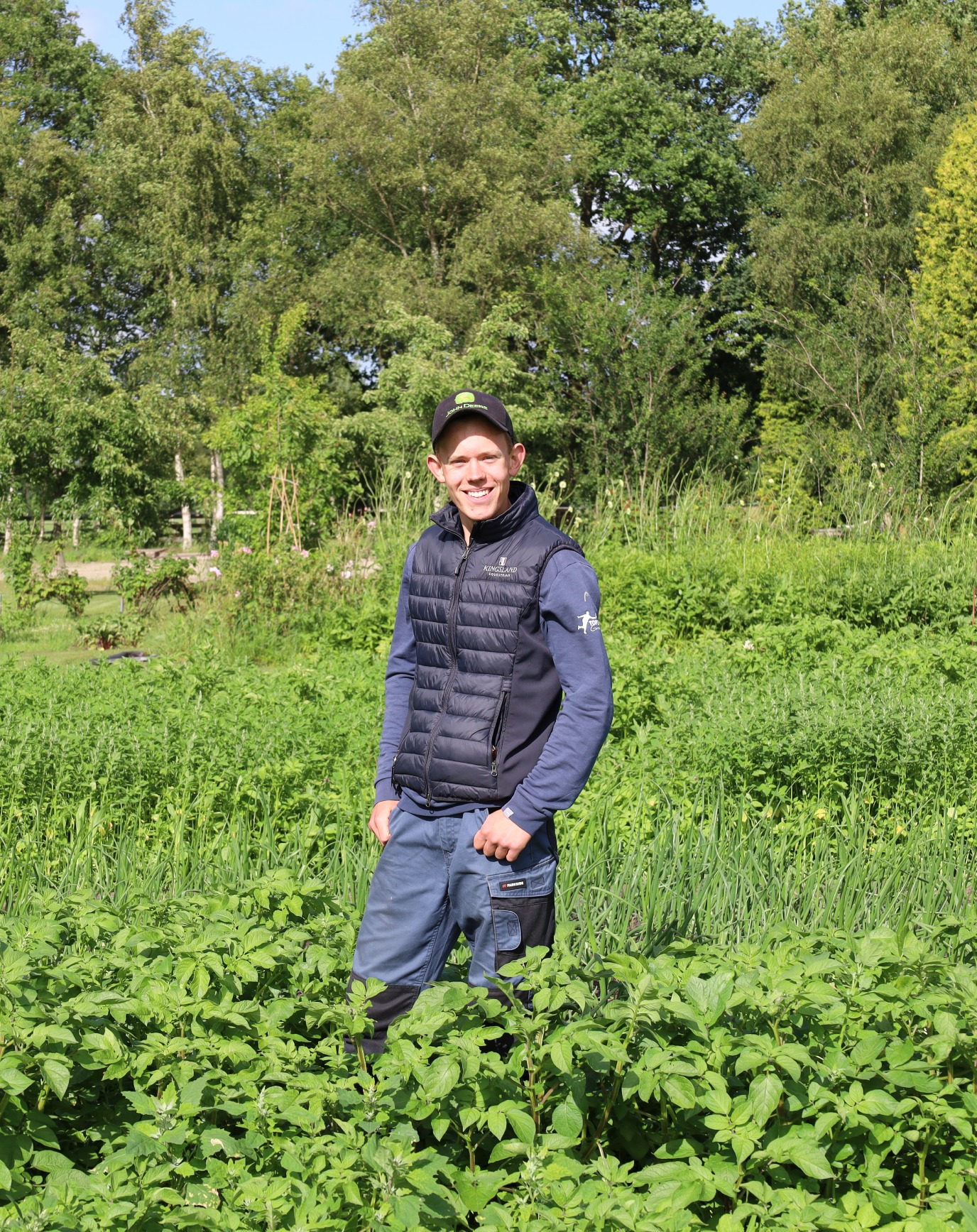
It wasn’t a given that Daan would one day want to go into farming. His parents don’t have an agricultural business. Even so, his interest took root at a young age, simply because he grew up surrounded by farms.
'When you’re a little kid, you see tractors drive by at some point and you think: that looks like fun. Then one day you get to ride along on one, stand in the milking parlour, help feed the cows, head out into the field or stand on a potato harvester. And I absolutely loved it.'
That curiosity grew into a serious interest in the soil beneath our feet. Because according to Daan, sustainable farming starts there. 'Without good soil life, you have nothing.'
Making soil life visible
For his project, Daan and a classmate investigated how three farming systems – conventional, organic and regenerative – differ in their influence on soil life. On three plots in the area, they buried cotton cloths. The further the cloths had broken down after two months, the more active the soil life, according to their research theory.
The main research question was: How does soil life activity differ between plots where conventional farming, organic farming and regenerative farming take place? 'You have conventional farming, which uses pesticides, artificial fertiliser and deep tillage. Does that affect soil life compared to organic farming, where no pesticides are used? And how does that compare to regenerative farming, where non-inversion tillage is applied and no pesticides are used?'
The results of their research were clear. The breakdown percentage of the cotton cloths on three regenerative plots rose to 80%; on one of the plots, only a few shreds of cotton were left. On the organic plot, around 50% of the cotton cloth had broken down, and on the conventional plot only 5%. 'From that we can conclude that regenerative farming really has a positive effect on soil life compared to organic, and certainly compared to conventional farming.'
A study that also changed his own outlook
Perhaps the most important outcome of the project wasn’t the experiment itself, but the effect on Daan’s perspective. He went into the research with an open mind and came out with new insights. 'I actually didn’t know anything about regenerative farming.' He had heard once that a neighbour farmed regeneratively, but he didn’t know what that involved. 'I’m also a bit of the old guard in that respect: just plough and go.'
After the research, he sees it differently: 'I think it really makes a difference when you leave the soil life alone. And that it pays off.'
I think it really makes a difference when you leave the soil life alone. And that it pays off.
This new knowledge doesn’t just stay on paper. On his own plot, Daan is now experimenting with compost instead of solid manure, and he chooses to use a rotary tiller (frezen) rather than deeper tillage. In doing so, he accepts that a slightly lower yield in the short term can contribute to healthier soil in the long term.
'You can keep spreading as much artificial fertiliser as possible and get the highest possible yield, but in 10 to 15 years that land is worth nothing. If you farm regeneratively, you make the land future-proof. Then in 100 years you can still harvest just as much from it as you do now.'
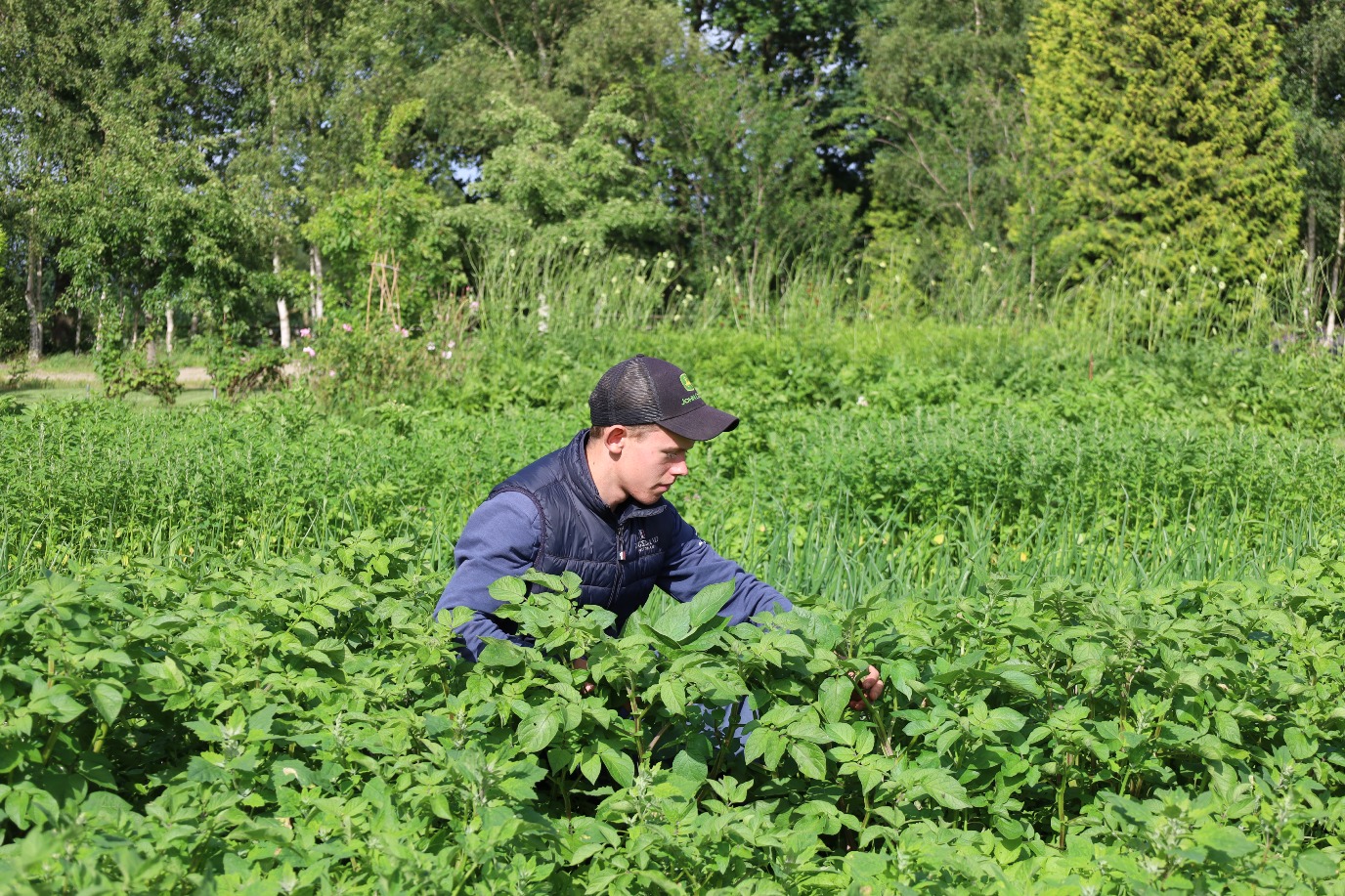
Proving that it works
According to Daan, sharing knowledge is at least as important as developing new knowledge. He notices that regenerative farming isn’t yet a given everywhere. 'If I bring up regenerative farming with a conventional farmer now, I hear: "No, that all doesn’t work." It’s simply not well known enough yet.'
His solution is simple: prove that it works. He believes practical examples ultimately persuade more than any discussion can. 'Take three plots on the same soil type. One conventional, one organic and the other regenerative. Visit them together and show: it does work.'
At the same time, he understands that farmers can only invest if there is enough future prospect to justify it. 'It’s an expensive investment. If you want to start with strip cropping, for example, and you only want to make strips of three metres, you also have to adapt your machinery. To do that, you need to have a future perspective; it has to be profitable.'
A vision for the future that looks beyond a single plot
Daan has since passed his havo exams, and after the summer he will start the Innovative Plant Cultivation programme at Van Hall Larenstein. His dream is ultimately to have his own farm in which soil life, closed loops and biodiversity take centre stage. A farm with a variety of crops, animals that make use of residual streams, and as little dependence on external inputs as possible.
'I think that has the future. Because it also saves a lot of logistics if you can spread your own manure on your own land, and use the products you make yourself, selling part of them. That way you’ve closed the loop. I think that’s the way to go into the future.'
He also sees strip cropping as an important part of that future, where different crops reinforce one another and diseases spread less quickly. His view is remarkably nuanced. In his opinion, not everything can be fully organic, and some challenges call for new innovations. But one wish for the farming of the future is firm. 'I hope that a large share of arable farmers, but also dairy farmers, are actively working on their soil life. That artificial fertiliser and pesticides are left behind by then, and that we’re busy monitoring soil life.'
Asked whether he would also test soil life with cotton cloths on his own farm, his answer is clear. 'No, this test is a bit too superficial for that. I would do soil tests to map out the nutrients in the soil, look at which organisms are present, or test whether there’s enough water permeability. After that you can look at how to make up for any deficiencies and make more targeted crop choices to keep the soil healthy.'
The next generation
The questions Daan and his classmate asked themselves during their project touch on themes that the Centre for Sustainable Agriculture Transition (Centrum voor Duurzame Landbouw Transitie) works on every day. How do we make farming more ecologically resilient, economically viable and socially future-proof? How do we make sure new knowledge doesn’t stay on paper, but is also applied in the field?
Daan’s story shows that the agricultural transition isn’t shaped only by today’s researchers and farmers. The next generation is also already thinking critically about the future of our food system, asking questions, doing research and daring to challenge existing ways of working. That very curiosity and inquiring attitude are indispensable if we are to build the farming of tomorrow together.