

Revealing Relations: Why Better Knowledge Infrastructures Matter for Liveable Futures
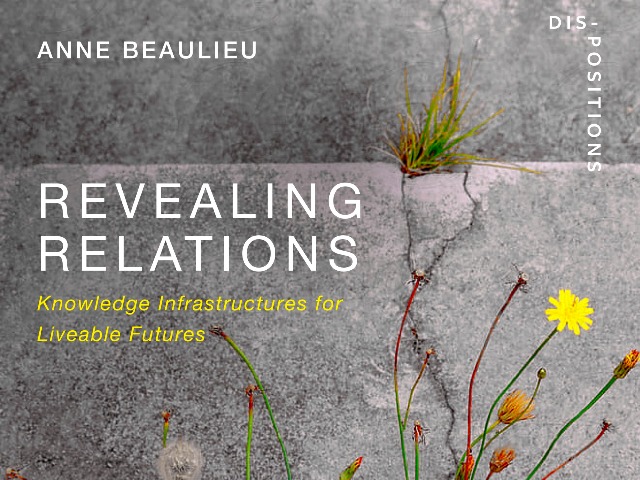
Knowledge infrastructures matter and actively contribute to shaping the futures we are able to imagine and realise. These ideas are explored in depth in the new book Revealing Relations: Knowledge Infrastructures for Liveable Futures by Anne Beaulieu, which builds on research done at Campus Fryslân. Anne was recently appointed Chair in Knowledge Infrastructures for Sustainability at the Copernicus Institute of Sustainable Development within Utrecht University’s Faculty of Geosciences. In this blog post, Anne examines the limitations of current knowledge infrastructures, argues for the need to rethink how they are designed and used, and highlights examples of researchers who are developing and experimenting with promising alternative ways forward.
What knowledge infrastructures do
Think about the following words:
-
Crop
-
Weed
-
Refugee
-
Citizen
-
Emission
-
Contaminant
These are categories that are supported by knowledge infrastructures that help classify and manage objects. They are also categories that determine whether something is seen as desirable or harmful, whether certain forms of life are supported or threatened.
As a result, the futures of some forms of life are either made precarious or liveable. The book Revealing Relations builds on the work of the past 5 years pursued in the Knowledge Infrastructures Department of Campus Fryslân, and explores the intersection of knowledge infrastructures and liveable futures.
Technologies have ethics and politics
Knowledge infrastructures play a determinant part in establishing thresholds and their monitoring, whether at small scale, like water quality, or very large scale, like transgression of planetary boundaries—as in the recent work of Clarisse Kraamwinkel. They are also central to conservation measures and climate adaptation.
An important contribution of the book is to demonstrate how ethical problems arise when we neglect to account for the role of technologies in shaping encounters with forms of life. When these roles are made explicit, much better knowledge infrastructures can be developed.
Baselines as example of why we need better knowledge infrastructures
Contemporary knowledge infrastructures have a strong tendency to background relations and to foreground objects. For example, knowledge infrastructures are often used to determine baselines and to pursue monitoring activities over a long period of time.
Through the creation of baselines as technical common ground, knowledge infrastructures open up the possibility of monitoring action in equally technical ways, and introduce a logic of ‘harm’ to many contexts. This means that rather than opposing an action (such as mining, building on green fields, or fishing in a nature reserve), the discussion is shifted to a logic of ‘how much’ of this activity can be pursued, with what quantifiable level of harm.
Rather than being a matter of principle, with the production of a baseline via a knowledge infrastructure, it therefore becomes a question of how much, where, in which ways, with which effects. This backgrounds relations to place, to nature, and puts forth a view of human and more-than-humans relations that is limited and impoverished.
This approach to knowledge infrastructures maintain the underlying logic of resource assessment -- whether for exploitation or preservation. Knowledge infrastructures can be very effective ways of creating conditions for extractive practices, even in contexts where that is not the primary intention.
Ongoing work
It is possible to develop and use knowledge infrastructures in more critical and reflexive ways. For example, the work of Ruth Howison and Mohamed Henriques and Selen Eren engages with how to track the state of migratory bird conservation; Carol Garzón-López innovates with biodiversity monitoring, while Taylor Craft develops suites of tools for more integrated approaches to research and environmental regulation, and Matilde Ficozzi does the same for showing relations in data sets that first seem intractable, along with Dario Rodighiero. Marina Bool explores how regenerative agriculture in the Netherlands requires regenerative knowledge infrastructures and Stephanie Ketterer examines the material and regional aspects of data infrastructures. In addition, the work of Maarten Loonen, Sarah Feron and Raúl Cordero shows that it is crucial to include how climate mitigation and monitoring of climate effects can have distinct impacts in different regions of the world, and Efe Cengiz and Marije Miedema put forth proposals for imagining futures that do not reproduce extractive dynamics.
Hope and imagination
These lines of work inspire critical assessment, spur imagination and feed hope. The first part of Revealing Relations examines the mechanisms that lead to extractive knowledge infrastructures, while the second half presents alternative paths to better knowledge infrastructures.
By making relations central to knowledge infrastructures, rather than focus on discrete objects like populations, levels of pollution, or global average temperatures, the hope is that better knowledge infrastructures contribute to liveable futures by enhancing the means for living together, rather than perpetuate the view of nature-as-resource.
Read more
Published by Bristol University Press, the book Revealing Relations: Knowledge Infrastructures for Liveable Futures will be available from 26 February 2026 as an open access publication and in paperback. It also includes a jointly authored chapter by Selen Eren and Marthe Stevens.
About the author
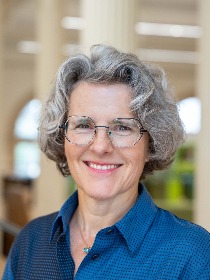
Prof. dr. Anne Beaulieu held the Aletta Jacobs Chair of Knowledge Infrastructures at the University of Groningen, The Netherlands.
More recently, professor Beaulieu has been appointed to the newly established chair in Knowledge Infrastructures for Sustainability, within the Faculty of Geosciences’ Copernicus Institute of Sustainable Development of Utrecht University. She will focus on developing knowledge infrastructures in biodiversity and climate science to support liveable futures.
More on her profile, publications and research engagement is available here.