
Local confidential advisor Ella Sebamalai: ‘Together, we’ll decide on the wisest course of action’
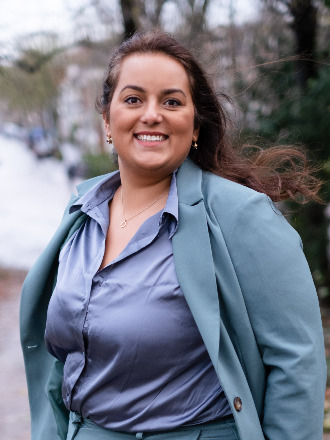
The University of Groningen is committed to creating a working and learning environment in which everyone feels welcome and at home. Unfortunately, unwanted behaviour sometimes stands in the way of this. Examples include an inappropriate joke, a coercive text message or a disparaging remark. Anyone who experiences this often feels the need to discuss it with an independent person. In a number of faculties, this is possible through a local confidential advisor. Ella Sebamalai is the project leader for expanding this form of support. ‘Often, you’re not quite sure how to interpret what someone has said or done. That’s when it helps to have someone who can think things through with you.’
As an anthropologist, Ella has always been interested in power and inequality and the underlying patterns. Her appointment as Diversity & Inclusion Officer at the Faculty of Economics & Business fits in seamlessly with this. She has also been the local confidential advisor at this faculty since 2022. ‘In this role, I’m approachable and readily available to students and colleagues who are faced with inappropriate behaviour. Over the course of one or more conversations, we discuss what has happened. The colleague’s or student’s experience is the guiding factor here. Together, we identify possible solutions and decide on the wisest course of action.’
Door-handle conversations
‘In my role as Diversity & Inclusion Officer, I often found myself dealing with people who, after a formal meeting, felt confident enough to raise a sensitive issue as they were leaving, with their hand on the door handle. Based on this experience, I became a local confidential advisor. A number of other faculties have now introduced this role as well. We are now at the stage of standardising and professionalising this role. To this end, we have set up a network. Faculties or services that do not yet have a local confidential advisor are warmly invited to find out more and get involved. Within the network, we organise peer support sessions to learn from one another. We are also working on frameworks, procedures, record-keeping and visibility.’
Collaboration
‘The reason for formalising and expanding the role of local points is the need for faculties and services to create an accessible environment in which behaviour that undermines social safety can be discussed. Our project is part of the Social Safety Programme, which – in line with the national recommendations by Ellemers and Hamers – is working to establish an effective support structure and a culture of mutual understanding, trust and solidarity. We work closely with the Central Confidential Advisor Office, including on peer review sessions and themed meetings. As the central confidential advisors are facing increasing waiting times, we, as local confidential advisors, provide a valuable complement to their work. Of course, anyone can also contact the Central Contact and Information Point for Social Safety. That service is primarily intended to point you in the right direction if you are unsure where to turn.’
Unconscious beliefs
‘Let me be clear: there is behaviour that is simply unacceptable, and we all agree that this must be addressed. At the same time, it’s my experience that we also deal with behaviour that is normal for one person but undesirable for another. Unconscious beliefs play a role here, such as the assumption that everyone speaks their mind or that jokes should be allowed. This can lead to a false consensus, which can only be broken by making uncomfortable situations open for discussion, even as a bystander. What certainly helps is asking each other open-ended questions as a preventive measure: what do you need, or what do you feel comfortable with? That’s how you discover just how different we are. It is precisely by being mindful of these differences that respect and appreciation for one another grow. And that is exactly what we want.’
Here you’ll find more information about the Social Safety Programme and the support the University of Groningen can offer you. If you’d like to know more about the role of local confidential advisors, take a look here.
More news
-
19 October 2026
From research to business: RUG Ventures helps ideas move forward
-
-
03 September 2026
Ming Cao reappointed as scientific director of the Jantina Tammes School