
New Social Safety Dialogue Sessions
The Social Safety Programme is organising a series of dialogue sessions in 2026. During these sessions, participants will engage in open and honest conversations about what it means to feel welcome and at ease at the University of Groningen. The next session will take place on Tuesday, 9 June. Would you like to find out more about this initiative? Please send an email to socialsafety rug.nl. We will then send you further information as soon as possible. You can find more information about the Social Safety Programme here.
Programme Manager Anne-Marie Petter states: “We believe that dialogue is one of the most powerful tools for improving social safety. It is more than just a conversation; it is a form of attention and reflection that helps us connect with ourselves and one another. In our experience, this leads to insights that really help us to move forward in understanding one another better and in sharing perspectives, without necessarily having to agree.”
Discomfort
The dialogue sessions provide an opportunity to experiment with tools that can help you have better conversations and experience genuine connections in your own workplace or study environment. Previous participants noted that the sessions helped them to explicitly express attention and appreciation, which can feel uncomfortable for people. These dialogues also helped participants to pause and reflect on the discomfort you may experience in moments when you feel unheard or disrespected.
Art of Hosting
The tools used by the dialogue session facilitators are based on the Art of Hosting practice. This methodology aims to promote participatory leadership with regard to complex issues, such as social safety. Participatory leadership means that everyone is invited to explore how we can work together to create more opportunities for meaningful conversations about social safety. In November, almost forty colleagues participated in a training session on this method. A new training will be organised in the autumn of 2026. More information can be found here.
‘Harvest’ of Dialogue Sessions in 2025
-
Story tell & Talk (May)
A storytelling session about silence and unspoken or unheard stories. We explored how we can create a space where all voices are welcome.
-
Walk & Talk (June)
A walk and a conversation about what you need to feel welcome and at home in your workplace or study environment. We listened to each other’s perspectives and discussed how we can achieve a shared understanding of social safety. -
Story tell & Talk (July)
A storytelling session about moments when you felt invited to speak up. We shared the impact of receiving this invitation and having the courage to use it to your advantage.
-
Watch & Talk (September)
Participants watched short video clips and then reflected on the influence of the context in creating safer spaces. We became more aware of how this is perceived differently. -
Story tell & Talk (November)
A storytelling session about intercultural differences in community building. We used the UNESCO Storytelling Circle method and discovered that sharing your story and inviting others to do so varies from culture to culture.
-
Creative Do & Talk (November)
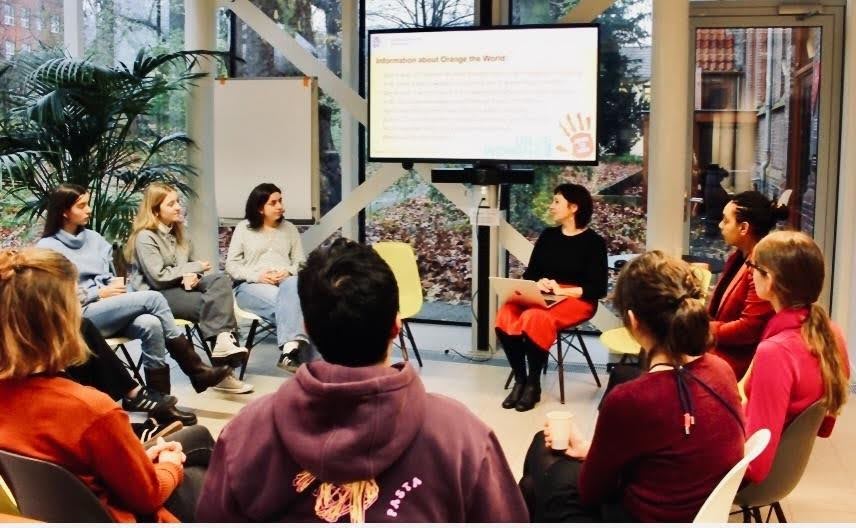
This creative session was inspired by the global Orange the World campaign. The campaign raises awareness of the need to prevent violence against women and girls. During the session, we drew pictures and reflected on how this issue is experienced in different contexts, as well as considering what we can do to contribute to a society where women and girls feel safe. It is crucial that we openly discuss what is not going well and how we can learn from that.
Creative Do & Talk Session (november)
Anita Wagner, trainer and coach at the Learning & Development department, facilitated the Creative Do & Talk session. “This session helped participants to listen to each other in a different way. For example, we drew while others were talking. This helps you to better understand others’ ideas before forming an opinion. Some participants shared a meaningful insight when asked to imagine a society without violence against women and girls. Ah, imagine that… I look back on an inspiring dialogue. Thanks again to the participants!
More news
-
19 October 2026
From research to business: RUG Ventures helps ideas move forward
-
-
03 September 2026
Ming Cao reappointed as scientific director of the Jantina Tammes School