
Best Practice Awards in Teaching & Learning 2026
The Best Practice Award is an annual celebration of best teaching practices at the University of Groningen. The UG Best Practice in Teaching and Learning Award recognizes courses that have implemented pedagogical practices or approaches and learning practices that relate to the UG's educational aims.
Our 11 faculties have nominated their best practices of the highest quality. The Best Practice Award Ceremony is planned to be the opening event of the Education Festival. It will take place on the 23rd of March, 2026. All nominated teams are invited to attend the ceremony during which the Rector Magnificus will award the winners.
Best Practice Awards 2026
The Teaching Academy Groningen congratulates the winners and all the other nominees on their inspirational best practices!
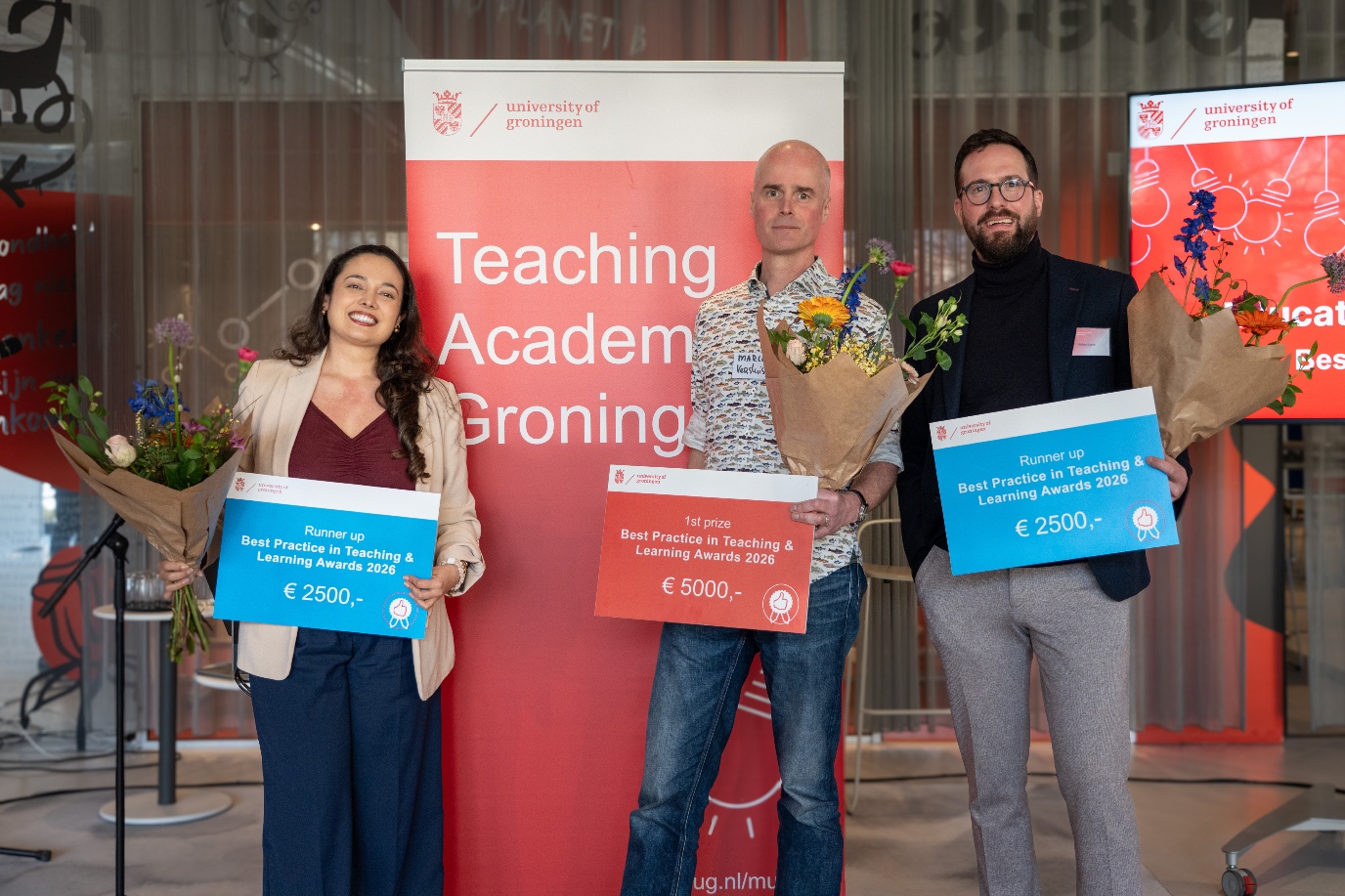
1st place: Faculty of Medical Sciences
The Teaching team of Marco Versluis and Heleen Helmholt from the Faculty of Medical Sciences was awarded the first place for the Interprofessional Education (IPE) unit in clinical education. The aim of this innovative teaching approach is to show the benefits of bringing together various relevant disciplines within healthcare in the context of patient care. This is achieved by having nursing, medicine and midwifery students work together within interdisciplinary clinical care. The team used interactive ‘working conferences’ to develop this course module in collaboration with nurses, midwives and doctors. This Best Practice demonstrates the successful integration of interdisciplinary and evidence-based education.
Shared runner-up: Faculty of Law
Maria Lorena Flórez Rojas from the Faculty of Law has developed her Best Practice to enable her students to combine theory and practice through a serious game titled ‘You Are Hired!’. In her course, students can develop skills in communication, teamwork and problem-solving by working on a practical case study. Students are ‘hired’ as consultants by private and public, international and Dutch tech companies. The aim is for them to take on different roles, conduct analyses, devise strategies and propose tailor-made solutions to the various stakeholders. Badges and leaderboards form part of gamification elements designed to reward effort and reinforce key learning objectives. The initiative enables students to work in a professional environment that strengthens inclusivity, dialogue and mutual respect.
It was also announced that Maria Lorena Flórez Rojas’s Best Practice has been nominated on behalf of the University of Groningen for the ENLIGHT Teaching & Learning Award 2026. This gives Flórez Rojas the opportunity to attend the ENLIGHT Teaching & Learning Conference 2026. This prize is awarded annually to a course or educational programme that has implemented innovative teaching and learning practices in line with the educational focus of the ENLIGHT network.
Shared runner-up: Faculty of Science and Engineering
Michael Lerch and Clemens Mayer’s course, titled ‘Yes, Chemistry is for me!’, was designed to foster a sense of belonging among STEM students and to encourage their engagement. Firstly, diverse, often overlooked, scientific role models are integrated in all aspects of the programme. Secondly, students are offered an engaging task in which they design chemistry puzzles collectively. These puzzles ultimately form part of an escape game. Underlying Lerch and Mayer’s instructional design is the assumption that the need for belonging and engagement with one’s studies promote academic success.
Nominees Best Practice Awards 2026
Faculty of Arts
Nominee: Josh Prada
Best Practice: Engaging Mind, Body, and Community: A Sensescapes Exhibit Model for Humane, Participatory Learning in Higher Education
Engaging Mind, Body, and Community in Sensescapes Research is a student driven, research driven teaching practice in the MA Euroculture that turns abstract cultural concepts into tangible inquiry through embodied, multimodal fieldwork and a public exhibition. The design aligns with UG’s Making Connections strategy by linking teaching and research, connecting disciplines, and positioning learning in dialogue with wider audiences. Students formulate a researchable question, collect and analyse multimodal data (fieldnotes, images, sound, sketches, linguistic landscape materials), and curate their findings into an accessible exhibit station. Alongside this authentic assessment, each group writes a short report that situates the exhibit within scholarly conversations and makes their interpretive decisions explicit. Structured peer feedback through a rubric supports formative development, strengthens collaboration, and improves analytic precision. The culminating exhibition invites co-learning among students, staff, and visitors from outside the programme. Students report increased ownership, confidence, and deeper conceptual understanding because they learn through making, analysing, revising, and communicating knowledge beyond the classroom.
Faculty of Behavioural and Social Sciences
Nominee: Marina Roos
Best Practice: Multi-stakeholder involvement in teaching research practice (In the course: Neighborhoods and Values)
The Neighborhood and Values course breaks new ground by re-embedding citizens and policymakers into the research cycle. While traditional research training often remains detached from society, this course places multi-stakeholder involvement at its core. Students investigate pressing social issues in neighborhoods — such as safety, loneliness, and social cohesion — working with recent municipal data and engaging directly with inhabitants of Groningen and local policymakers. From problem analysis and question formulation to data collection, analysis, and dissemination, stakeholders are actively involved throughout. Lectures provide methodological guidance, while tutorials and scaffolded assignments ensure continuous feedback and refinement. A guest lecture from the municipality introduces data sources and survey design, anchoring students’ projects in real policy contexts. The course culminates in a forum day at the House of Connections, where students present their infographics to both citizens and policymakers. This dual emphasis on research quality and science communication equips students with the ability to translate findings into accessible outputs for diverse audiences. By integrating multiple perspectives, the course strengthens trust in science, fosters professional development, and demonstrates that complex societal questions can be addressed collaboratively. Its transferable model shows how project-based education across disciplines can benefit from stakeholder engagement and science communication.
Faculty of Economics and Business
Teaching team: Bram de Jonge, Wei Zhu, Maximilian Osterhaus, Bertrand Achou, Nicky van Foreest
Best practice: Enhancing student engagement through programme-level continuous assessment
This best practice involves the design and implementation of a programme-level approach that increases student activity and attendance through continuous assessment in a controlled environment. The design consists of weekly joint assessment sessions for multiple courses in the exam hall. This is supported by a developed tool that facilitates continuous assessment and assessment for learning. The approach has led to more active students and higher tutorial attendance, which is important for fostering a sense of community. In course evaluations, students report that it helps them stay engaged throughout the course and appreciate completing courses over time. Moreover, students are more focused on understanding the material. The best practice can easily be transferred to other programmes at the UG and is particularly valuable in the first year of study. By successfully activating students and increasing their offline attendance, it contributes to overall educational quality at the UG. When exam hall capacity becomes a constraint, weekly assessment sessions may need to be scheduled on days other than Friday.
Faculty of Law
Nominee: Maria Lorena Flórez Rojas
Best Practice: You Are Hired! A Serious Game for Building Communication, Problem-Solving, and Team Dynamics in Legal Education
You Are Hired! challenges traditional legal education by immersing master’s students in real-world scenarios where they are “hired” as consultants to assist public and private organizations. Each stakeholder, ranging from Microsoft to the Dutch DPA, presents a complex legal-tech challenge, requiring students to analyse, strategize, and deliver tailored solutions. Students rotate through roles: presenters, feedback providers, and support members, mirroring professional teamwork and reinforcing inclusivity, dialogue, and mutual respect. Grounded in experiential learning theory and constructive alignment, the game combines sprint-based learning with authentic deliverables: client memos, stakeholder maps, legal briefings, and oral presentations. Gamified elements (badges, leaderboards) reward formative effort and reinforce key learning outcomes like communication, ethical analysis, and collaboration. Offered during Blocks 3 and 4, the simulation is scalable and platform-flexible, with hybrid delivery options and strong interdisciplinary potential. Students consistently report increased confidence, professional insight, and motivation. External stakeholders value the students’ professionalism and continue to co-develop challenges.
Recognized at ISAGA 2025 and selected for publication in the ZNS series, the practice also underpins an Erasmus+/ENLIGHT-funded project on digital simulation games. You Are Hired! bridges academic learning and real-world impact, offering a transferable model for future-proof education at UG.
Faculty of Medical Sciences
Teaching team: Marco Versluis, Heleen Helmholt
Best Practice: Interprofessional education (IPE) ward
This nomination concerns the successful implementation of an Interprofessional Education (IPE) Unit on a clinical maternity ward. Addressing the difficulty of implementing IPE in high-pressure workplaces, this project utilized Educational Design Research (EDR) to bridge the gap between educational theory and clinical practice. The innovative core of this practice is transformative participation: rather than a top-down implementation, the curriculum was co-created with workplace professionals (nurses, midwives, doctors) through interactive "work conferences." This resulted in a sustainable learning environment where students from different disciplines care for patients together. The project delivered 14 generalizable design principles and demonstrated that educational innovation can simultaneously improve clinical workflow (e.g., patient rounds) and bridge professional silos. This practice serves as a blueprint for evidence-informed, interdisciplinary education at the University of Groningen.
Faculty of Philosophy
Teaching team: Lodi Nauta, Pauline Kleingeld
Best Practice: Thinking Beyond Jargon
In philosophy, ‘old’ rarely means ‘outdated’. Letting the past speak to the present, however, is not easy. A main obstacle is the historical jargon that is alien to us nowadays. In the eighteenth century, for instance, David Hume uses terms like ‘impressions of reflection’ and Immanuel Kant speaks of the ‘synthetic a priori’. Understanding their ideas requires that we do not simply echo these terms, but translate them into plain, ordinary language. Our nominated practice promotes an understanding of ideas by letting students ‘peel off’ the jargon. The practice aims to teach students to express ideas of past thinkers in plain and contemporary language. Developing this skill does not only help philosophy students understand ideas, but is transferable to any discipline. In philosophy, biology, and physics alike, the same litmus test of understanding can be applied in the classroom: Can a student express the idea behind a formula or theory in their own, natural and plain, language, without the comfort of jargon or formalization? Inviting students to explain whatever they learn to themselves, using their own terms, instead of merely taking in what the author of an article or book tells them, is useful for teaching any discipline.
Faculty of Religion, Culture, and Society
Nominee: Todd Weir
Best Practice: The creative use of network in the course: Creative Heritage: Practices, Communities and Institutions
In the course Creative Heritage: Practices, Communities and Institutions, guest speakers and excursions are used to help students orient themselves within the professional field. Because this approach facilitates contact with both local stakeholders and experts from the Netherlands and abroad, it is a good example of the meeting of global and local. In addition, this method bridges the gap between theory and practice, particularly through the development of a plan focused on local heritage in Groningen. In this way, students are challenged to apply their theoretical knowledge in a practical case study. As such, the creative use that the instructor, Professor Todd Weir, makes of his network provides a valuable opportunity for students: on the one hand, by offering insight into different disciplines of the heritage sector, and on the other, by allowing them to gain hands-on experience at the local level.
Faculty of Science and Engineering
Nominee: Michael Lerch
Best Practice: Yes, Chemistry is for me! Belonging and Engagement in a STEM classroom, through models and escape games
This Best Practice presents an out-of-the-box, research-informed approach with clear potential for implementation across the university. The initiative addresses a critical challenge: the lack of visible diversity in science education. By integrating portraits of scientists representing diverse genders, backgrounds, and abilities, co-created with former students, it offers first-year students authentic, relatable role models that strengthen their sense of belonging and engagement. Its pedagogical design is particularly compelling. The combination of storytelling, role-model exposure, co-creation, and game-based learning fosters deeper understanding, collaborative skills, and active participation. Students work together to design puzzles that are later transformed into an educational escape-room experience. Because the escape-room format is not lab-dependent, the concept of learning through discipline-specific riddles is broadly adaptable. Likewise, the inclusive role-model materials can be easily integrated into courses across programmes. Together, the game-based learning concept and the diversity-focused approach offer a creative, impactful model that can be transferred widely across the university.
Faculty of Spatial Sciences
Nominee: Peter Groote, Erik Meijles, and guest lecturers
Best Practice: Nature, Landscape and Heritage
Nature, Heritage and Landscape is an interdisciplinary course, where a combination of different teaching styles are used to encourage students to actively contribute to the course. The course evolves around interaction and discussion, where different perspectives are shared and students and teachers learn from each other. Because students prepare beforehand, during classes we are able to delve deeper into concepts. Fieldwork trips show a clear link to the working field, showing students how they are being prepared for their future careers. Students feel that the combination of lecture styles creates a steeper learning curve and creates a deeper understanding of the concepts discussed. Students feel motivated to actively contribute to the course and learn from their peers.
Campus Fryslân
Nominee: Taís Fernanda Blauth
Best Practice: Teaching critical AI literacy through AI exploration
This best practice introduces first-year undergraduate students to critical Al literacy through a creative and reflective learning activity. Students explore the societal and ethical implications of GenAl by using these tools to create an artwork related to the topic of Al companionship. They then analyse the output, identify underlying assumptions and biases, and present their reflections as part of an exhibition titled "Al Love You”. The activity combines hands-on experimentation, structured discussion, and conceptual development, encouraging students to act as creators, critics, and communicators. By examining issues such as algorithmic bias, lack of transparency about training data, and the inner workings of these systems, students develop a deeper understanding of how GenAl might be shaping their own study practices. The practice positions itself as an opportunity for questioning and learning through direct engagement with the technology under analysis. Feedback shows that students became more aware of the limitations of Al tools and more confident in evaluating outputs critically. The approach is flexible, engaging, and easily transferable to other educational programmes. This practice demonstrates how educators can support responsible and meaningful engagement with Al in the classroom.
University College Groningen
Nominee: Roland Chiu
Best Practice: Own the Evidence: Journal Clubs That Train Independent Thinkers
Dr. Roland Chiu, who has been one of UCG’s most experienced lectures has a best practice that truly represents LAS education. “Own the Evidence” is a progressive, evidence-focused journal club model that trains students to think and speak like practicing scientists. Instead of summarizing papers, students learn to dissect them through unscripted, lab-meeting–style discussions that emphasize methods, controls, statistics, and the distinction between claims and evidence. Across three years, autonomy increases: first-year students analyze instructor-selected papers; second-year students choose from a curated shortlist and justify their choice; third-year students independently select top-tier articles and lead the discussion themselves. This approach builds scientific identity, confidence, and critical thinking by immersing students in authentic scholarly dialogue. The assessment is focused on prioritizing preparation, clarity of reasoning, quality of critique, and reflective understanding of evidence and limitations. The format is highly transferable across disciplines, requiring only suitable articles and a capable discussion chair. Colleagues who have adopted the practice report stronger engagement, clearer expectations, and noticeable gains in students’ communication skills and analytical depth, while students experience the transformative effects: they shift from summary to critique, challenge data appropriately, and feel prepared for real lab meetings, MSc interviews, and professional environments.