
Clothing and circularity
Twenty years ago, sustainable fashion was still a niche, but it has now become far more mainstream. Second-hand platforms and growing consumer awareness have played an important role in this shift. At the same time, fast online fashion companies are rapidly gaining ground, particularly among younger audiences sensitive to targeted marketing.
Researchers at RUG are working to make clothing production more sustainable, addressing barriers such as low prices, rapid turnover, and complex supply chains, while exploring solutions that are both scalable and impactful.
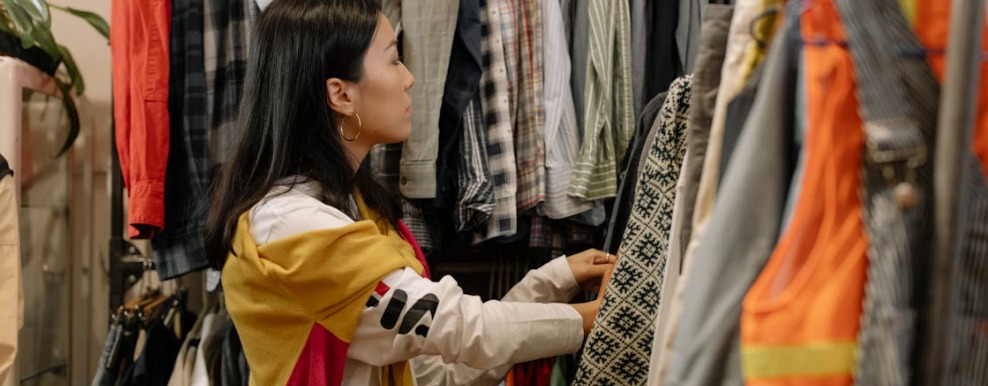
Passion for sustainable fashion
Chilean journalist María Pilar Uribe Silva has dedicated half her life to making the clothing industry more sustainable. This summer, she started a PhD project at the RUG. ‘I think it is possible, a more just and sustainable clothing sector. What we need is a different narrative.’
he fashion industry is one of the largest manufacturing industries in the world, alongside cars and technology. Every year, a hundred billion new items of clothing are released onto the market, many of which are ‘fast fashion’: cheap, poor-quality clothing intended to last just one season. The sector is one of the most polluting in the world, with as much CO2 emissions as the whole of Europe, plus an astonishing amount of waste and water consumption.
Interview with Kim Poldner and Ellen van der Werff on Fast Fashion
UG scientists Kim Poldner and Ellen van der Werff talk about ‘circular textiles’. Although the rise of ‘ultra-fast fashion’ is disturbing, the two researchers also see great opportunities, for example in the field of digital fashion.
From oyster mushroom to overalls
A T-shirt made from fungi — or mycelium textile, to be more exact. It would be a great step toward a more sustainable fashion industry. At least it could be if the material could be developed in such a way that it can be used for clothing and if consumers accept it and want to wear it.
Marleen Kamperman, Professor of Polymer Science, and Marijke Leliveld, associate professor of Consumer Ethics, have combined their expertise and are working on both questions at the same time.
University of Groningen plays key role in circular textile project SORTED
The University of Groningen is one of fourteen partners in the groundbreaking SORTED project. The multidisciplinary project is led by Sympany and focuses on innovation, recycling, behavioral change, and circular business models throughout the textile chain, from collection and sorting to reuse and fiber-to-fiber recycling.
Sympany, an organization that collects and sorts textiles, is working with partners to automate the sorting of collected textiles using artificial intelligence and robots. For this, Dr. Mauricio Muñoz-Arias of the Faculty of Science and Engineering (FSE) is developing robotic sorting cells that automatically recognize and separate textiles by material type.
Another part of the project is the high-quality chemical recycling of discarded textiles, in which, for example, polyester fibers are reused as raw material for new clothing. Led by Prof. Gert-Jan Euverink (FSE), advanced recycling methods are being sought for cotton and polyester, so that sorted textiles can be sustainably converted into new fibers.