
UG and India open call for proposals in hydrogen fellowship scheme
At a high level meeting in Delhi on Friday 6 February the Indian government’s Department of Science and Technology (DST) has officially opened the first call for applications for the Netherlands India Hydrogen Valley Fellowship Programme. President Jouke de Vries chairman of the Board of the University of Groningen (UG) was in attendance, as well as a number of top Indian partners with whom the UG expects to work with. The signing ceremony of an agreement between the UG and 19 Indian Institutes of Technology (IITs), paving the way for research collaboration through this government sponsored programme, was also part of the event.
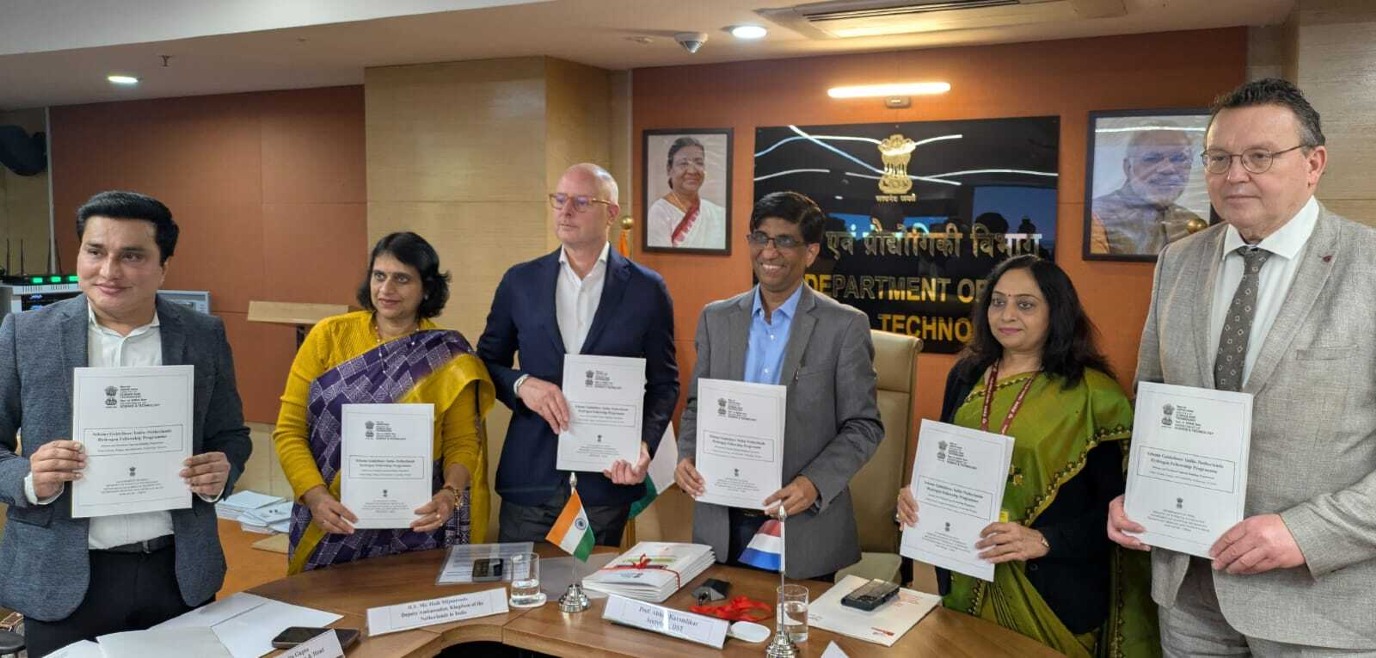
The overall goal of the fellowship is to develop much needed talent for India’s energy transition, contributing to the Indian hydrogen mission and the EU-India hydrogen partnership.
Starting signal
The opening of the call for proposals on 6 February is the signal for young researchers in India to actively approach principal investigators in both the UG and at Indian universities to propose their project. It allows researchers in both countries to begin working closely together on various aspects of the hydrogen economy, and to develop long-term working relationships which are key to success in such collaborations.
Hydrogen fellowship scheme
The fellowship scheme will allow doctoral candidates and post-docs at well established Indian universities to come to the UG for 12 months, to have their doctoral or postdoctoral research co-supervised by one of the UG’s experts in the field (a so-called double PhD, and double post-doc). Funding for the duration of their research will be provided by the Department of Science and Technology, with co-funding for their stay in the Netherlands from the UG. The scheme also allows for a smaller number of fully fledged academics to spend up to one year at the UG, which will further strengthen the collaboration.
New Indian partners
As part of the high-level gathering, an MoU was signed between the UG and 19 of India’s Institutes of Technology (IITs). India has a total of 23 such universities, and signing one agreement with such a large number will swiftly pave the way for researchers from these universities to begin working with colleagues from the UG. It is very rare for such an agreement to be signed between a large number of IITs and just one overseas university. The UG is honoured to be recognised for its strong technical and interdisciplinary expertise in this area, and for its work in the further development of the northern Netherlands hydrogen valley. The Indian government is funding four such hydrogen valleys (in Pune, Jodhpur, Kerala, and Odisha) and there are more privately funded valleys collaborating with Indian knowledge institutions.
Collaborations through the fellowship scheme are not limited to these 19 institutions; in principle any of India’s hundreds of universities are welcome to propose collaborative projects for funding from DST. Indeed the UG also expects a number of the first fellows to be from other Indian institutions, such as BITS Pilani, with whom the UG already has an MoU and a framework agreement for double degree PhDs.
Hydrogen, and beyond
Research in hydrogen at the UG is interdisciplinary, and a main focus of one of the UG’s four Schools for Science and Society - the Wubbo Ockels School of Energy and Climate. It therefore represents just one of the four major research themes at the UG, defined by global societal challenges. These first steps in working together on the energy transition will hopefully lead to further collaborations in digitization and AI, healthy aging, and sustainable society.

An exciting and inspiring week
Friday’s signing and launch comes at the end of a series of events in India which the UG has attended. Goa was host to the India Energy Week 2026 (27 - 30 January), followed by the QS India Summit (1 - 3 February) at which higher education leaders from India and around the world were present to discuss the future of HE in India.
Professor De Vries is in India for the first time, and the visit has made a big impression on him:
“India is the largest country in the world by population, and on this visit I have learned that around half of this population is under the age of 25. This is a challenge for the country’s educational sector, but also a great opportunity f or India to be ambitious in forging a bright future. There are also ambitious plans for the energy transition to renewables such as green hydrogen, and India looks to countries like ours to provide collaboration, expertise and to train talent for that transition. I am proud that the UG has been highlighted for its expertise in this area, and we are keen to begin working on the new collaborations that have been set in motion this week.”
Professor Lorenzo Squintani (Professor of Energy Law and the Director of the Wubbo Ockels School of Energy and Climate):
“With this step, Hydrogen Valley Campus Europe (HVCE) broadens the international network of the Northern Netherlands in the field of green molecules transition. This opens new concrete opportunities for HVCE partners to establish new contacts in a strategically important country for the production of green hydrogen. Now that the scheme has been launched, the real work begins!”
More information
Applications for the first call will be accepted until 6 March 2026. If you have any questions about how to apply for the fellowship programme, please contact the UG at dstfellowships.groningen rug.nl.
More news
-
-
03 September 2026
Ming Cao reappointed as scientific director of the Jantina Tammes School
-
01 September 2026
Evrim Ursavas appointed scientific director Wubbo Ockels School