
Groningen on the map as European capital of hip-hop
Groningen has had a lively hip-hop scene for many years, but nowadays it stretches as far as the academic world. Steven Gilbers is researching the linguistic aspects of rap. He helped to compile an exhibition about hip-hop in the Groninger Museum, and arranged for an international hip-hop conference to be held in the city.
Text: Kirsten Otten / Photos: Siese Veenstra
Luckily, the Groninger Museum is quiet when I meet Steven Gilbers for a guided tour of the Hip Hop Is exhibition. A group of school pupils is standing around a work of art by Rammellzee, listening a commentary given by their guide, with rap music playing in the background.
This is like a second home to Gilbers. The assistant professor of English Linguistics, specializing in hip-hop and African-American English was closely involved in compiling the exhibition, which runs until May, and prepared the European Hip Hop Studies Conference, that took place in March. ‘Along with UG colleague Alex de Lacey and a PhD student from Leiden, Dastan Abdali, I form the core team of the organization. It was a four-day conference with over 100 speakers, panel discussions on themes like hip-hop activism, film screenings, and obviously concerts and dance.’

Love at first sight
Although Gilbers refers to the conference as ‘having got slightly out of hand’, he certainly doesn’t seem stressed. With a spring in his step, we pass works that he’s particularly fond of. He points to photos of graffiti art in New York metros taken by Martha Cooper and Henry Chalfant. ‘The idea behind these train bombings was: if we can’t hang our work in the art galleries, we’ll turn the city into a gallery instead,’ he explains.
‘This creativity and defiance is deeply rooted in the hip-hop culture and is what appealed to me as a child. When I was nine, my father, who was also a linguist and musician, gave me Eminem’s CD The Marshall Mathers LP. I only understood one word in the track list: criminal. So I skipped straight to that track. You know why? Because I'm a criminal! It was a bolt from the blue, love at first sight (or sound!). I learned the lyrics by heart and studied rhyme schemes. Eminem said that he sounded black and I tried to work out what that meant. What is African-American English, and what is hip-hop language? So that’s how I ended up in the Groningen hip-hop scene, started rapping, and studying English. Everything I do is hip-hop if you think about it.’
Tupac’s language
We enter a room with portraits of hip-hop legends and stop to look at Dana Lixenberg’s famous black-and-white photo of Tupac Shakur. ‘Tupac’s speech and rap style was the subject of both my Master’s thesis and my PhD research. I focused on how they changed after he moved from the east to the west coast of America.’ Gilbers carried out a detailed analysis of the development of Tupac’s vowels, rhythm, and intonation, and discovered that he had been adjusting his style to match his new identity as a West Coast rapper. ‘Fuck New York doesn’t sound convincing when spoken with a New York accent,’ Gilbers laughs. ‘Language and music are instruments for expressing your identity. It’s almost impossible to separate style and content in hip-hop. Rhythm and pronunciation reflect a social reality and Tupac understood this only too well.’
Layered
Gilbers is continuing his research line as a linguistics lecturer in the English programme: ‘Last year, I introduced The Language of Hip Hop as an elective. We studied creative aspects such as word play, and more complex aspects like gender norms in hip-hop, which led to some lively discussions among the students.’
According to Gilbers, the fact that manifestations from hip-hop culture are now being embraced as accepted forms of art, are being displayed in museums, and are the subject of academic research, does not detract from the scene’s authenticity and meaning: ‘On the contrary: the social dimension is still very much at the forefront. Hip-hop now responds to political tensions, social inequality, and identity issues — sometimes explicitly, but usually in a highly layered form. You only understand it if you really listen.’
Groningen scene
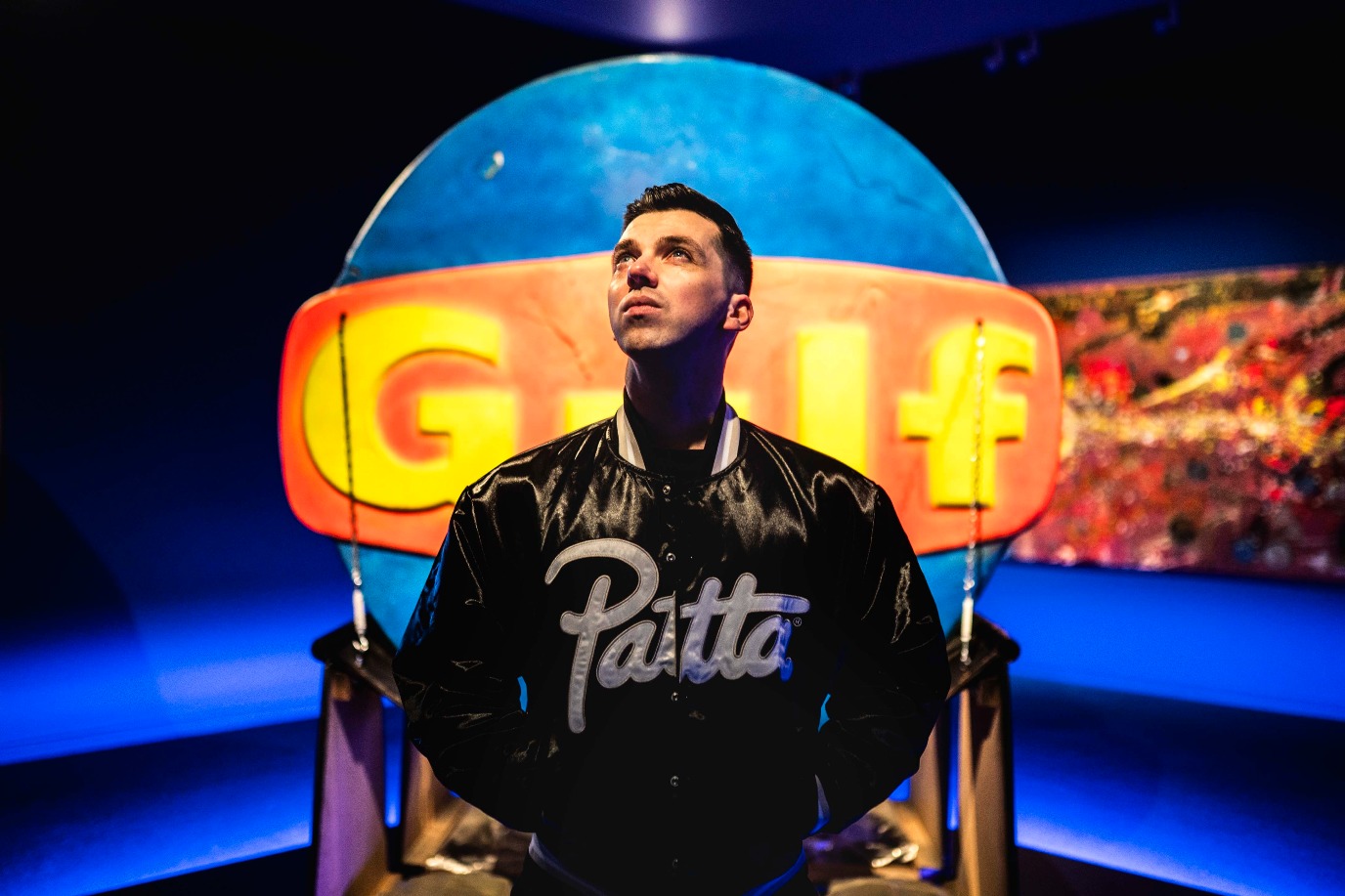
One room in the exhibition is dedicated to the history of the Groningen hip-hop scene. It was arranged by Sherlock Telgt and Dennis Kok, alias DJ Lowpro. ‘They’re both veterans of the local scene, who campaigned hard to get this room.’ Gilbers is himself part of this scene, as a rapper — he recently released the single Scenic Route on an American label — and as a programmer at the Homebase event. ‘It’s not widely known that Groningen has long been an important place for graffiti and hip-hop music in the Netherlands, particularly in the early days.’
Knowledge as a pillar
The exhibition also highlights Gilbers and Abdali’s hip-hop research at the UG. ‘I’m pleased that our work gets a mention,’ says Gilbers. ‘Knowledge is one of the five pillars of hip-hop, alongside DJing, graffiti, break-dance, and rap. If you want to delve into the culture as a whole, you can’t ignore knowledge and research. This is also the idea behind The European Hip-hop Studies Network, supported by researchers from all around the world in disciplines varying from linguistics and anthropology to history and religious studies. Their aim is not only to generate knowledge, but also to share it outside the academic world.’
The appreciation of knowledge within hip-hop culture is also evident in the room featuring Kemet, ancient Egypt. ‘Egyptian and Nubic logos in hip-hop culture stand for pre-colonial knowledge and spirituality. They symbolize a type of black excellence concept; a reaction to the history of slavery and ongoing racism, which diminish people of colour as being inferior.’
Groningen as a city of hip-hop
Gilbers hopes that the exhibition and the conference will put Groningen firmly on the international map as a city of hip-hop, and the UG as a global centre for hip-hop studies. ‘If it were up to me, we’d set up a minor or a Master’s degree programme focusing entirely on hip-hop in all its facets. I think that there is both demand and opportunity for developing it, as long as the time, money, and space are made available. The Faculty and the University must not be allowed to stagnate, and a field like hip-hop studies can bring fresh momentum that will appeal to a new, and very welcome, audience.’
More information
More news
-
01 July 2026
Ninah Tiemersma named Alumnus of the Year
-
02 June 2026
Impact |The wainscotting at Museum Janning
-
18 April 2026
Combating climate injustice through art