
The fight for gender equality doesn't have to be detached from religion
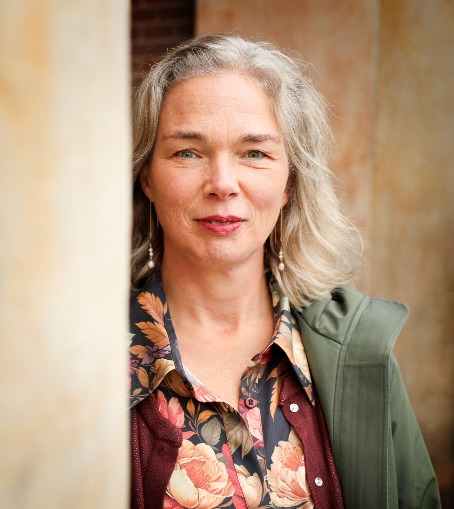
Those who aren't religious themselves may be quick to associate religion with strict norms and traditional roles, rather than with gender equality. In fact, for many, the topic of religion and gender will evoke associations with oppression and even violence. That contrast is misguided, argues Brenda Bartelink. Although many patriarchal ideas exist within religion, they also exist in society beyond it. What’s more, there are also people who are fighting for equality and justice precisely within religious communities.
Text: Marrit Wouda, Corporate Communicatie RUG / Photos: Henk Veenstra
A dimension of existence
Brenda Bartelink trained as a religious studies scholar, but prefers to call herself an ethnographer or anthropologist. As a assistant professor at the Faculty of Behavioural and Social Sciences and the Faculty of Religion, Culture and Society, she explores how people find meaning in relationships, well-being and other life questions, and how this manifests itself in a diverse society. ‘We sometimes think that religion is a thing of the past, as if we’ve moved beyond it here in the Netherlands. But that’s not the case,’ says Bartelink. ‘Whether we call it religion, spirituality or the search for meaning, such ways of looking at the world are a dimension of existence.’
You ‘are’ because we all ‘are’
Patriarchal oppression, the idea that women are inherently different from men and therefore occupy a different position, is something that manifests itself in a religious context. But that does not mean that patriarchal ideas stem exclusively from religion. ‘Religion and religious communities are always part of a wider society. And in fact, all societies worldwide are shaped by patriarchal structures,’ she explains. In Kenya, where Bartelink is currently conducting research into gender justice, the distinction between religion and society is virtually impossible to make. ‘Religion is embedded within a community. And yes, forms of oppression may be experienced there, but so too are love, care and meaning. You can’t say: “I’ll just step out of it, then I’ll have freed myself,” because then you lose a part of who you are,’ she explains. ‘Ubuntu, a philosophy from southern Africa, revolves around that idea: you “are” because we all “are”. We can’t see people entirely as individuals.’
Religious straitjacket
So, according to Bartelink, moving away from religion does not solve gender inequality. In the Netherlands, the second wave of feminism roughly coincided with secularisation. ‘This gave rise to the idea that gender equality goes hand in hand with freeing oneself from oppressive religious systems,’ explains Bartelink. There is some merit to this, but it is not always helpful. After all, even in our secular society, patriarchal ideas still prevail and men and women are still not equal. It is not helpful to strive for equality solely from a secular perspective. ‘Here, it is quite normal for feminism to be primarily secular, but that is of little use to a Kenyan woman,’ Bartelink continues.
Women’s Circle
In Kenya, Bartelink is studying, amongst other things, how The Circle of Concerned Theologian African Women operates. The members of the network, which has been in existence for at least 40 years, have developed theological methods for examining the stories from the Bible from a female perspective. Together with groups of women, they read stories and look for ways in which they recognise them in their own lives. In this way, women can share their own experiences of violence and oppression. ‘This creates a safe space and enables them to develop a shared language, because they can refer to the Bible stories they all know. But that is completely different from the feminist language we are familiar with in the Netherlands!’ explains Bartelink. The members of the circle often hold senior positions within universities and churches, and are thus able to spread this new language and this new way of looking at things. Bartelink describes an influential community, almost a kind of ecosystem in its own right, that is interwoven with various institutions in Kenya. Its influence is subtle, far more subtle than the Dutch, Western activist approach to setting the agenda. And in this way, new narratives, new ways of thinking and a new approach are introduced.
Female leadership
It extends beyond Kenya. In an urban ethnography project within Pentecostal communities in Amsterdam and The Hague, Bartelink observed a substantial group of female leaders, something one might not readily associate with a religious community. ‘These leaders caught my attention because they adhered to a kind of conservative ethic and morality – marriage is between a man and a woman, sex only within marriage, that sort of thing,’ explains Bartelink. ‘But at the same time, they also stand for specific values. I followed a female leader within a congregation where a teenager became pregnant unintentionally. Rumours began to circulate, mainly about the girl,’ Bartelink continues. The leader in question addressed her community on this matter: they were not there to judge, but to be a caring community. Bartelink: ‘She shifted the moral, gendered judgement of the visibly pregnant girl towards a different set of values.’
Better policy
It is just as with other organisations: diversity leads to better policy. And the Pentecostal Movement is not alone in this; nor is it a new or exclusively Christian development. In Indonesia, female ulamā, scholars authorised to adjudicate Islamic law, have organised themselves. As part of the gender justice project, Bartelink works with researchers who are studying this group of female ulamā. ‘They also address issues that male ulamā have never before raised, thereby highlighting gaps in religious interpretation, and that is very important,’ explains Bartelink. These female leaders do not do this by stepping outside the religion, but rather by standing even more firmly within it. ‘This enables women to free themselves from patriarchal systems without losing their connection to their religious context, their community and their family,’ Bartelink continues. ‘It’s a long-term endeavour, but it didn’t happen overnight for us either. In fact, we’re still not there yet. ’ Finally, she concludes: ‘I have immense admiration for the perseverance and patience of these women. As a researcher, I may have all sorts of opinions on this, but is that really my place? The only thing I can do is try to understand and describe it, so that we, even those outside that community, can learn from a different perspective.’
Orange the World
On Wednesday 25 November, the global ‘Orange the World’ campaign kicks off. This is the United Nations campaign dedicated to ending violence against women and girls. Buildings lit up in orange are used to draw attention to violence against women and girls. The campaign will be opened on 25 November at the Academy Building by Rector Magnificus Jacquelien Scherpen. Are you yourself a victim of violence, intimidation or another distressing incident? Or have you witnessed something that you feel has gone too far? If so, there is always someone at the University of Groningen you can turn to.
Read more
Within the University of Groningen, various researchers are conducting in-depth studies into gender, violence and the position of women and girls in society. Read a number of interviews about their work below.
More news
-
-
19 October 2026
From research to business: RUG Ventures helps ideas move forward
-
03 September 2026
Ming Cao reappointed as scientific director of the Jantina Tammes School