
Social media: swimming or drowning?
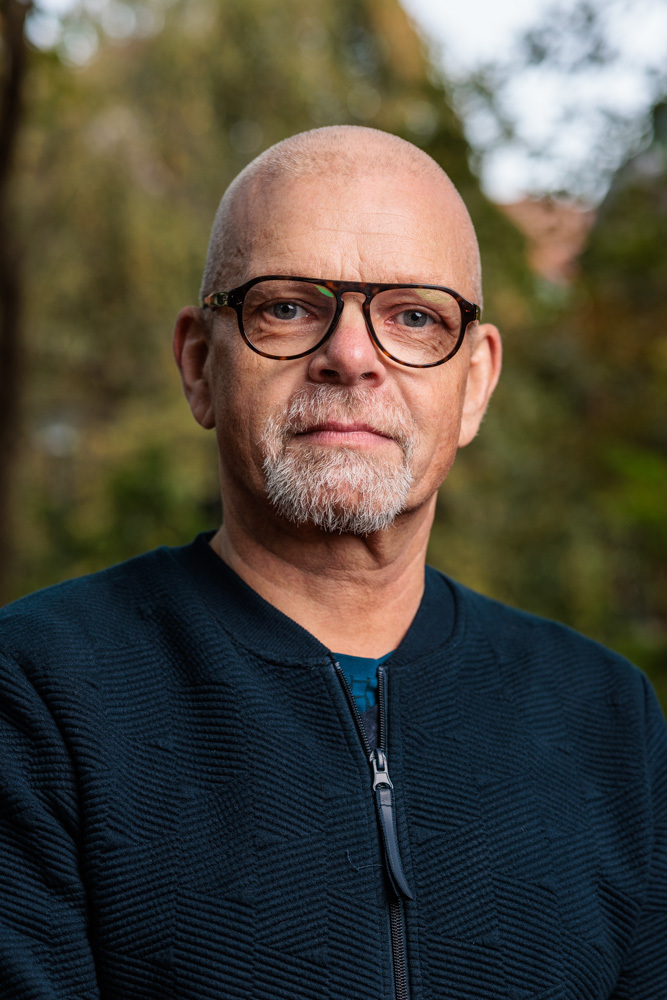
‘Smoking, online gambling, shooting heroin, nail biting. A daily glass of wine, as enjoyed by so many academics. Using social media. It’s all much the same,’ says Arie Dijkstra, Professor in the Social Psychology of Health and Illness, specializing in the psychology of health behaviour and addiction. ‘They are all types of behaviour that become disproportionately important to some people, at which point, behavioural psychology calls it addiction.’
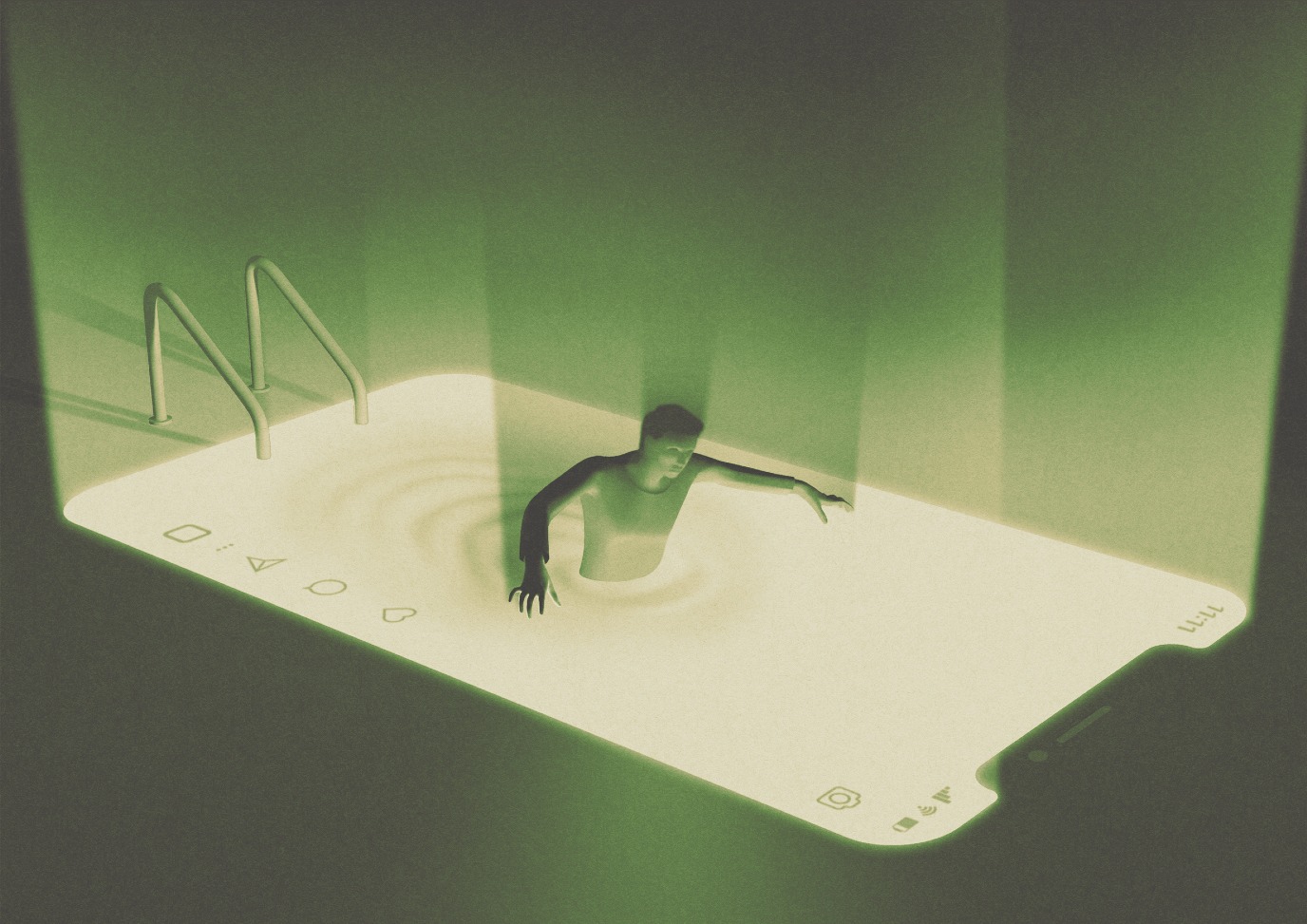
Text: Dorien Vrieling / Illustration: Maarten Huizing
When does social media behaviour become ‘disproportionately important’; when does all that scrolling, liking, and sharing become unhealthy? This is up for debate, but one thing is certain. The use of platforms like Instagram, Facebook, WhatsApp, and LinkedIn is here to stay. The National Social Media Survey carried out in January 2026 showed that 14.6 million Dutch people are active on one or more of these platforms. We spend an average of two hours per day on them, despite the fact that they do not actually add much enjoyment to our lives. The same survey reports that social media are making 2.6 million Dutch people unhappier, and 5.5 million people are trying to spend less time on these apps.
Being seen
Spending less time on the apps is harder than it sounds, because hanging around on social media serves a deep-seated human need, says Dijkstra. ‘We want to be socially embedded, be part of the group. This is just as important to humans as eating, drinking, and moving around.’ He often thinks back to the COVID-19 pandemic, when this became blatantly clear. ‘At one point, you heard people saying: I’m longing to sit at a pavement café again. But it wasn’t just about sitting outside with a drink. No, it was about being seen. You need to be seen to know you exist.’
So why are the apps so enticing to some people, and not to others? Why do some people clock up eight hours screen time per day? According to Dijkstra, self-esteem plays a role in this. ‘Sociometer theory states that a person’s self-esteem is an indication of their sense of connection with others. People who feel connected are often very confident: I have social status. People who feel less confident may use social media to raise their self-esteem.’
Mass addiction?
In addition, a few of the principles adhering to other types of addiction also apply to addiction to social media. ‘Every addiction involves creating a pleasant feeling that leads to an expectation. You want to have that feeling again. But there is always a downside. The degree of addiction depends how you view this downside.’ In general, the negative side of an addiction to social media is less obvious than that of an addiction to drugs, for example. ‘This need to stop seems less urgent. After all, you won’t lose an eye from spending too much time on social media, so the short-term risks are minimal.’
The prominent role played by these apps today raises the question of what life will be like in the future. Will we all be subject to mass addiction? To answer this question, we must put ourselves in the shoes of the younger generation, says Dijkstra. They will uphold different standards and values.
Touch and smell
‘We are an in-between generation: we still remember what the world was like before we had internet and smart phones. The next generations will always be able to connect with the entire world and will not know any different. They will have other ideas about what is normal and healthy.’ It's possible that social relationships will take on an entirely different form in the future, says Dijkstra.
‘At the moment, we set store by ‘real contact’, actually seeing each other in person. But just look at the opportunities offered by video calls! If you talk to each other on Teams, you can see each other's facial expressions perfectly clearly. The only thing you can’t do is touch and smell each other. But I don't think we really need to do that during a conversation with a colleague or an interview. Perhaps in the future, physical contact will be reserved for an appointment with a doctor, seeing your partner, or your father.’
Strict regulation
So that's one future perspective. In another scenario, we might see less of each other on the screen because the government has restricted the power of smart phones. ‘Very little is known about the long-term effects of social media at the moment. There are strong suspicions that social media causes depression and poor concentration, for example, but the causal link is still uncertain in many respects. If in ten years’ time we discover that the effects really are that dramatic, the powers that be will probably introduce strict regulation. That’s what happened with smoking, after all.’
Or should the government step in now? Dijkstra does not consider this to be ‘an academic question’. It is up to the politicians. ‘They must weigh up the uncertainties, the things we don’t yet know, against the risks. Choosing to regulate now would certainly be a legitimate decision, simply because the effect on the brain could be enormous.’
There is no doubt that standards and values are changing, but in essence, human beings will remain the same, says Dijkstra. Even when they spend days staring at a screen. When it comes down to it, we need other human beings. ‘This need for social embedding has been with us throughout evolution. We will always want to connect with others.’
Planning to cut down on social media?
Anyone who wants to spend less time scrolling and texting must ask themselves two things, says Dijkstra. Question 1: Who do I want to be? ‘Do you want to be someone who is constantly on their device, in the knowledge that experts are deploying every mechanism of the psyche to entice you with it?’ Question 2: What else do I want to do with my time? ‘Spending two hours a day on social media can be great fun. But if you invest that time in playing the piano, you could be a fantastic pianist in a couple of years. Think about what you’re missing out on during those two hours. Motivation is the most important factor if you want to change your behaviour.’
About Arie Dijkstra
Arie Dijkstra (1961) is Professor in the Social Psychology of Health and Illness at the UG. He studied health sciences and was awarded a PhD in Maastricht in 1998 for research into the effectiveness of computer-generated tailored interventions. He was then a fellow of the Royal Netherlands Academy of Arts and Sciences (KNAW) for five years. In 2008, he was appointed professor. The title of his inaugural lecture was ‘Het nut van de sociale psychologie voor preventie van ziekte en omgaan met ziekte’ (What social psychology can do for prevention of illness and adaptation to illness). In addition to his professorship, Dijkstra is also chair of the board of the Knowledge Platform for Lifestyle Coaching and a member of the advisory group on prevention policy for Holland Casino.
This article has been taken from our alumni magazine Broerstraat 5.
More information
More news
-
19 October 2026
Concerns about reputation drive solidarity
-
08 October 2026
Diversity Week: What can I do for LGBTQIA+ acceptance?
-